
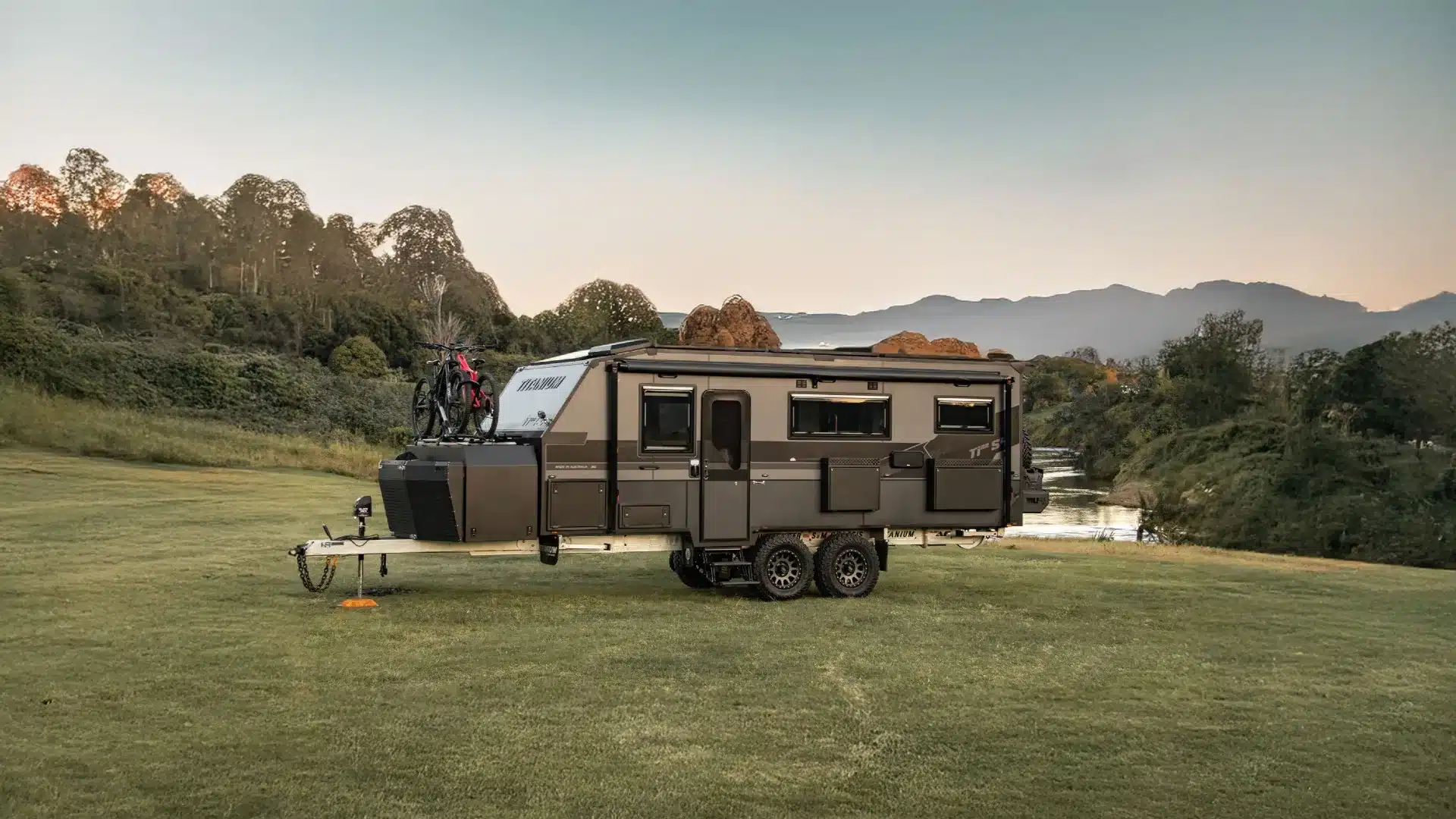

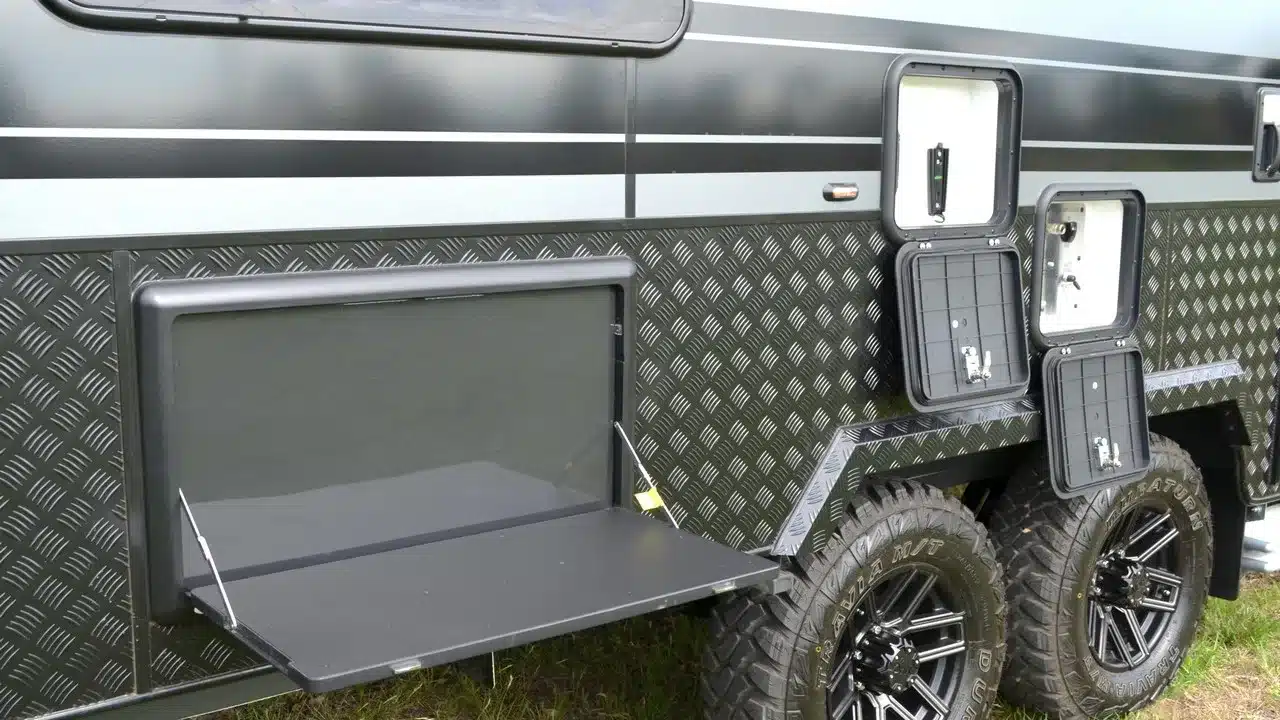
We priced 20 caravans on sale in Australia now, from $76,990 to $189,990, and worked out what the 16 with published weights can actually carry. The answer runs against instinct. The median payload in our $80,000 group is 583kg. In our $180,000 group it is 544kg.
Spending around $100,000 more buys a lot. It buys solar, lithium, heavier-duty off-road suspension and more equipment. What it does not buy, on the published figures, is room for your water, food, bikes and firewood. In payload terms the dearer vans cost more than twice as much per kilogram: a median of $142 per kg at $80k against $334 per kg at $180k.
Here is what each price tier gets you, model by model, and how to check the van you are looking at.
How we built the three baskets
Every price, tare, ATM and water figure comes from the manufacturer’s own website, checked on 22 October 2026. One price is from a dealer because the maker does not publish one, and we say so where it appears. Payload is simply ATM minus published tare: the most the van is allowed to weigh, less what it weighs empty.
Three cautions before the numbers. First, price types differ. Some brands quote a tow-away or drive-away price, some an RRP, and some a starting price that excludes on-road costs, so a few thousand dollars either way is noise. Second, published tare is often an average or an approximate figure, and options add to it. Third, this is a sample, not a census: many builders, including some big names, do not publish prices or weights online at all. Where we could not read both, we left the van out of our payload figures.
If tare, ATM and payload are new terms, our caravan payload guide explains each one in plain English.
Around $80,000: the most payload for the money
This is where on-road tourers and lighter semi off-road vans live, and where payload is cheapest. Our six vans run from $76,990 to $87,490.
| Caravan | Published price | Payload, fresh water |
|---|---|---|
| Snowy River SRC-22 (22ft tourer) | $76,990 tow-away | 540kg, 190L |
| Windsor Wild 176RD (5.4m body, semi off-road) | $79,990 drive-away | 550kg, 164L |
| Crusader CRV Gladiator Storm (16ft 7in on and off-road) | $80,987 RRP | 796kg, 200L |
| Crusader Lifechanger Passage (19ft 8in on-road) | $81,956 RRP | 1,100kg, 200L |
| Snowy River SRT-18 (18ft multi-terrain) | $86,990 tow-away | 527kg, 200L |
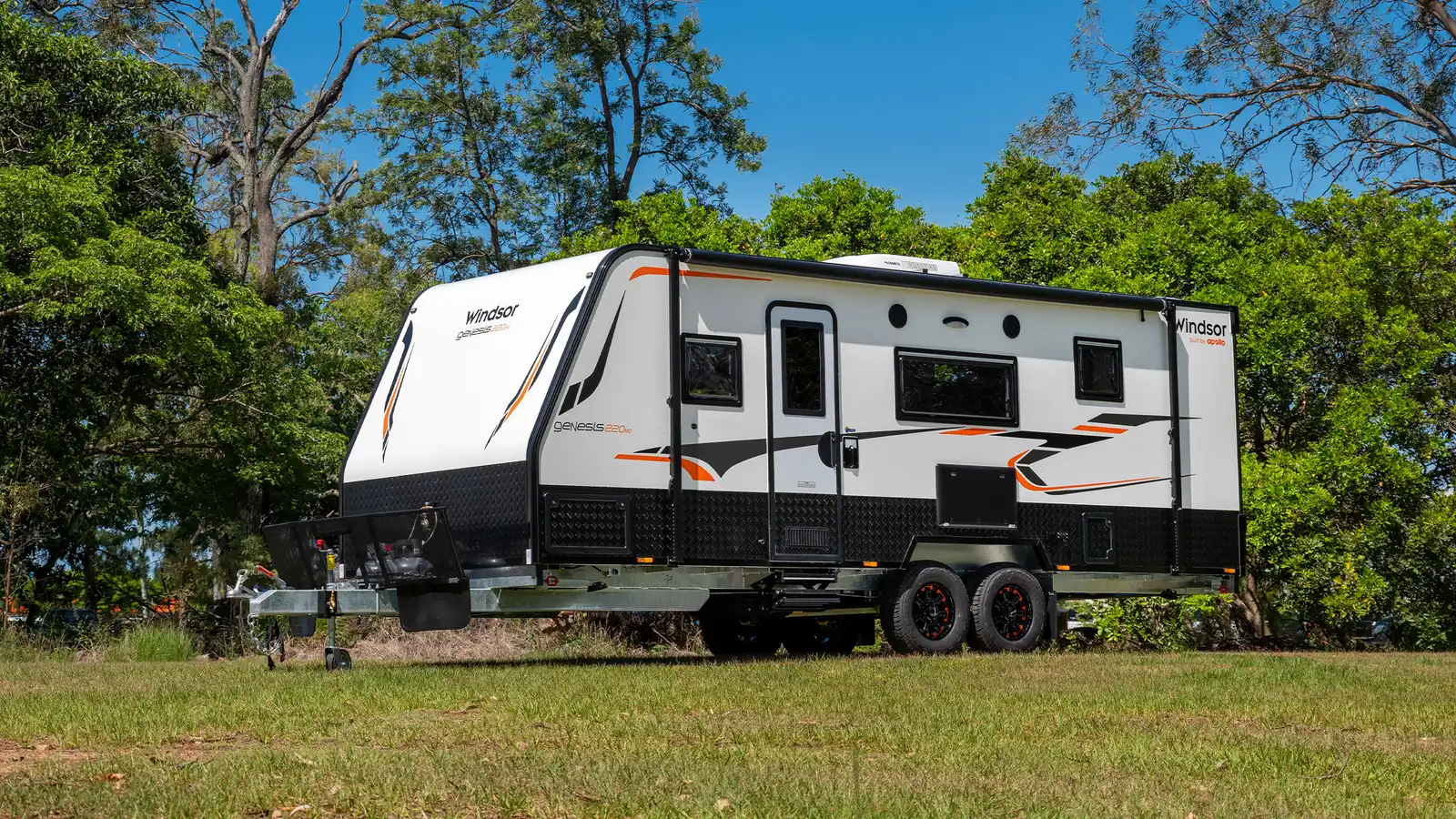
| Windsor Genesis 220MD (6.9m body, tourer) | $87,490 drive-away | 615kg, 164L |
The standout is the Crusader Lifechanger Passage. Its published ATM of 3,200kg against an average tare of 2,100kg leaves 1,100kg of payload, about $75 per kg, the lowest in our whole sample. It does that on a roller-rocker leaf spring set-up, and the key is its generous ATM: Crusader plates a relatively light on-road van at 3,200kg, which leaves plenty of room.
Power is where this tier economises. The two Windsors list a 120Ah deep-cycle battery and a single 190W panel. The others step up to lithium, from 100Ah on the Snowy River SRC-22 to 135Ah on the two Crusaders, with 200W to 400W of solar. The Snowy River SRT-18 is the exception, with a 48V 5kWh lithium battery and 700W of solar listed as standard at $86,990.
Around $120,000: off-road suspension becomes standard
Spend another $40,000 or so and every van in our group is sold as off-road, on coil or airbag suspension. Our six run from $112,966 to $125,990.
| Caravan | Published price | Payload, fresh water |
|---|---|---|
| Crusader Musketeer Doriemus (22ft 4in) | $112,966 RRP | 564kg, 200L |
| Salute Governor SL-1 (22ft) | $112,990 drive-away | 550kg, 190L |
| Gold Class AC16C (16ft single axle) | $114,990 RRP | 440kg, 160L |
| Crusader Excalibur Orion (19ft 11in) | $124,557 RRP | 810kg, 200L |
| Gold Class AC17C (17ft tandem) | $124,990 RRP | 580kg, 160L |
| Salute Garrison SL-2 (19ft 6in) | $125,990 drive-away | 800kg, 190L |
Median solar doubles to 600W and lithium is standard on every van in the group, from 200Ah to 600Ah. The Gold Class pair are the power leaders here, with 600Ah of lithium on both and 1,095W of solar on the AC17C.
Median payload, though, does not move: 572kg against 583kg at $80k. The heavier off-road build eats the extra ATM. Median tare jumps to 2,718kg, and most vans in this group are plated at a 3,500kg ATM, which puts you straight into the territory of our guide to tow vehicles that can legally pull 3.5t fully loaded. If your tow vehicle is not rated for it, the van choice is already made for you.
Worth knowing: Salute publishes one tare figure for each model across its spec levels. The SL-2 adds a bigger battery bank and more solar than the SL-1, so its real tare is likely higher, and its payload lower, than the figure in our table. Ask for the compliance plate of the exact van.
Around $180,000: off-grid power, at a price per kilo
At this level, builders compete on how long you can stay away from a powered site. Eight vans in our search fell between $164,650 and $189,990, but only four publish both tare and ATM.
| Caravan | Published price | Payload, fresh water |
|---|---|---|
| Crusader XCountry Trailbreaker (19ft 4in) | $166,343 RRP | 451kg, 200L |
| Crusader XCountry MadMax (19ft 7in) | $177,799 RRP | 690kg, 200L |
| Crusader XCountry Extreme (21ft 4in) | $182,347 RRP | 400kg, 200L |
| Grand Caravans Luma (21ft) | $189,990 from | 637kg, 330L |
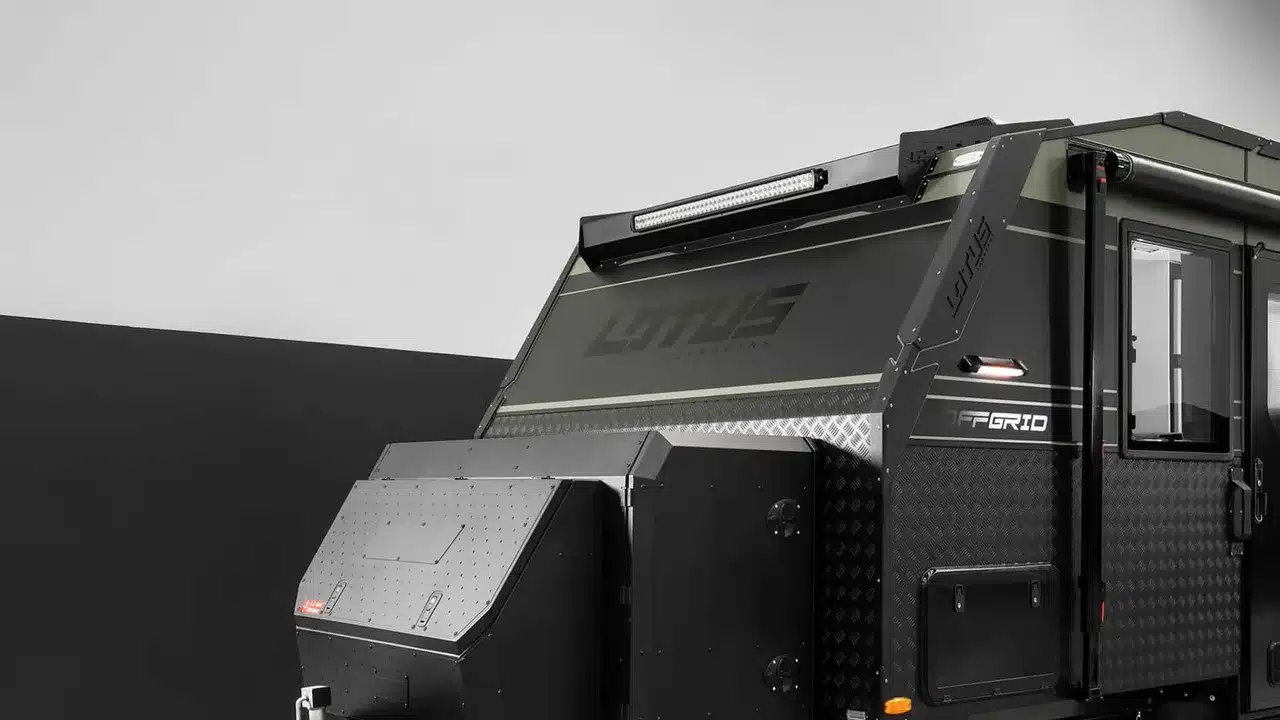
The other four publish prices but no weights: the Lotus Off Grid from $164,650, the Lotus Trooper from $177,100, the Titanium S4 from $179,995 for its smallest layout, and the Vacationer Roughrider, which its dealer Off Track RV lists from $174,700. We could not calculate their payload, which is a useful lesson in itself: at this money, ask for the weights in writing before you ask about the upholstery.
Across all eight, solar runs from about 1,000W to 1,505W and lithium from 400Ah to 600Ah, plus the Grand Luma’s 10.2kWh 48V system, about 850Ah at 12V. (Lotus’s Off Grid page quotes its solar and battery figures more than one way, so confirm the spec of the exact van.) That is roughly four times the solar of the $80k group. Fresh water barely changes: six of the eight carry 190L to 200L, with the Titanium S4 at 245L and the Grand Luma at 330L the exceptions.
Payload is where the premium bites. The Crusader XCountry Extreme lists an average tare of 3,100kg and an ATM of 3,500kg to 4,500kg. At the base 3,500kg rating that leaves 400kg, or about $456 per kg; Crusader’s own page puts payload at up to 1,400kg at the top rating. Higher ATM ratings can be requested at order, which is the usual fix at this level. Check whether your tow vehicle and licence suit it before you tick the box.
Spend more, carry less
We lined up 16 current caravans by published price, tare and ATM. Moving up the price ladder buys power and suspension. It does not buy room for your gear.
Median of the caravans we checked, October 2026
$142/kg
of payload
$203/kg
of payload
$334/kg
of payload
Check a van you are looking at
$146 per kg of payload
650kg of payload and $500 per litre of fresh water. That is closest to the $80k tier median of $142 per kg.
Prices, tare, ATM and water checked on manufacturer websites (one dealer price, flagged in the article) on 22 October 2026. Payload is ATM minus published tare. Tiers: six vans priced $76,990 to $87,490; six priced $112,966 to $125,990; four priced $166,343 to $189,990 with published weights. Price types differ (RRP, drive-away, tow-away and “from”), so treat dollar figures as indicative. Published tare is often an average or approximate; weigh the van you buy. Fresh water excludes grey water.
What the extra money actually buys
- Power. Median solar goes from 300W to 600W to 1,320W across the three groups. Lithium goes from absent on the Windsors and 100Ah to 135Ah on most other $80k vans to 400Ah or more at $180k. If you free camp for a week at a time, this is real value; our guides on how much solar you need and lithium batteries help you size it.
- Suspension. Our $80k group mixes leaf springs, torsion, trailing arm, rubber, coil and even one airbag set-up. Every van in the $120k group is sold as off-road on coil or airbag suspension, and every one of the $180k vans is on airbags.
- Build and finish. Heavier chassis, thicker walls and more equipment. All of it shows up in the tare.
What it does not buy
- Payload. Median payload falls slightly from 583kg to 544kg, while median tare climbs by more than 600kg.
- Water. Median fresh water sits at 190L to 200L in every group. Only a few premium vans carry much more.
- A lighter tow. The dearer the van, the more likely it is plated at 3,500kg, and the fewer tow vehicles can legally pull it fully loaded.
Power you can add later. Payload you mostly cannot, because ATM is set by the manufacturer and any upgrade has to be approved and re-plated. That is why we suggest settling the weights before the features, and why choosing the van or the vehicle first matters so much.
The tow vehicle cost nobody puts on the price tag
Every step up the price ladder in our sample also stepped up the weight. The median ATM in our $80k group is 2,975kg, with the lowest-rated, the Windsor Wild 176RD, plated at 2,500kg. In the $120k and $180k groups the median ATM is 3,500kg, and 7 of the 10 vans are plated at exactly that figure.
That matters because a 3,500kg towing rating is not the same as being able to tow 3,500kg with a loaded car. When we ran the numbers for popular 3.5t tow vehicles, only some stayed inside both their gross vehicle mass and gross combination mass with four adults, gear and a 3,500kg van behind them. A premium van can force a premium tow vehicle, or a lighter load in the one you already own.
So the real price of the $180k van is not only the $100,000 gap on the sticker. It may include a tow vehicle upgrade, a GVM upgrade or a heavier licence class, plus more fuel. On the other side of the ledger, the lighter $80k vans open up a far wider choice of tow vehicles, and more of them will tow it with room to spare.
Reading the price on a spec sheet
Caravan prices are quoted in at least four different ways, and our sample used three of them. Before you compare two quotes, convert both to the same basis.
- Tow-away or drive-away. Usually the closest to what you pay to leave the yard. Snowy River’s tow-away price includes registration, pre-delivery and dealer delivery costs. Salute’s drive-away price includes Victorian registration, with delivery extra.
- RRP. A recommended retail price. Crusader’s RRP includes all costs except state registration and is described as indicative only.
- From, or starting at. The base layout before options. Lotus and Titanium say their starting prices exclude on-road and delivery costs.
- Dealer stock price. A specific van on a specific yard, which may be a plate-year special, a demonstrator or a unit with options fitted.
A difference of a few thousand dollars between two vans can disappear, or double, once both are converted to drive-away. Ask the dealer for the drive-away figure in writing, with every option listed.
Five checks before you spend
- Get the plate, not the brochure. Ask for the tare and ATM on the compliance plate of the exact van, after options are fitted.
- Load it on paper. Add water, gas, food, clothes and gear. A full 200L of fresh water is about 200kg on its own, before bikes or a generator.
- Compare like with like. Convert every quote to drive-away, including rego, delivery and dealer charges, before you compare prices.
- Match the tow vehicle. Check the van’s loaded weight against your vehicle’s towing capacity, GVM and GCM. Our weight trap guide walks through it.
- Price the power separately. If the cheaper van suits you but is light on solar or lithium, cost an upgrade. Our 200Ah lithium battery comparison shows how far battery prices vary.
Tip: show specials can blur the comparison, with stock vans, plate-year discounts and bundled options. Our guide to show-only caravan deals covers what to check before you sign.
Questions buyers ask about caravan prices

Does a more expensive caravan carry more?
Not on the published figures we checked. Median payload was 583kg in our $80k group, 572kg at $120k and 544kg at $180k. Dearer vans tend to have higher ATMs, but their tare rises faster.
What is a good payload for a caravan?
It depends on how you travel, but water alone is about 1kg per litre, so 200L of fresh water is 200kg before anything else. On those numbers, a payload under about 450kg can leave a touring couple little margin once water, gas and gear are aboard.
Is $80,000 enough for an off-road caravan?
For semi off-road and lighter multi-terrain vans, yes. Three in our $80k group are sold for off-road or multi-terrain use. For heavy corrugations and remote tracks, the $120k group is where off-road coil or airbag suspension became standard across every van we checked.
Can I increase a caravan’s payload later?
Sometimes, but not cheaply or simply. An ATM increase usually needs the manufacturer’s approval, often with an engineering sign-off and a new compliance plate, and your tow vehicle still has to cope with the extra weight. Some builders offer a higher ATM as a factory option: Crusader lists its XCountry Extreme at 3,500kg to 4,500kg. It is far easier to buy the payload you need at the start.
Why don’t all manufacturers publish prices and weights?
Some sell through dealers who set the price, and some build to order, so weights vary with options. It makes comparison harder for buyers. Ask for both in writing, and see our guide to buying with confidence for the paperwork to request.
What does $400,000 get you?
A different kind of vehicle altogether. Our look at the $400k caravan arms race covers the extreme end of the market.
Where the smart money sits
Decide how much you need to carry before you decide what to spend. If payload and an easy tow matter most, the $80k tier gives the most kilograms per dollar, and you can add solar and lithium over time. If you will free camp in remote country for weeks, the $120k and $180k vans earn their price in power and suspension, but only if the weights still work once you have loaded them. The price tag tells you how well a van is equipped. The compliance plate tells you whether you can take your life with you.
Images: Titanium Caravans, Salute Caravans, Gold Class Caravans, Lotus Caravans and Windsor, used for editorial comparison.


