

Solar is one of those topics where everyone has an opinion and almost nobody gives you a straight number. The marketing material says “go solar and camp anywhere forever.” The forums say “get as much as you can fit.” Neither of those is particularly useful when you’re trying to decide whether to spend $1,800 or $6,500.
Here is the honest version. It involves some arithmetic, but it’s simple arithmetic, and doing it once before you buy anything will save you from the most common and expensive mistakes in the caravan electrical world.
How a Caravan Power System Actually Works
The 30-second version before we get into the numbers
Panels
DC-DC
Bank
Caravan
= Wh per day
= Panel watts needed
AGM: 3× Wh
Start With What You Actually Use
The single most important thing you can do before buying a single panel or battery is work out your actual daily power consumption. Most people skip this step, buy a system based on a guess or a forum recommendation, and then wonder why they’re flat by 9pm or why they’ve massively overspent on capacity they never need.
Every appliance has a wattage on its label. Multiply that wattage by the number of hours you run it each day, and you get watt-hours (Wh). Add those up across everything and that’s your daily budget.
Here’s what a typical two-person touring setup actually draws:
Your 12V compressor fridge is the single biggest consumer. A quality 45 to 55 litre unit in mild conditions (20°C ambient, which is typical winter up north) uses roughly 25 to 35Ah per day. In summer heat at 30°C that climbs to 50 or more. It’s also the most variable figure in your budget because ambient temperature and how often you open the lid makes a genuine difference.
LED lighting for an evening runs about 3 to 5Ah. Phone and tablet charging, 3 to 5Ah. Water pump across a day’s use, 1 to 2Ah. A laptop running a few hours, 5 to 8Ah. A 32-inch TV for two to three hours, 6 to 10Ah.
Pull that together and a touring couple running a fridge, lights, devices, and occasional TV use is looking at roughly 40 to 70Ah per day in moderate conditions. That’s 500 to 850 watt-hours.
The CPAP exception. If either person uses a CPAP machine, the numbers change significantly. A CPAP without a humidifier uses around 13Ah per night. Add a heated humidifier and that jumps to 50 to 70Ah for a single night’s sleep. That’s more than many people’s entire daytime budget. If a CPAP is part of your setup, it needs to be the first number in your calculation, not an afterthought.
What Your Panels Will Actually Produce
Once you know your daily consumption, working out how many watts of solar you need follows a formula:
Panel watts needed = Daily Wh ÷ (peak sun hours × 0.7)
The 0.7 accounts for real-world efficiency losses: heat, cable resistance, minor shading, and the gap between rated output and what panels actually deliver in non-ideal conditions.
Peak sun hours is the part that trips people up. It doesn’t mean hours of daylight. It means the equivalent hours of full-rated sunshine. In Australia, the rough planning ranges are:
Victoria and Tasmania in winter: 2.5 to 3 peak sun hours per day. NSW and SA in winter: 3 to 4. Queensland, the NT, and northern WA: 4 to 5 even in the depths of July.

This matters more than most people realise. The same 400W panel array that comfortably powers your setup while touring the Kimberley in July will struggle to keep pace in southern Victoria in the same month. If you’re heading up the NT corridors or through outback Queensland this winter, you’re in the most solar-friendly part of the country at its most solar-friendly time of year. If you’re touring Victoria year-round, you need to size for winter performance, not summer.
Cloudy days produce roughly 10 to 30% of a panel’s rated output. Two or three consecutive overcast days will drain even a well-sized system. Battery capacity and a solid backup charging strategy both matter.
Lithium vs AGM: The Numbers That Actually Matter
The battery chemistry question gets more attention than almost any other topic in caravan forums, but the decision is simpler than it seems once you look at the numbers rather than the marketing.
The key difference is usable capacity. AGM batteries should only be discharged to 50% of their rated capacity if you want them to last, which means a 100Ah AGM battery gives you just 50Ah of practical use. Lithium batteries (specifically LiFePO4) can be safely discharged to 20%, giving you 80Ah of usable power from a 100Ah unit. In practical terms, 100Ah of lithium delivers 60% more usable energy than 100Ah of AGM.
The cycle life difference is where the long-term economics flip. A quality AGM battery lasts roughly 400 to 600 charge cycles before capacity degrades meaningfully, which is two to four years with regular use. A quality lithium battery lasts 3,000 to 5,000 cycles, typically eight to twelve years. A $300 AGM lasting 400 cycles costs $0.75 per cycle. A $600 lithium lasting 3,000 cycles costs $0.20 per cycle.
For occasional weekenders who stay mostly on powered sites, AGM is still entirely serviceable and the upfront cost is lower. Anyone free camping regularly, doing extended touring, or running high loads from an inverter, lithium’s combination of usable capacity, charge speed, and longevity makes it the better long-term investment. If you want to go deeper on what the switch involves, including brand comparisons and BMS compatibility, our full lithium caravan battery guide covers the detail.
One more thing on batteries: if you’re upgrading an existing AGM system to lithium, do not assume your existing chargers, solar regulator, and DC-DC charger are automatically compatible. They need to be programmed with a lithium-specific charge profile. Using an AGM charge profile on a lithium battery will undercharge it at best and damage it at worst. The caravan power system upgrade mistakes guide covers this and the safety and documentation steps that often get overlooked.
The DC-DC Charger: The Piece Most People Miss
If you’re running lithium batteries, a DC-DC charger (also called a battery-to-battery charger) is not optional. It’s essential. Standard voltage-sensitive relays, which are common in older setups, do not work correctly with lithium batteries. They either fail to charge adequately or confuse modern smart alternators into cutting their output.
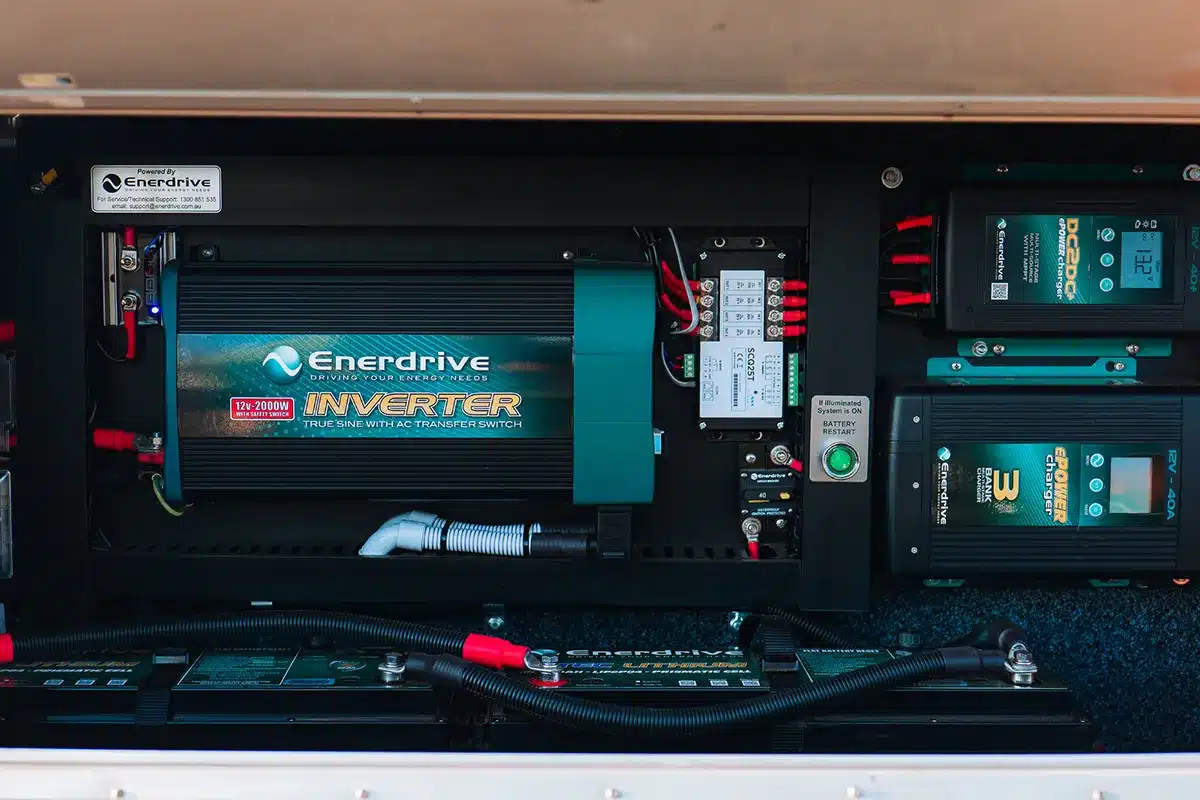
A DC-DC charger steps down your alternator’s output to the correct charge voltage and profile for your battery chemistry. It also typically includes an MPPT solar input, meaning a single unit manages both your driving charge and your solar charge in one device.
A 25A DC-DC unit delivers roughly 300Wh per hour of driving, meaning a two-hour drive between camps will contribute meaningfully to your daily budget before solar even gets a look-in. Getting to each campsite with a reasonably full battery before solar takes over is the whole game.
Popular Australian choices are the Redarc BCDC series and the Victron Orion Smart range. Both are well-regarded and proven in Australian conditions.
Three Setups, Three Price Points
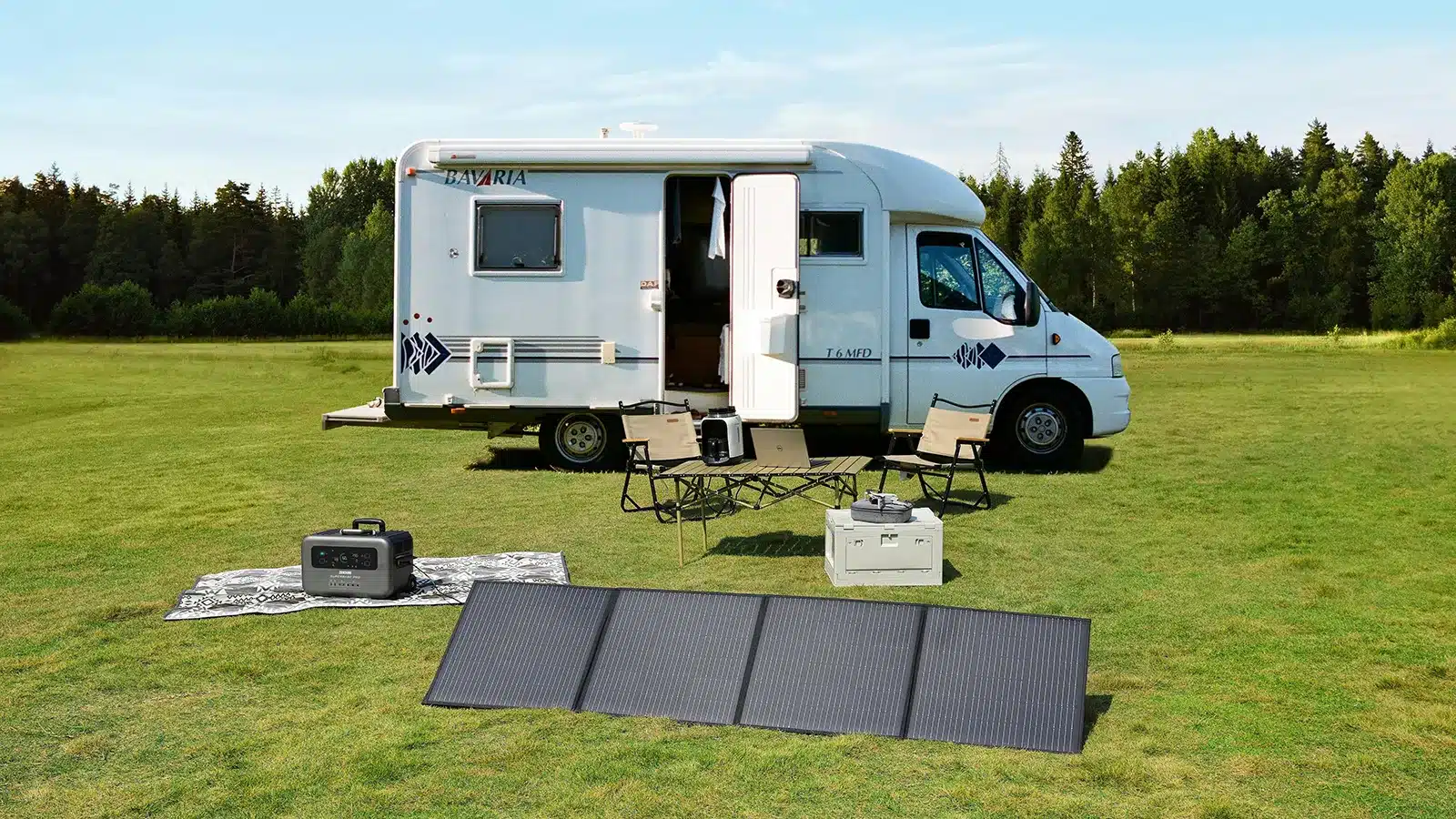
Weekend camper (lights, fridge, phones, 1 to 2 nights free camping) 200W of portable solar (folding mat), 100Ah lithium battery, 20A MPPT controller. Budget $1,500 to $2,200 for a quality kit. This setup comfortably handles 300 to 500Wh/day and will carry you through a couple of nights without sun before running low. Not ready to commit to a full installed system? We’ve done the numbers on whether a 1kWh portable power station is genuinely enough for weekend trips.
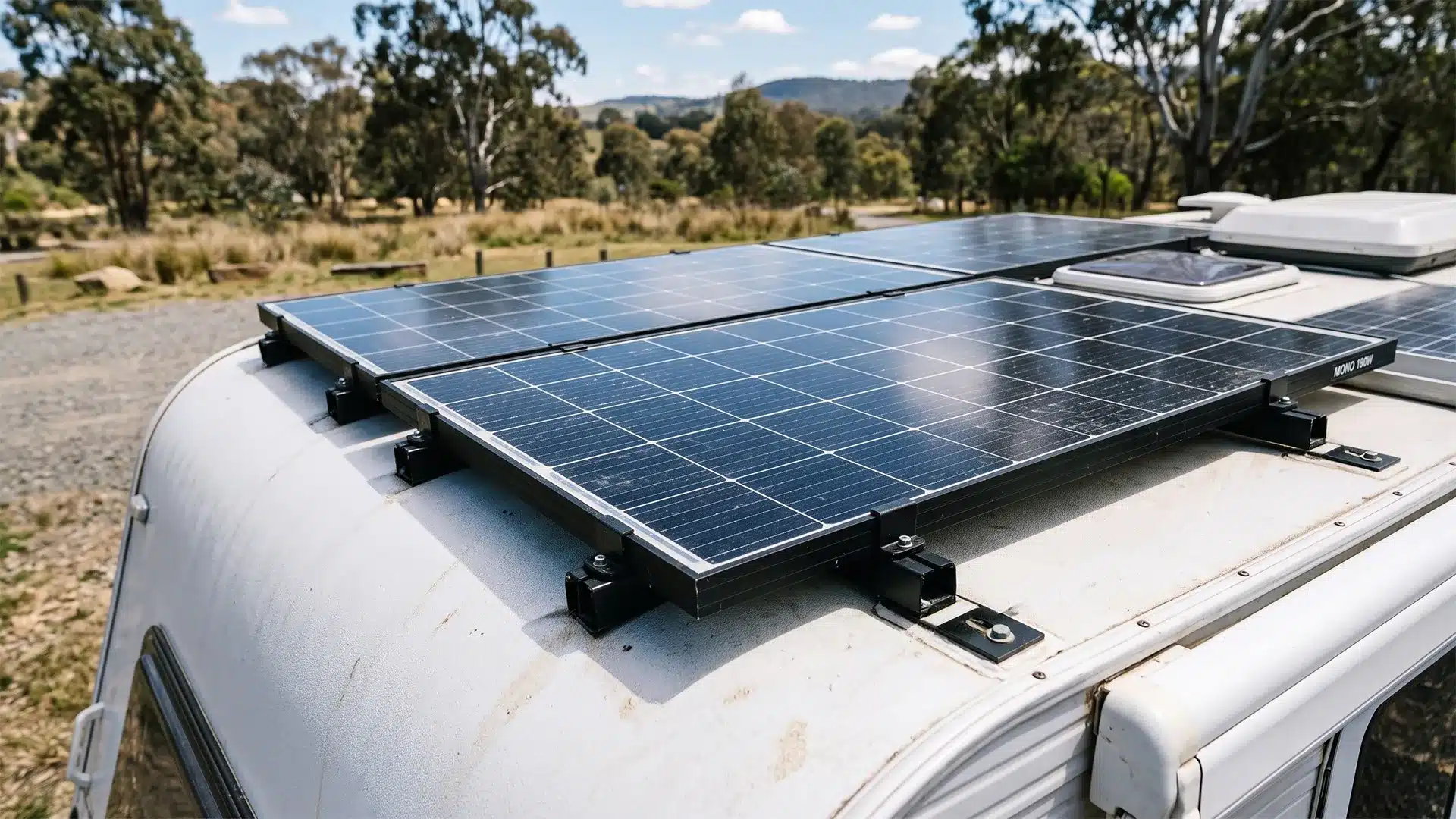
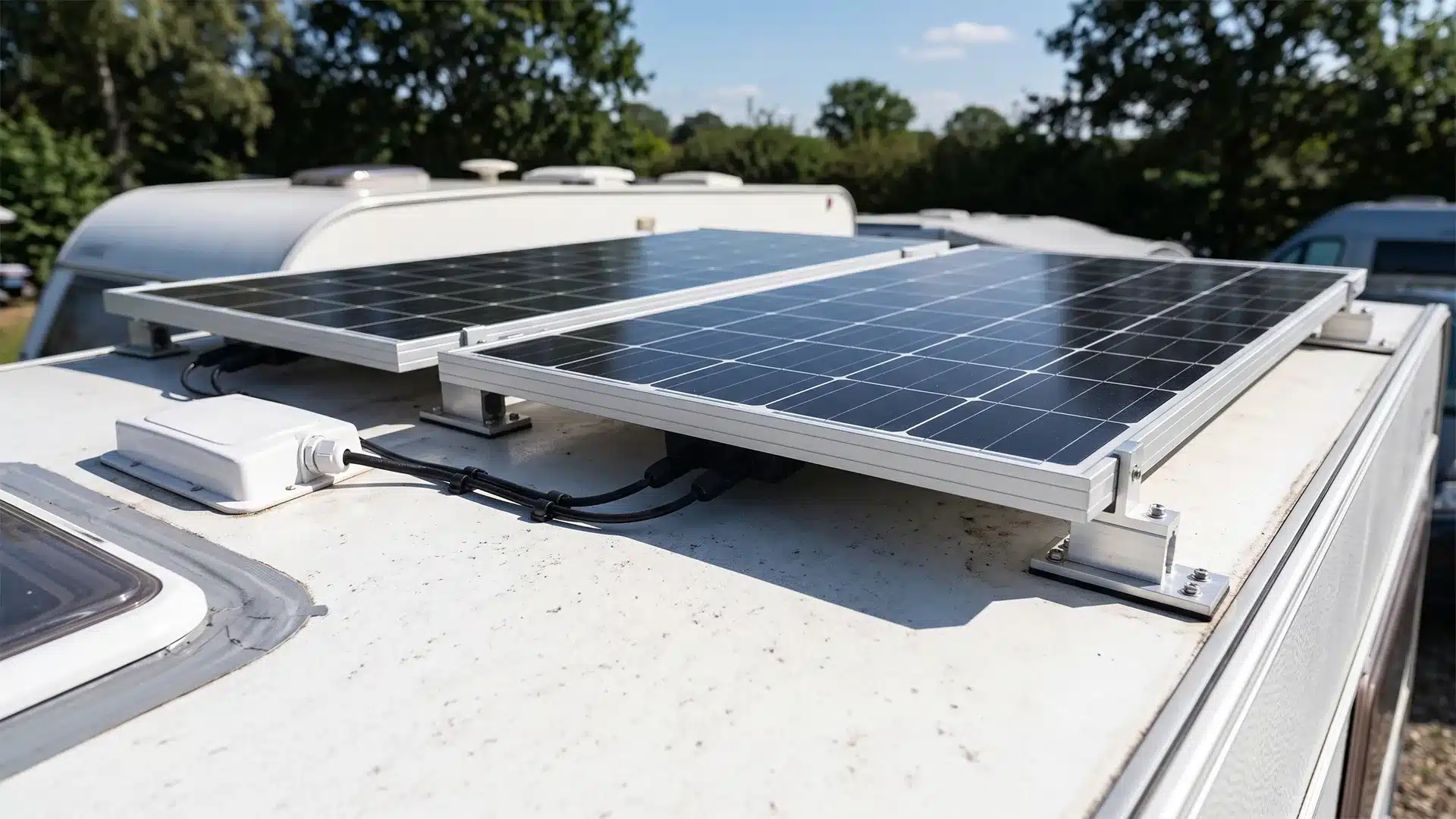
Touring couple (fridge, TV, laptops, regular free camping, 2 to 4 weeks at a time) 300 to 400W of rooftop solar, 200Ah lithium battery bank, 40A MPPT, 25A DC-DC charger. Budget $4,500 to $7,000 installed, depending on whether your existing wiring needs upgrading. This handles 600 to 900Wh/day comfortably and gives you two to three days of autonomy in cloudy conditions. It’s the setup that genuinely unlocks the free camping savings that make a touring budget work. The $540 difference between a three-week trip on free camps versus all caravan parks pays for a meaningful chunk of the upgrade over time.
Full-timer or off-grid (CPAP, inverter loads, weeks in remote areas) 600W or more of rooftop solar, 200 to 300Ah lithium battery bank, 40A MPPT, 40A DC-DC charger, 2,000W pure sine inverter. Budget $7,000 to $12,000 installed. If you’re running a CPAP with humidifier, add that consumption figure in early and size accordingly. It will determine your battery bank more than anything else.
For a calculator that shows exactly how your solar, battery, and DC-DC sizing balance against each other, the balanced caravan power system guide has a purpose-built tool for this.
Caravan Solar & Battery: The Numbers at a Glance
Typical daily consumption, system tiers, and realistic prices for 2026
| Appliance | Ah/day |
|---|---|
| 12V fridge (45–55L compressor), mild temps | 25–35Ah |
| 12V fridge (same fridge), summer heat 30°C+ | 50–80Ah |
| LED lighting (evening) | 3–5Ah |
| Phone & tablet charging | 3–5Ah |
| Water pump | 1–2Ah |
| Laptop (2–3hrs) | 5–8Ah |
| TV/streaming (3hrs) | 6–10Ah |
| CPAP machine (no humidifier, 8hrs) | ~13Ah |
| CPAP + heated humidifier (8hrs) | 50–70Ah |
20A MPPT
Handles 300–500Wh/day
40A MPPT + DC-DC
Handles 600–900Wh/day
40A MPPT + 40A DC-DC
2,000W inverter
When You Actually Need a Generator
The honest answer is that a small generator (1 to 2kW) is genuinely worth considering if you’re a full-timer doing extended time in remote areas, running a CPAP with humidifier, or regularly camping in southern states through winter. Three consecutive overcast days will deplete any reasonably sized battery bank. A generator as a backup (not a primary power source) removes that vulnerability entirely.
If you’re a touring couple doing mixed free and paid camping across northern Australia, you probably don’t need one. If you’re genuinely off-grid for weeks at a stretch in less-than-ideal solar conditions, it’s cheap insurance.
The Mistakes That Cost People the Most
Buying before calculating is the one that leads to every other mistake. Spend an hour with a spreadsheet first.
Skipping the DC-DC charger when running lithium is the second most common. The alternator charge on long drives between camps is real money. Don’t leave it on the table.
Cheap lithium batteries from unknown brands have a higher rate of BMS (battery management system) failure in Australian heat conditions. A flat battery 500km from the nearest town is expensive. Quality brands (Enerdrive, Victron, and established Australian distributors) cost more upfront for a reason.
Finally, flexible solar panels laid flat against a roof with no air gap run significantly hotter than rigid panels, which reduces efficiency and shortens lifespan. If you’re going flexible, leave a gap.
The Actual Answer
For a touring couple doing a mix of free and powered camping in Australia: 300W of solar and a 200Ah lithium battery bank will handle most of what you need, most of the time. If you run a CPAP or spend significant time in southern states in winter, size up.
Do the arithmetic on your own consumption first. The number you land on will probably surprise you in one direction or the other. Either way, you’ll buy the right system instead of the wrong one.