


These five are different. Two correct things you have probably been told wrong. Two are legal traps that bite at the worst moment. All five are cheap to get right and expensive to ignore.
1. The $25 part that decides whether your hot water system lives or dies
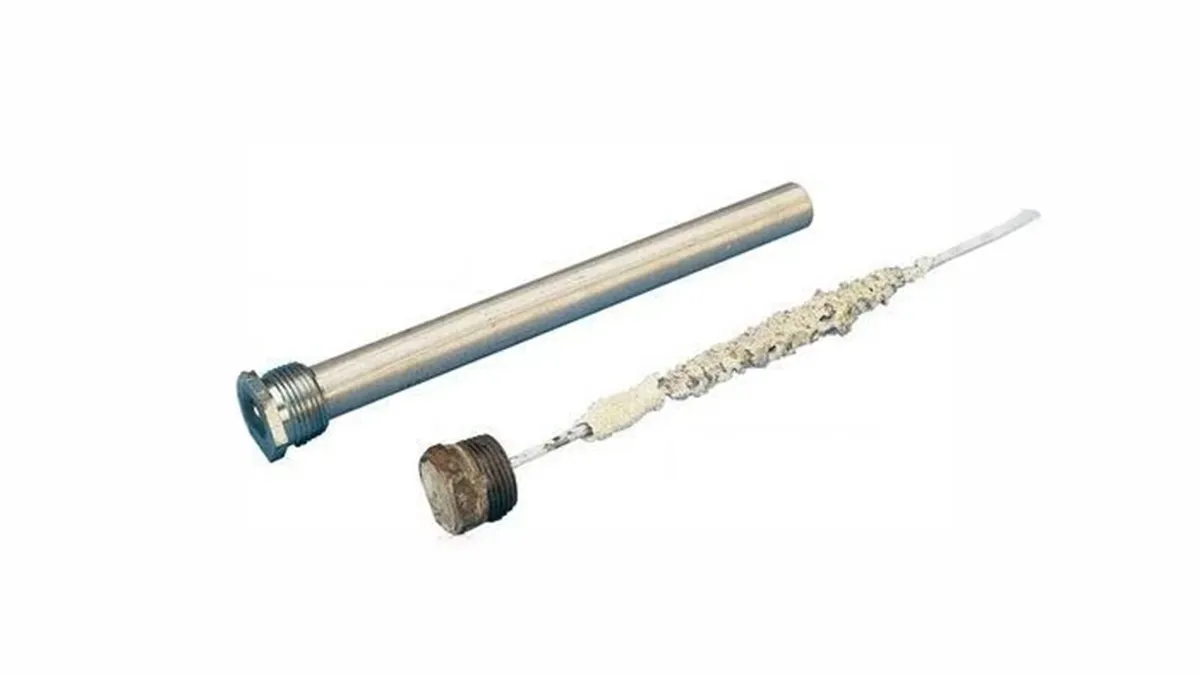
If your van has a Suburban hot water system, there is a magnesium or aluminium rod screwed into the bottom of the tank that doubles as the drain plug. It corrodes so the steel tank does not. Replace it once it has worn to about half its original diameter, and inspect it at least once a year.
Here is the part almost nobody knows. Whether you have this job at all depends entirely on your brand.
- Suburban: steel tank, has an anode, needs checking.
- Atwood and Dometic: aluminium tank, no anode, plastic drain plug. Dometic explicitly warns against fitting aftermarket anodes.
- Truma: stainless steel tank, no sacrificial anode.
So half the owners reading this have a yearly job they have never done, and the other half have been sold a part they do not need. Check the brand on your exterior access panel before you buy anything. It is the same pattern we found looking at which caravan appliances last and which fail first: the failures are rarely the expensive parts.
Tip: Isolate the gas, 240V and 12V supply and let the system cool and depressurise before you touch the anode. A tank full of hot water under pressure is not something to surprise yourself with.
2. The fridge levelling myth that damages cooling units

You have probably heard that a three-way fridge only needs to be level when it is running on gas, and that on 240V you can park however you like.
That is wrong, and believing it can cost you a cooling unit.
An absorption fridge moves liquid ammonia by gravity. The heat source, gas flame or electric element, does not change that. The tolerance is the same either way: roughly 3 degrees side to side and 6 degrees front to back. Across a 300mm spirit level, 3 degrees is about 15mm of rise, far tighter than most people picture.
Park further out than that and the cycle can stall, the boiler can overheat, and crystals can form in the tubing. That damage is permanent and not repairable.
The 30-degree figure people quote is real, but it belongs to compressor fridges, which are pump-driven and genuinely do not care about slope. If you have a compressor fridge, stop fussing with levelling ramps for the fridge’s sake, though you will want to check it against your power budget. Our guide to how much solar you actually need has the honest numbers. If you have a three-way, get the bubble centred no matter what it is plugged into.
3. Your caravan tyres will almost certainly age out before they wear out
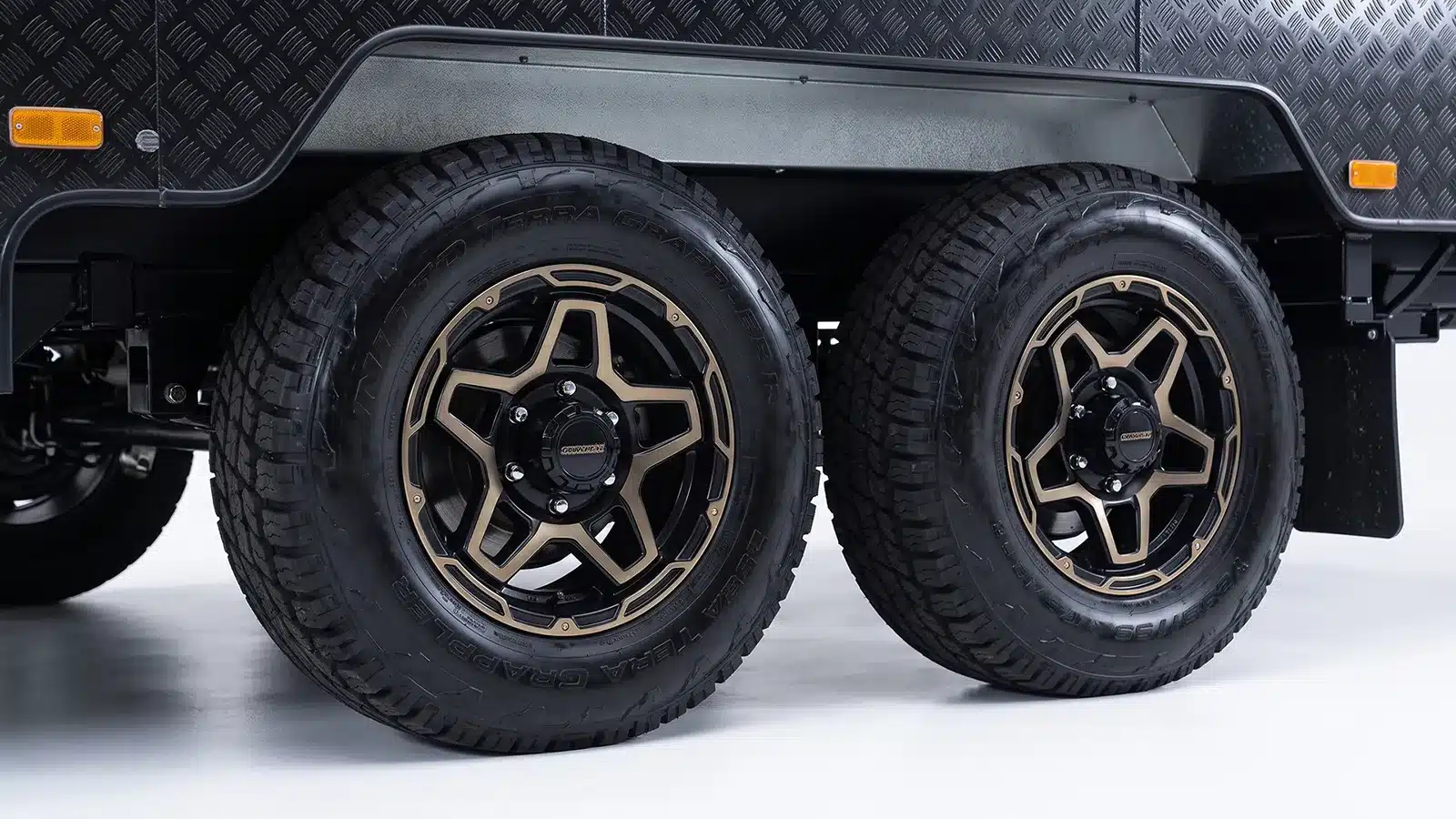
Caravan tyres live a strange life. They sit still for months, cop UV, then carry a heavy load at highway speed. Tread depth tells you very little about whether they are safe.
Australia has no legal maximum tyre age. The only legal requirement is a minimum 1.5mm of tread. Manufacturer and industry guidance is to have tyres professionally inspected from around five years, and to replace them between five and seven years, with ten years as an absolute ceiling regardless of how good the tread looks.
Find the four-digit DOT date code on the sidewall. The first two digits are the week, the last two the year, so 1423 means week 14 of 2023. It is sometimes stamped on one side only, so check both.
And check the spare. It is the same age as the others and it is the one you will need when a tyre lets go. Age is also the gap a pressure monitor cannot close, which is worth knowing before you buy one. We went through whether you actually need a TPMS in detail.
The Numbers Worth Writing Down
Five jobs, five thresholds. Check these before your next trip rather than on the side of the road.
Intervals and thresholds
Replace once the rod has worn to about half its original diameter. Inspect at least annually.
Owner jobSide to side and front to back. The same on gas or 240V. About 15mm across a 300mm level.
Check every setupIndustry guidance regardless of tread. Ten years is the ceiling. Legal tread minimum is 1.5mm.
Include the spareStamped on the foot ring or valve collar. Fifteen years for cylinders of 100kg water capacity or more.
Refill ruleZones are redrawn every month and extend 5km beyond each new detection. Check the live map.
Legal dutyGas systems need a licensed gas fitter and a compliance certificate. Hard-wired 240V needs a licensed electrician.
Not a DIY jobDoes your van even have an anode?
4. Your gas bottle can be legal to use and illegal to refill at the same time
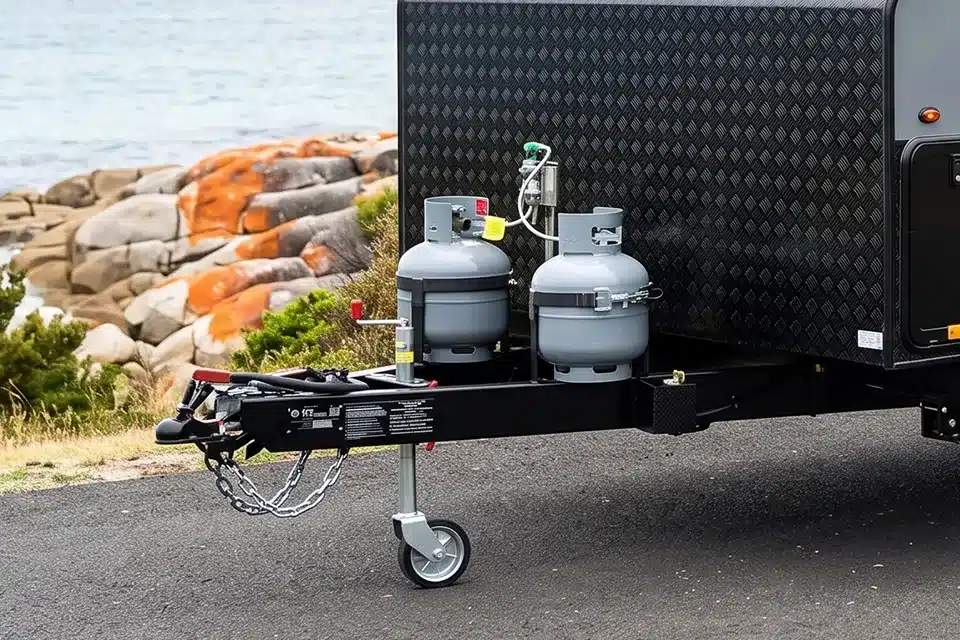
Every LPG cylinder carries a test stamp on the foot ring or the valve collar, valid for ten years. Cylinders of 100kg water capacity or more run on a fifteen-year cycle.
Most people assume an out-of-date bottle is dead. It is not. WorkSafe Victoria puts it plainly: a cylinder that already contains gas can still be used, sold and transported past its inspection date. What you cannot do is refill it until an approved test station has inspected and re-stamped it.
The trap is discovering this at a remote servo on your last bottle. Check the stamp before you leave.
Retesting runs around $45 to $60 including a new valve. Since a new 9kg bottle is roughly $49 and an exchange often less, most travellers simply swap it. Elgas accepts out-of-date cylinders for exchange at no extra charge.
5. Fire ant rules apply to you, not just to farmers

Queensland’s fire ant biosecurity zones are now redrawn every month, and they extend 5km beyond each new detection rather than following suburb boundaries. A spot outside a zone on your last trip may be inside one now.
Most coverage frames this as a grower and builder problem. It is not. Under the Biosecurity Act 2014, the General Biosecurity Obligation applies to everyone, including individuals.
Specific movement controls attach to soil, mulch, hay, manure, quarry products, turf and potted plants. Carry any of those out of a zone and the rules are yours. Firewood is not on that prescribed list, but the general duty still applies, and anything stored on the ground can carry ants.
The practical version: check the live map at fireants.org.au before you move on, and do not carry soil, potted plants or ground-contact material out of a zone. For specific items, the program runs a material movement advice tool.
Before you pick up a spanner
Three of these are owner jobs. Two are not.
Any work on your van’s gas system beyond using the appliances must be done by a licensed gas fitter, who issues a compliance certificate. Hard-wired 240V work needs a licensed electrician. Doing either yourself is illegal in Australia and can void both your warranty and your insurance. Worth reading alongside what caravan insurance actually covers and the ownership mistakes that lead to claims, because that is where unapproved work usually surfaces.
The anode, the spirit level and the tyre date codes are all yours. Half an hour with the van in the driveway is enough to sort the lot.