
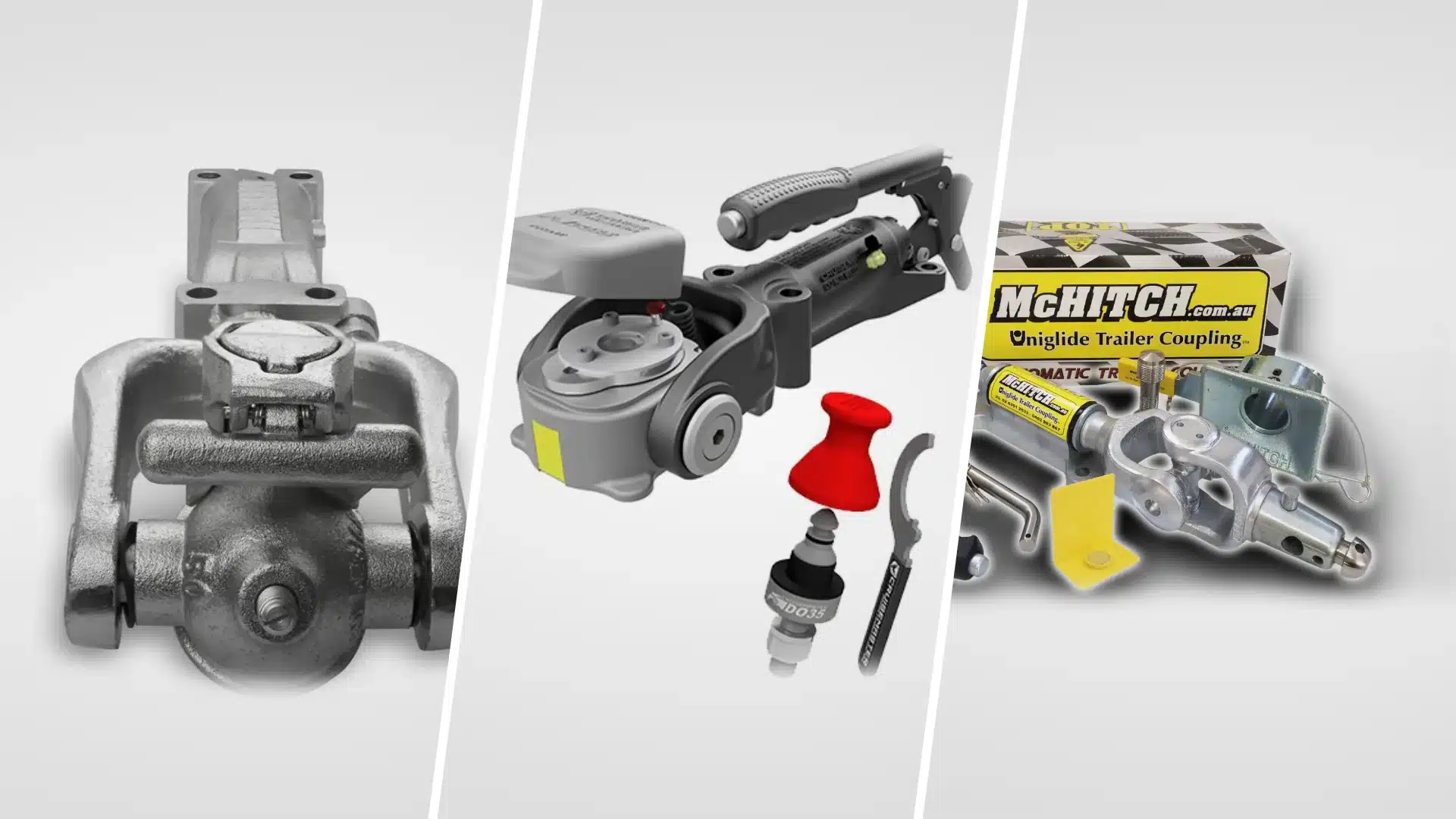

Cruisemaster publishes “360 degrees axial, minimum 70 degrees on other axis” for its DO35 V3Plus coupling. The federal trailer bulletin, VSB 1, prints no angle at all for the everyday 50mm ball. Instead, its couplings section answers a camper trailer builder who says ball couplings “do not provide the required articulation that is needed off-road”, and explains how to check that an off-road alternative is compliant.
That exchange sums up why off-road couplings exist. A coupling is a joint, and the question is how far it can bend, twist and swing before something binds and starts to lever. The law, meanwhile, cares far more about ratings than angles.
Below we compare what five couplings Australian caravanners commonly meet actually publish: the standard 50mm ball, the AL-KO Off-Road Ball Coupling, the ARK XO, the Cruisemaster DO35 (with its bigger DO45 sibling) and McHitch. Every figure comes from the maker’s own page or manual, or from the regulator. Where a maker prints no number, we say so rather than guess.
Three ways a coupling has to move
Picture the caravan’s drawbar as an arrow pointing at the tow vehicle. The coupling at its tip must let it move three ways at once.
Pitch is the nose rising and falling: cresting a dip, rolling off a kerb, or the tow vehicle climbing a creek bank while the van is still at the bottom.
Roll is twist along the drawbar. One van wheel climbs a rut while the tow vehicle leans the other way, and the coupling has to absorb the difference.
Yaw is side to side: every corner, and every tight reverse into a campsite.
On sealed roads all three stay small. On a rutted track they arrive together, and a coupling that runs out of range in one direction starts levering on the towbar, the drawbar or itself. The diagram below shows how much of that range each maker puts a number on.
How far each coupling bends, by the maker’s own numbers
Each wedge is a published articulation angle, drawn to the same scale. A dashed grey dial means the maker prints no figure.
Articulation
50mm ball coupling
AS 4177.3 body on a 50mm ball
No angle in the text of ADR 62/02 or VSB 1
Articulation
AL-KO Off-Road Ball
Over a 50mm ball
Described as extreme vertical and horizontal; no figure
Articulation
ARK XO
Over a 50mm ball
Described as full off-road articulation; no figure
Articulation
Cruisemaster DO35 V3Plus
Drop-on; 7/8in tow pin, 1 1/4in optional
Published: “360 degrees axial, minimum 70 degrees on other axis”. Reading axial as roll is ours, not Cruisemaster’s.
Articulation
McHitch automatic
Coupling plus McHitch receiver
Published for 3.5t to 6t: over 90° of movement on every axis
WUDU calculation
10%
Cruisemaster’s recommended maximum ball weight for a DO35 (350kg), as a share of a 3,500kg van. The same figure against lighter vans:
2 of the 5 couplings here publish any articulation angle at all.
Assumptions: angles and ratings as published by each maker or the regulator, checked 20 November 2026 (Cruisemaster DO35 V3Plus spec block; McHitch 3.5 tonne Easy Fit product page; AL-KO 619350/619200 brochure; ARK XO product pages; VSB 1 Revision 6). Wedges are drawn at the published angle; makers do not say whether a figure is per side or total, and a “minimum” or “over” figure is drawn at that value. Cruisemaster does not say which movement “axial” means; we have drawn it as roll and its “other axis” figure as pitch and yaw. The DO45 publishes no angle. Ball weight share = 350kg recommended maximum drawbar weight (Cruisemaster DO35 V3Plus User Guide Rev.1 and CIS-036) divided by van mass.
The standard 50mm ball coupling
What it does well. Both halves are covered by Australian Standards: ADR 62/02 calls up AS 4177.2 for 50mm towballs and AS 4177.3 for the coupling body on trailers up to 3.5 tonnes. VSB 1 lists the three ratings set by AS 4177.3, 750kg, 2,000kg and 3,500kg, each for trailers with an ATM not exceeding that figure, and requires the rating and a ‘50’ to be marked on the coupling. VSB 1 notes that vehicles designed to tow up to 3,500kg must comply with AS 4177.1, the towbar standard, so most tow vehicles with a standard towbar can take it.
What to check. Movement is the weak point once the bitumen ends. Neither ADR 62/02 nor VSB 1 prints an articulation angle in its own text (any articulation requirement would sit inside the paid Australian Standard, which we have not reviewed), and the bulletin’s off-road question starts from the premise that ball couplings fall short off-road. The rating is the other trap: a van plated above 2,000kg needs the 3,500kg type, not a lighter coupling carried over from an earlier build.
AL-KO Off-Road Ball Coupling
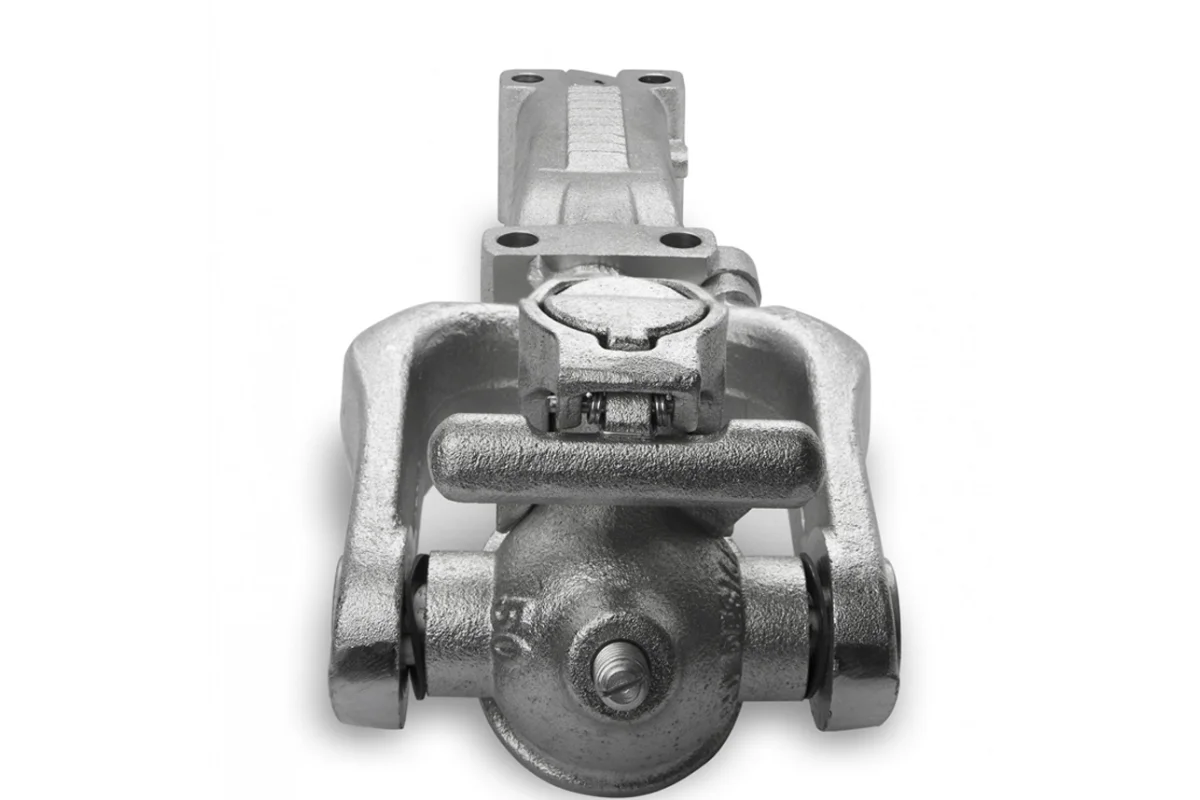
What it does well. AL-KO’s design keeps the tow vehicle’s standard 50mm ball and changes how the coupling body moves around it. AL-KO says it offers “extreme vertical and horizontal articulation” and needs no pin or hole alignment when hitching. The fixed version (part 619350, for electric brakes) is rated at 3,500kg, and the override version (619200, for hydraulic or mechanical brakes) at 2,000kg, according to AL-KO’s brochure. Both use a 184mm by 54mm mounting pattern. The coupling latches over the ball, and the user manual tells you to confirm the latch by trying to lift the coupling straight up off it.
What to check. AL-KO does not publish a number for that articulation, so it cannot be compared degree for degree with a pin coupling. Its product page says level rides should be removed when towing off-road so the coupling can articulate, which matters if you rely on a weight distribution hitch on the highway. The manual warns that no other size of towball is safe to use, and that the ball adjustment screw should make only very light contact, or premature wear may occur.
ARK XO off-road coupling
What it does well. The ARK XO takes the same route: an articulating body that sits over a standard 50mm ball, so there is no need to change the hitch on the tow vehicle. ARK’s product page promises “full off-road articulation”, a quick-hitch locking system, compliance with AS 4177.3-2004 and a two-year warranty. The 3.5t XO for electric brakes is listed from $354.70 with a tow ball included, and ARK sells a 2t version for mechanical and hydraulic brakes from $317.07.
What to check. The ball must be a 50mm ball complying with AS 4177.2 without a flat flange, and ARK’s fitting instructions call for at least 80mm of clearance on the tow hitch, warning that some towbar designs are not compatible. Like AL-KO, ARK says not to use load levelling devices off-road, and the shaft needs grease through nipples at both ends. ARK publishes no articulation angle.
Cruisemaster DO35 and DO45
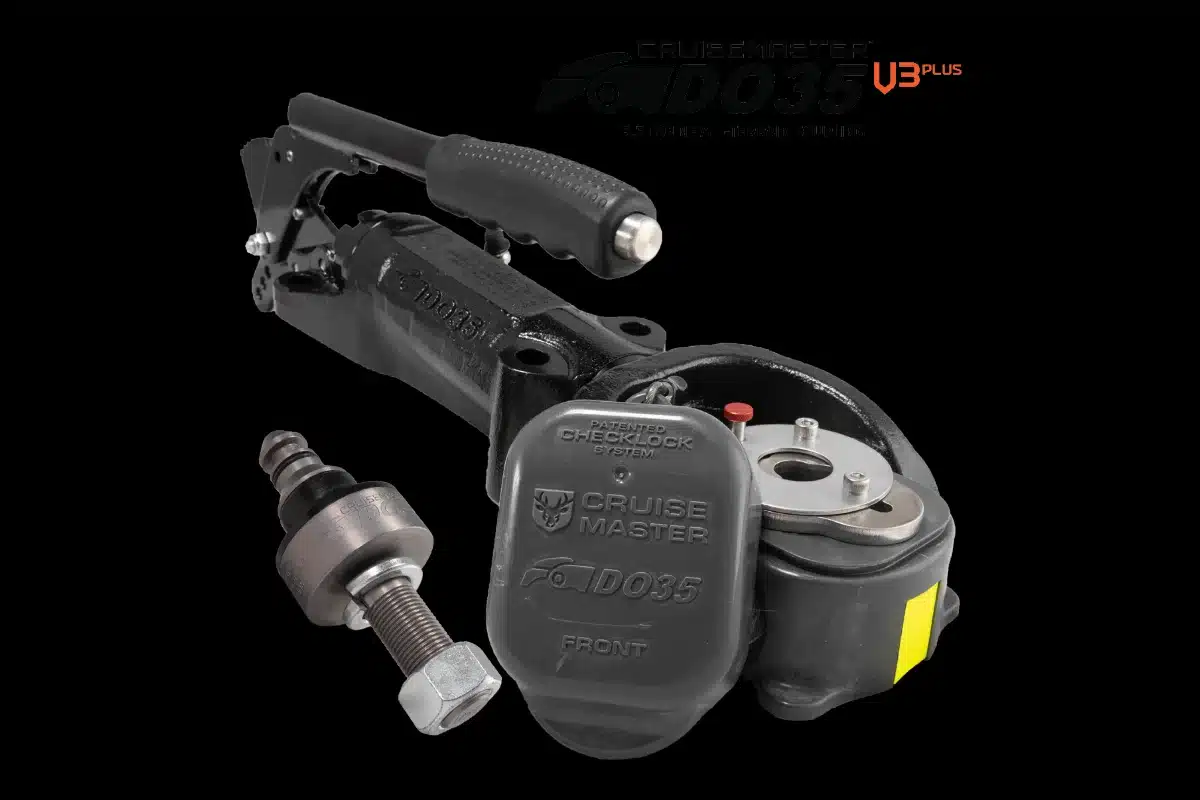
What it does well. The DO35 is a drop-on pin design: a tow pin bolts to the tow vehicle’s tongue and the coupling lowers over it, with a view port to help line it up. Cruisemaster rates the DO35 V3Plus at 3,500kg and describes its locking as fully ADR 62/02 compliant, including an automatic secondary lock. The Checklock dust cap only fits once the lock is engaged, which doubles as a visual check, and Cruisemaster says the greaseable bushes are for easy maintenance and “noise free towing”. The heavier DO45 Plus is rated at 4,500kg.
What to check. Cruisemaster’s V3Plus user guide and customer information sheet recommend a drawbar weight of at least 50kg and no more than 350kg. That recommended maximum is exactly 10 per cent of a 3,500kg van, so a van loaded to its full rating with more than that on the ball is over Cruisemaster’s recommended maximum (our towball leverage explainer covers why ball weight matters). The DO35 comes with a 7/8-inch tow pin (Cruisemaster also lists an optional 1 1/4-inch pin), while the DO45 uses a 1 1/4-inch shaft and a wider bolt pattern on the drawbar, so check the tongue and mounting plate before swapping one for the other. Cruisemaster’s page lists no price.
McHitch automatic and drop-on couplings
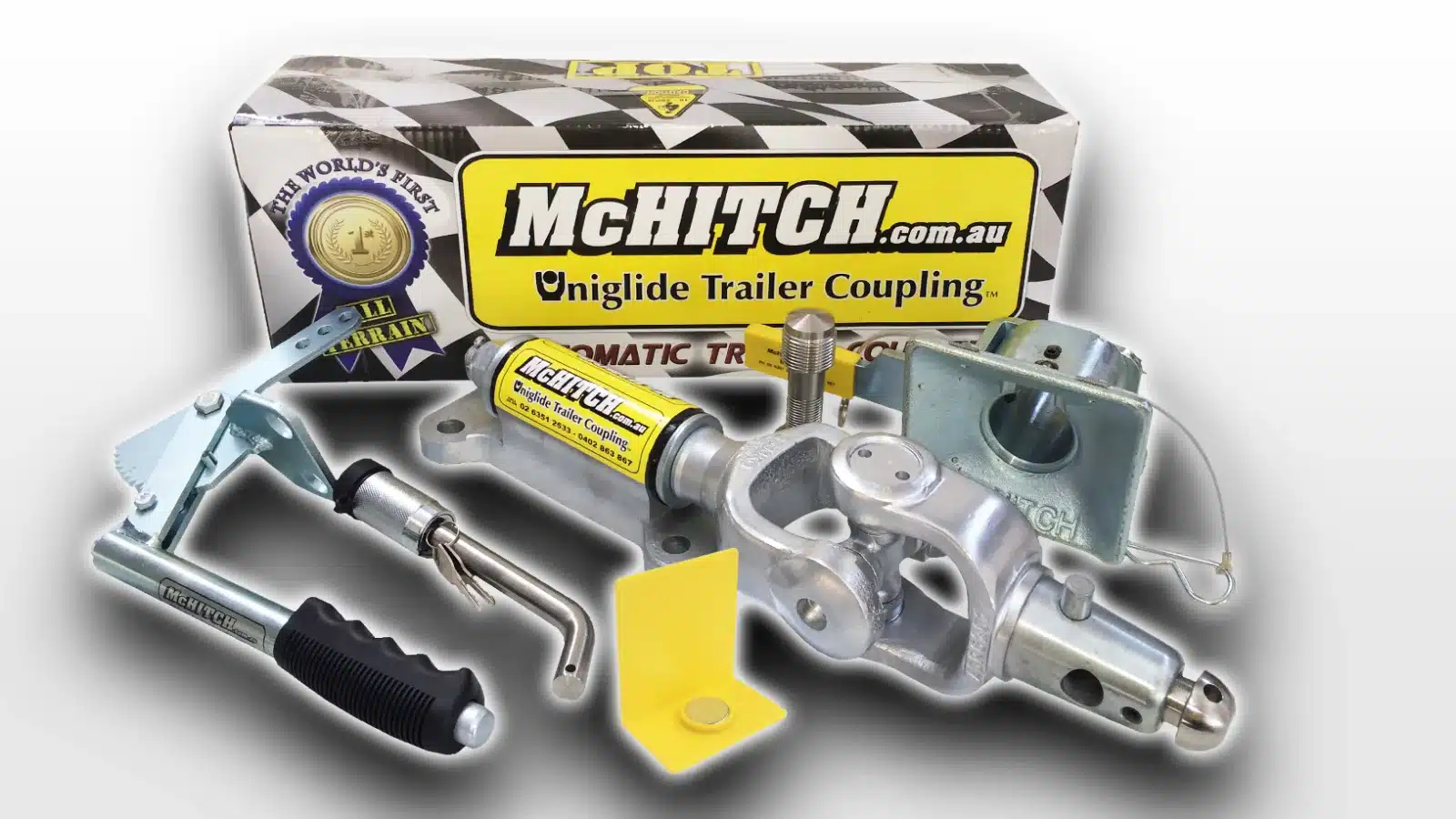
What it does well. McHitch’s automatic couplers pair a coupling on the van with a separate receiver on the tow vehicle, in 2 tonne (mechanical override), 3.5, 4.5 and 6 tonne ratings. The 3.5 tonne Easy Fit is listed at $435 and the 4.5 tonne at $545 on McHitch’s own site, with a receiver on its own (no shank) at $215. McHitch says its 3.5, 4.5 and 6 tonne automatics are “capable of over 90 degrees of movement on every axis” and fully ADR 62/02 tested; the 2 tonne override page gives no angle. Its FAQ explains that movement happens in a universal joint kept separate from the point of attachment, and that the 3.5, 4.5 and 6 tonne models use polyurethane bushes sealed for life. The 3.5 tonne drop-on platinum kit, with a tapered tow pin and locking hitch pin, is listed at $325.
What to check. An automatic coupler hitches to a McHitch receiver, so every vehicle that tows the van needs one fitted. McHitch’s figures also differ between pages: the product pages say over 90 degrees on every axis, while the FAQ describes the Uniglide design as over 105 degrees, with 210 degrees in total. Ask which figure applies to the model you are buying. The FAQ says the universal joint needs only minimal greasing once a year, plus a regrease if it has been submerged and moisture has got in. We found no download limit on the product pages we read.
Watch out: a coupling’s rating is only half the match. The hardware on the tow vehicle has its own size and rating: the DO35 comes with a 7/8-inch pin (a 1 1/4-inch option exists), the DO45 a 1 1/4-inch pin, McHitch automatics need a McHitch receiver, and the ball designs need an AS 4177.2 50mm ball. Mix them up and a 4,500kg coupling can end up on a pin or tongue built for less, and the lowest rating in that chain is the one you are really towing on.
The five couplings side by side
Ratings and movement as each maker or the regulator publishes them, checked on 20 November 2026.
| Coupling | Rating | Movement |
|---|---|---|
| 50mm ball (AS 4177.3) | 750kg, 2,000kg or 3,500kg (VSB 1) | No angle in ADR 62/02 or VSB 1 text |
| AL-KO Off-Road Ball | 3,500kg fixed; 2,000kg override | “Extreme” vertical and horizontal; no figure |
| ARK XO | 3.5t electric; 2t mechanical/hydraulic | “Full off-road”; no figure |
| Cruisemaster DO35 / DO45 | 3,500kg / 4,500kg; DO35 download 50kg to 350kg | DO35: 360° axial, minimum 70° on other axis; DO45: no figure |
| McHitch automatic | 2t, 3.5t, 4.5t or 6t | Over 90° on every axis |
What the rules ask of every coupling
ADR 62/02 is the national standard for mechanical connections between vehicles, and VSB 1 is the federal bulletin that explains how the rules apply to trailers up to 4.5 tonnes ATM. Between them, they set four tests.
It must be rated for the trailer. VSB 1 lists the AS 4177.3 ratings for 50mm ball couplings: 750kg, 2,000kg and 3,500kg, each for trailers with an ATM not exceeding that figure. A van plated at 3,200kg needs a 3,500kg coupling. Our caravan weight audit shows where to find each plated figure.
It must be marked. For other coupling types used with trailers up to 3.5 tonnes ATM, such as the drop-on pin and McHitch designs here, ADR 62/02 requires both parts to carry the maker’s name or trademark, the maximum trailer ATM the coupling is rated for, and the words “use with model” naming the matching part, in letters at least 2.5mm high that stay visible when coupled. A 50mm ball coupling is instead marked under AS 4177.3, which VSB 1 summarises as the maker’s name or trademark, the rating, a ‘50’ for the ball size and a serial or batch code. Above 3.5 tonnes, the marking shifts to a D-value rating in kilonewtons.
It must lock, and show that it is locked. Couplings for trailers up to 3.5 tonnes ATM must be quick release, with a positive locking mechanism, a separate means of automatically holding it locked, and locking that can be checked by looking at it. VSB 1 applies the same locking requirement to couplings for trailers above 3.5 and up to 4.5 tonnes ATM.
The tow vehicle side has its own rules. For vehicles rated to tow up to 3.5 tonnes, ADR 62/02 says the towbar must comply with AS 4177.1-2004, and VSB 1 notes that 50mm balls fitted under that standard must adjust to between 350mm and 460mm, ground to ball centre, with the vehicle fully loaded. Our 3.5t tow vehicle guide covers whether a vehicle can still use its full rating once loaded. For an off-road coupling that is not a 50mm ball, VSB 1’s advice is to ask the supplier for its component type approval number, which shows it has been tested to the ADRs.
Bitumen, gravel or proper tracks: let the trip decide
Mostly bitumen. A correctly rated 50mm ball coupling does the job it was designed for and fits the 50mm ball on towbars built to AS 4177.1, provided the towbar’s own rating covers the van. The checks are the rating against your van’s ATM and a ball height inside the 350mm to 460mm window.
Regular gravel and corrugations. Ball-type off-road couplings keep your existing 50mm ball and add articulation; pin and receiver designs publish more about their angles but tie the van to vehicles carrying matching hardware. Read the grease schedule before you buy, because corrugations are where it gets tested.
Serious four-wheel-drive tracks. Steep entries, washouts and cross-axle ruts are what the published angles are for. Compare the numbers each maker actually prints, ask for them where none is printed, and remember that AL-KO and ARK both tell you to remove levelling devices off-road so their couplings can use their range.
The coupling is the one part of the rig that has to agree with two vehicles at once. Choose it for the roughest road you will genuinely drive, then confirm it agrees with the van’s plate and every tow vehicle’s hardware, in that order.
Prices and specs checked on 20 November 2026. We have no commercial relationship with any maker named here.
Images: AL-KO, Cruisemaster and McHitch (manufacturer images, used for editorial comparison).