
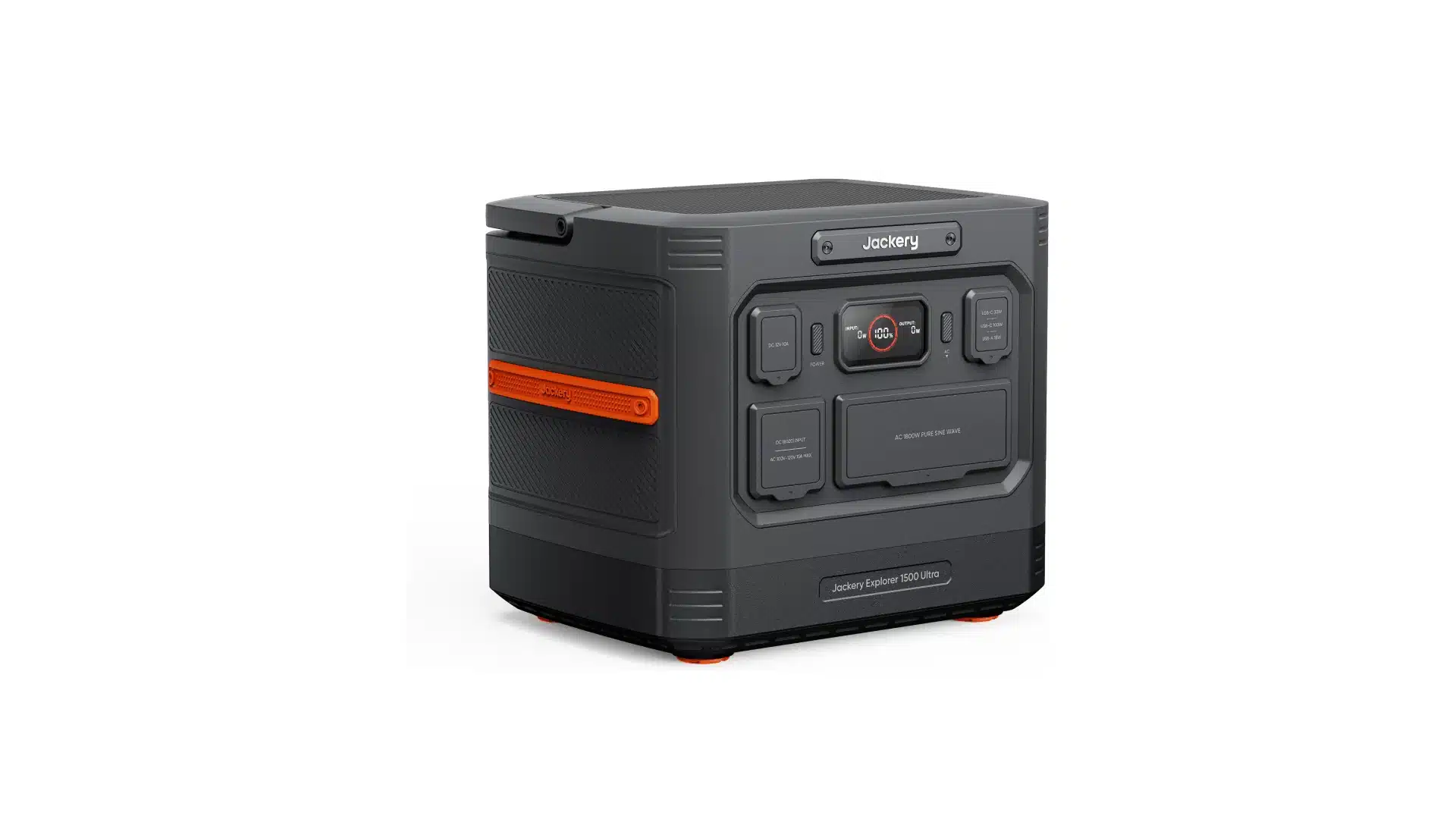

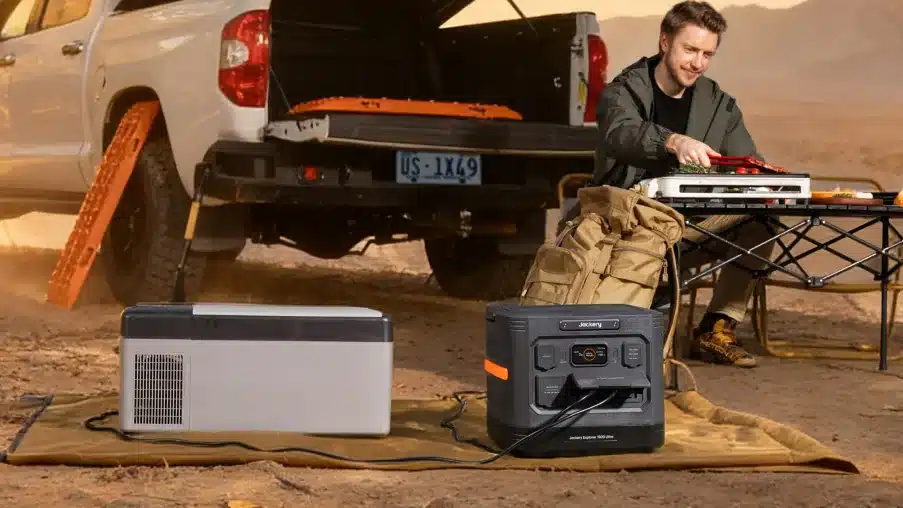
Jackery’s Explorer 1500 Ultra is a 17.5kg, 1536Wh lithium iron phosphate (LiFePO4) power station with an IP65 case. It has been on Jackery’s Australian store since May 2026, and Jackery lists its full price as A$2,299. When we checked on 15 October 2026, it was on sale for A$1,549.
Two to six days off-grid, on our maths
Jackery’s published specs for the Explorer 1500 Ultra, and what they mean for a typical camp load with no recharging.
The spec sheet that matters
Days of use, no recharging
Conservative Best case
Our assumptions: conservative is 95% of 1536Wh usable at 85% DC conversion (1240Wh); best case is 100% at 90% (1382Wh). Dometic CFX5 45 at 0.76Ah/h at 12V (32°C ambient, set to 4°C). Four LEDs at 0.22A each for 4 hours. Starlink Mini at 25–40W average for 8 hours (bottom row: 40W around the clock, 31–35 hours). Specs from Jackery Australia’s product page and AU user manual, 15 October 2026. Our maths, not Jackery’s.
What 1536Wh buys you at camp

Jackery doesn’t publish usable capacity or how efficiently it steps its 51.2V battery down to 12V, so we ran two cases: all 1536Wh usable at 90 per cent conversion (1382Wh delivered), and 95 per cent usable at 85 per cent conversion (1240Wh).
A Dometic CFX5 45 portable fridge on its own, using Dometic’s 32°C hot-weather figure, runs for 5.7 to 6.3 days with no recharging. Add four LED lights (0.22A each) for four hours a night and a Starlink Mini for eight hours a day, and that falls to 2.1 to 3.0 days, depending on where the Starlink sits in its published 25 to 40W average.
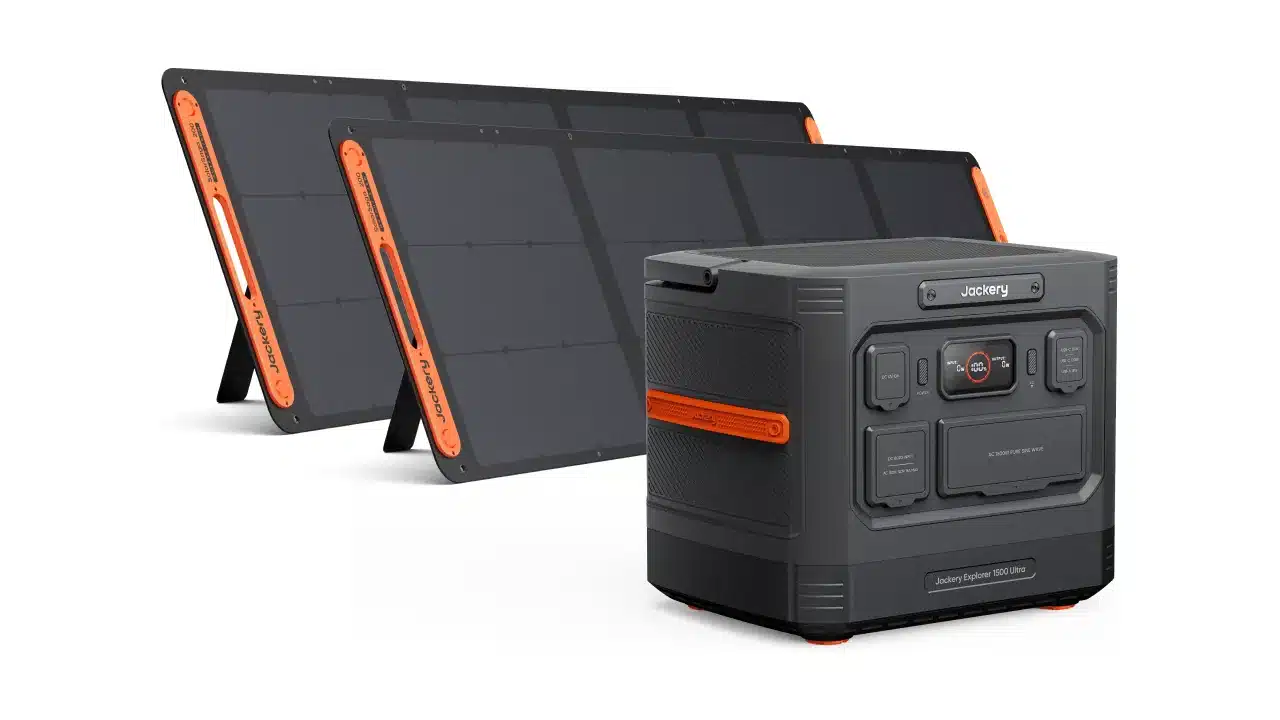
Refilling it is quick on mains power: 1.5 hours from flat. Solar is slower. One 200W panel takes 11 hours by Jackery’s own figure, an average of about 140W going in. Against that fridge, lights and Starlink load of 461 to 581Wh a day, that’s about four to five hours of the panel’s full charging rate just to stand still, once conversion losses are counted. Two panels (5.5 hours from flat) suit a longer stay.
Where it falls short for caravans
- One 12V socket, 10A maximum. A CFX5 45 is rated at 9.4A at 12V, which leaves about 7W of headroom on that socket. It suits one portable fridge, not a van’s 12V system.
- 12V vehicles only. The car socket and car charging are not suitable for 24V. You should also not use the car charger while driving on bumpy roads. The 600W alternator charger is sold separately, and it wasn’t listed on Jackery’s Australian store when we checked.
- IP65 means covers closed. The rating applies only with every port cover shut. Keep it sheltered from direct rain when ports are in use.
- Temperature limits. It charges between 0°C and 45°C and discharges from -15°C to 45°C, with output capped at 1000W below -10°C. The manual warns against high heat, including inside a hot vehicle.
- The warranty has homework. Bought from Jackery’s own store, it’s three years, plus two more if you register, for the original buyer only. Jackery says terms through authorised dealers may vary. Its terms exclude the battery cell unless you fully charge it within seven days of purchase and at least every six months after, so a unit stored between trips needs a diary note. Your rights under the Australian Consumer Law apply regardless.
Is it enough?
The Explorer 1500 Ultra is a capable portable battery for a camper trailer, a 4WD set-up or a caravanner on powered sites who wants a few nights off-grid without wiring anything in. The cells are rated to 4,000 cycles to 70 per cent capacity, and the 1.5-hour mains recharge is useful between powered nights. At the sale price it works out to about A$1.01 per watt-hour, against A$1.50 at Jackery’s full price.

For a caravan, that single 10A socket is the catch. If you want to run the van itself, a fixed lithium battery with a DC-DC charger is built for that job. Our 200Ah lithium battery comparison and is 1kWh enough? cover that side, and our Starlink Mini guide covers the power it needs.
Prices and specifications checked on Jackery’s Australian website and in its AU user manual (version JAK-UM-V1.0) on 15 October 2026. How we worked it out: CFX5 45 at 0.76Ah per hour at 12V (Dometic, 32°C ambient, set to 4°C); four LEDs at 0.22A each for four hours; Starlink Mini at 25 to 40W for eight hours; no recharging, no self-consumption by the unit, all loads on DC outputs.
Images: Jackery Australia (au.jackery.com).


