
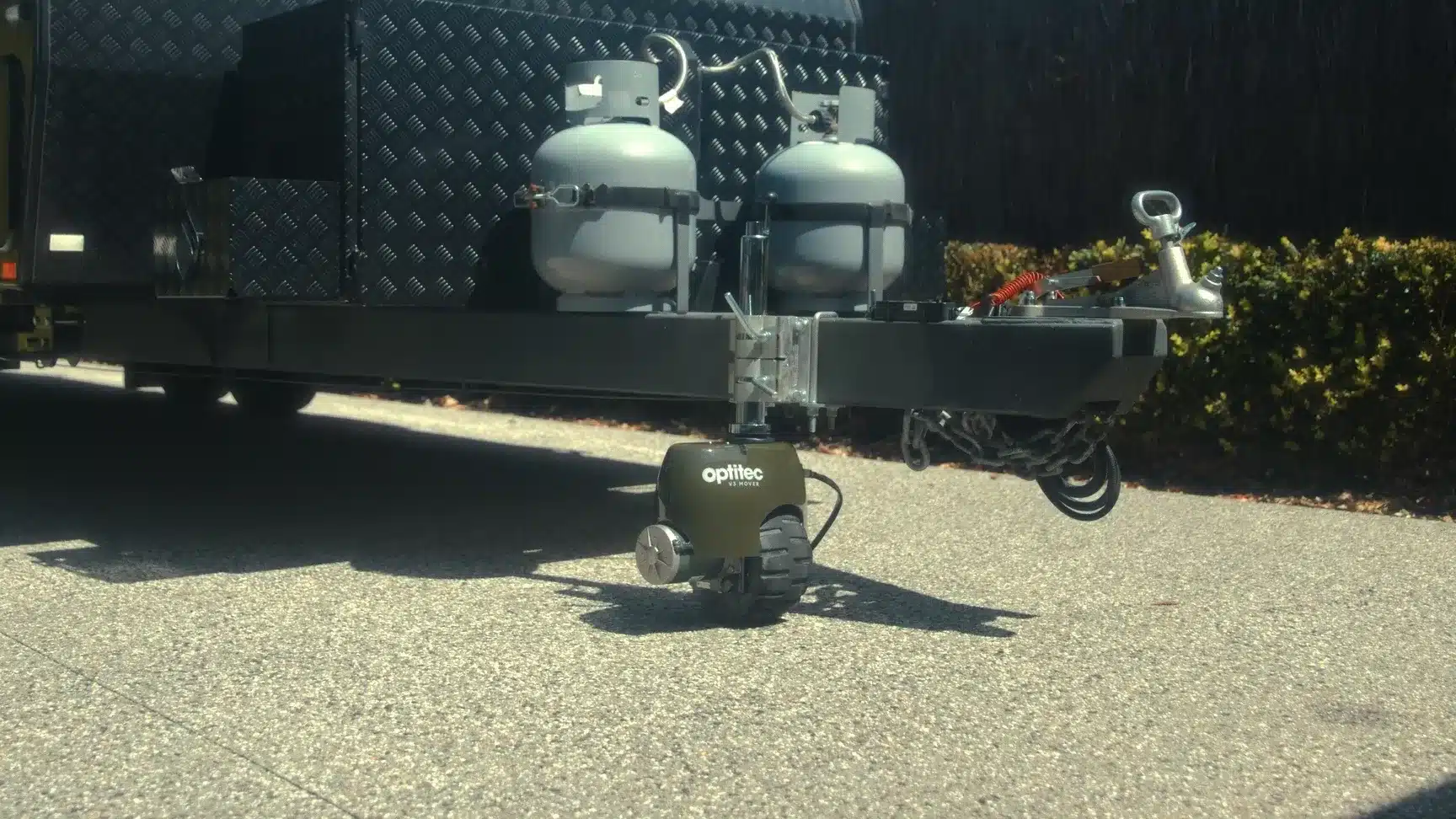

The van has to go backwards up a sloping driveway and into the shed, the tow vehicle is out, and nobody can guide you. That is the job an electric jockey wheel is bought for.
We have not had the Optitec Optimover V3 on test. This first look is built from Optitec’s own product page, FAQ, support and warranty information, and operator manual, with every limit quoted as published. Prices and specs checked on 18 November 2026.
The V3 is a remote-controlled motorised jockey wheel from Optitec, a Melbourne company that says it designed and engineered the Optimover in Australia in 2008. It sells for $2,625 with free shipping. The drawbar clamp is extra: the OW15, which Optitec lists as the most common caravan fit, is $180.
Four limits on one electric jockey wheel
The Optimover V3’s published ceilings drawn to scale, with one example van set against the ball weight rating.
Optitec Optimover V3: published limits
Ball weight
350kg
Maximum towball weight. Orange needle: our example van at 200kg.
Trailer mass
3,500kg
Maximum trailer weight. Heavy duty double clamp required over 1,500kg.
Gradient
10%
Guide: 2.5t trailer on concrete, mover pushing from below. Not advised above 10%.
Duty time
35 min
Operating duty on a level surface, at about 8 metres per minute.
Our example single-axle van’s 200kg ball weight uses 57% of the V3’s 350kg rating, leaving 150kg of headroom.
Assumptions: example van is single axle with a 2,000kg ATM and a ball weight taken as 10% of ATM (200kg); 200 / 350 = 57%. Your loaded ball weight will differ, so weigh it. Limits from Optitec’s Optimover V3 product page, FAQ and operator manual, checked 18 November 2026. Gauge scales run past each limit for illustration (500kg, 5,000kg, 20%, 60 min); green or coloured arc = within the maker’s figure, pink = beyond it.
Will it handle my ball weight?
Optitec rates the V3 at a maximum towball weight of 350kg and a maximum trailer weight of 3,500kg, both written as “up to” in the manual.
Ball weight is the number to watch, because the wheel carries it: any van with more than 10 per cent of its mass on the ball reaches the 350kg limit before the 3,500kg one. The manual says the unit “supports a loaded weight of 350kg”, so the reading that matters is your van packed for a trip. Our example van in the gauges sits at 57 per cent of the rating. If you have never weighed the ball, our caravan weight audit shows how.
Too little nose weight hurts as well: the manual says “sufficient down force must be applied” for traction, and our towball leverage explainer covers why nose mass matters.
What about a slope?
The manual says the V3 “is not recommended on any incline” if the trailer has no handbrake of its own, and asks for “a level, even, firm surface” before every move.
As a guide, the FAQ says it “will push a 2.5 Tonne trailer up a 10% or 6 degree gradient (1m rise for every 10m) on concrete”, and Optitec generally does not recommend gradients above 10 per cent. That guide uses 2.5 tonnes, not the 3.5-tonne headline.
Optitec also wants the mover at the low end, pushing; pulling a van uphill generally leaves too little downforce for traction.
Optitec says the V3 is most effective on concrete, aggregate or pavers, and will work on grass or compact gravel that is “flat, dry and firm”. On soft grass or loose gravel, or on any incline on those surfaces, the wheel can dig or spin. On the sloping driveway in our opening scenario, a damp lawn strip would be the real test, and Optitec says it may suggest a try-before-you-buy.
Where does the power come from?
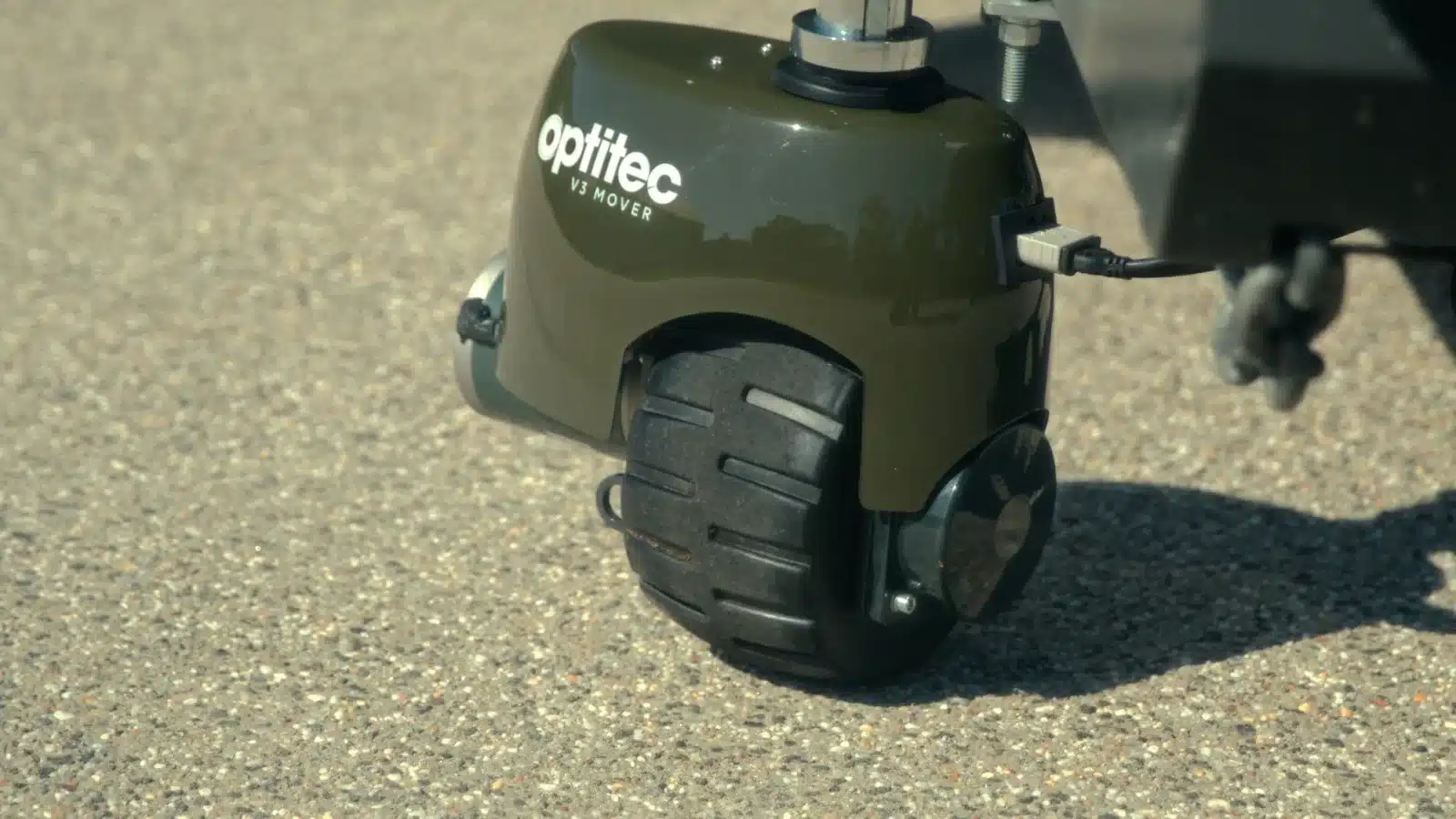
The V3 has no internal battery, which Optitec says keeps it lighter and smaller. It runs on 12V DC from the caravan battery via an Anderson plug, a separate battery or a jump-starter pack, and the motor is rated at 50 amps maximum.
The manual wants a source “capable of 70 Amps at 12 Volts and fully charged”, recommends at least an 80Ah battery, any inline fuse at 70 amps or more, and 6 B&S cable for any lead longer than 2m. It also warns that some caravans do not let the house battery supply power back out through the Anderson plug, so check the van’s wiring first; our caravan power system guide helps.
The unit has no reverse polarity protection, so swapped leads can kill the controller. If it turns left and right but will not drive forward or back, the manual says it is short of power. Optitec quotes an operating duty of 35 minutes on a level surface, at about 8 metres per minute.
What does the warranty actually cover?
Optitec offers a three-year parts warranty from the date of purchase on units bought from April 2024. It covers the original purchaser only and is not transferable, which matters if the mover is sold with the van.
Optitec will replace defective parts “at no charge for parts only”, and excludes water damage, commercial use, normal wear and tear, improper installation and accessories it did not make. The “parts only” wording suggests labour is not included, and freight on a claim is not mentioned, so ask before you buy. Optitec states its warranty is in addition to Australian Consumer Law guarantees, and it recommends a service every two years.
Jockey wheel mover or tracked caravan mover?
Optitec’s All Terrain Caravan Mover 4500kg runs on tracks for grass, compact gravel and dirt, carries its own 16Ah lithium battery, includes a mounting bracket and is listed at $5,400 to $5,500 with a two-year parts warranty. Optitec points buyers to it for vans above 3 tonnes on 5 to 10 per cent inclines, or softer ground. Our earlier All Terrain TK45 rundown covers Optitec’s tracked mover when it launched.
Even with an OW15 clamp ($2,805 all up), the V3 costs about half as much, weighs 22kg and runs off power you may already carry, but it leans on firm ground and a strong 12V supply. The tracked mover buys grip and its own battery for about twice the money.
The Optimover V3 suits an owner with a sealed driveway or concrete pad, a van up to 3,500kg with a weighed ball weight of no more than 350kg, and a 12V supply that can deliver 70 amps. If the yard is mostly soft grass or loose gravel, Optitec’s own documents point you to its tracked mover instead, and if it is steeper than 1 in 10, Optitec does not recommend either of its movers.
Images: Optitec (manufacturer images, used for review).