
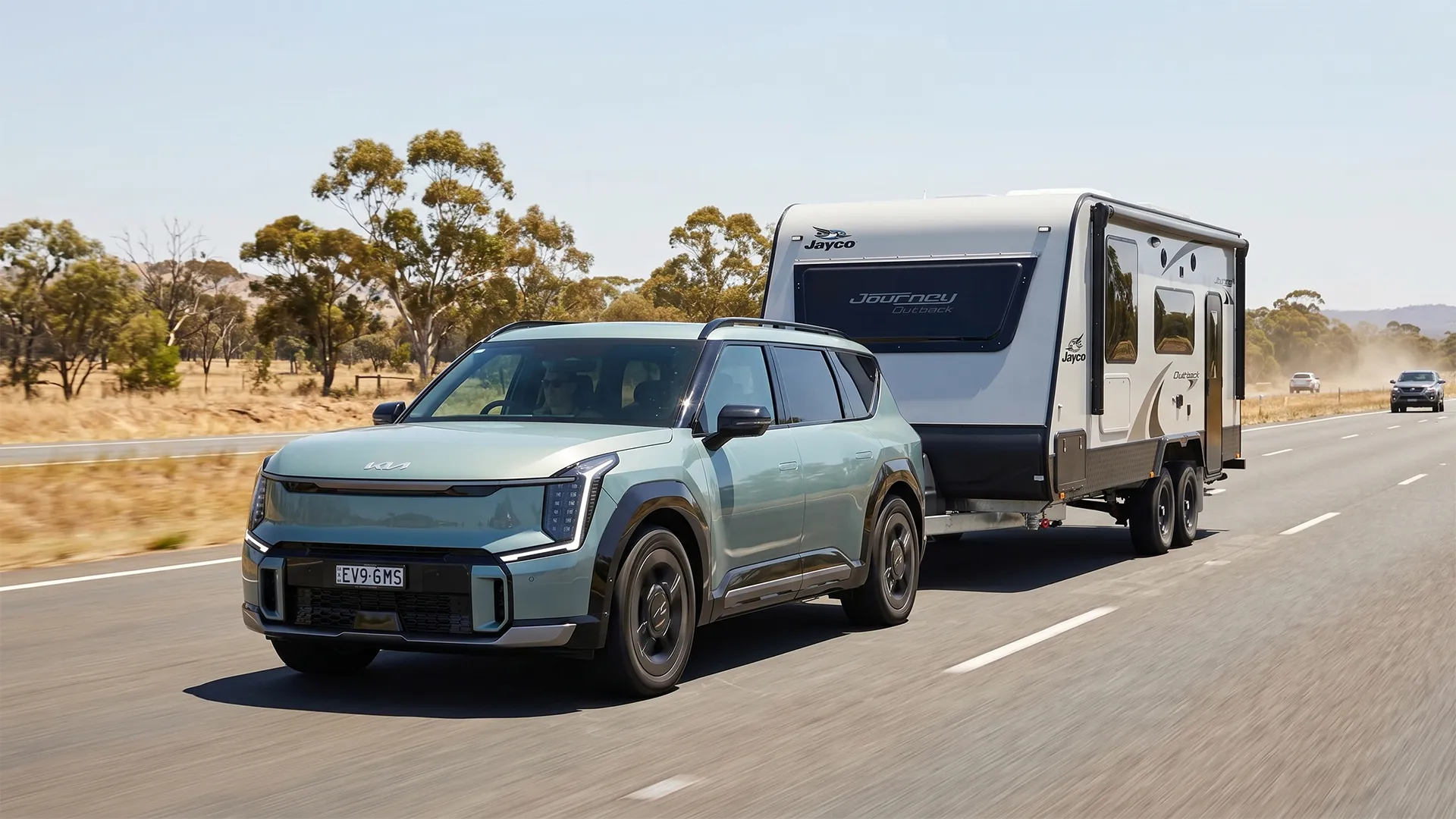

A few years back, most EVs weren’t rated for towing anything substantial. Now, we’re seeing electric SUVs with 2.0 to 2.5-tonne braked towing capacities, and electric utes are starting to appear. Plug-in hybrid utes are also promising familiar 3.5-tonne towing figures. This shift means it’s time for a serious look at what’s available and what it means for your next adventure.
Why EV Towing Is Different For Caravanners
EVs offer instant torque and a smooth towing experience, but their range can be significantly impacted by the added weight and aerodynamic drag of a caravan, requiring careful trip planning.
EVs bring some real advantages to towing. They deliver instant, seamless torque, which makes pulling away from a standstill or climbing hills feel effortless. The low-slung battery weight often contributes to a very stable towing platform. For shorter trips or around town, an EV can be a fantastic match for lighter caravans or camper trailers.
However, the biggest hurdle is range. Towing a caravan dramatically increases both weight and aerodynamic drag. A full-height caravan behind an EV can slash the driving range by a significant margin. This effect is amplified at highway speeds, in strong headwinds, in colder weather, or on hilly terrain.
This doesn’t make EV towing impossible for caravanners. It simply means you need a different approach to planning your journey and understanding your rig’s real-world capabilities. For some, an EV will be ideal, but for those with heavy off-road vans heading into remote areas, a diesel or plug-in hybrid might still be the more practical choice for now.
Understanding EV Towing Capacities
Caravan owners must look beyond the braked towing capacity and consider tow ball download, GVM, GCM, and payload, as these often present the real limitations for Australian touring rigs.
A 2,500kg braked towing capacity sounds impressive on paper. However, for caravanners, the numbers game goes much deeper than that single figure. Before you even consider an EV tow vehicle, you need to understand all the relevant weight limits.
This includes the maximum tow ball download, Gross Vehicle Mass (GVM), and Gross Combined Mass (GCM). You also need to factor in your usable payload after passengers, accessories, and luggage. The tow ball download is particularly critical for Australian caravans, which often carry 8 to 12 per cent of their loaded weight on the tow ball. A 2,500kg caravan could easily have a tow ball weight between 200kg and 250kg. Many EVs have a lower tow ball limit than buyers might expect, so always check the specific variant and its towbar rating. Understanding these limits is crucial for safe and legal towing, as WUDU has highlighted in our guide on caravan payload explained.
EV Tow Vehicle Shortlist For Australian Caravan Buyers
The EV market is evolving quickly, and more options are becoming available for caravanners. Here’s a look at some of the key players and what they offer.
Kia EV9
Best for: families towing lightweight to mid-size vans
Braked towing: up to 2,500kg on selected variants
Watch: not all EV9 variants tow the same
The Kia EV9 stands out as one of the most relevant electric SUVs for caravanners in Australia. This large seven-seat SUV offers a strong towing figure on its Earth and GT-Line variants. This makes it a genuine contender for families with a lighter touring van, pop-top, or a well-matched camper trailer.
It’s crucial to note that the EV9 Air variant has a much lower towing capacity. Buyers must confirm the specific model grade they are considering. The EV9’s spacious interior, robust EV platform, and practical design make it a realistic option, provided your caravan’s weight and tow ball download are carefully matched.
Hyundai IONIQ 9
Best for: seven-seat touring with a lighter to mid-size caravan
Braked towing: up to 2,500kg
Watch: real-world range when towing will matter more than brochure range
The Hyundai IONIQ 9 is another large electric SUV designed to appeal to family tourers. Its 2,500kg braked tow rating puts it in a similar league to the Kia EV9. It offers the benefit of three-row seating and a dedicated large EV platform.
This vehicle is well-suited for buyers who prioritise an electric family SUV first, with towing as a key part of their lifestyle. While it won’t handle every full-size caravan, it has strong appeal for those with a carefully matched van under its rating.
BMW iX
Best for: premium SUV buyers towing up to 2.5 tonnes
Braked towing: up to 2,500kg
Watch: tow ball download is often the limiting number for some vans
The BMW iX is one of the more powerful pure EV towing options currently available. It boasts a 2,500kg braked towing figure, ample power, a substantial battery, and a luxurious long-distance cabin.
The main consideration for caravanners is the tow ball download limit. A high braked tow rating doesn’t automatically mean it can handle every 2.5-tonne Australian caravan. Always check your van’s loaded tow ball weight and confirm the iX variant’s specific limits, including the genuine towbar.
Audi Q6 e-tron
Best for: premium mid-size SUV buyers towing campers or lighter vans
Braked towing: up to 2,400kg on selected variants
Watch: lower-output variants may tow less
The Audi Q6 e-tron adds another strong contender to the premium EV towing segment. Depending on the variant, its towing capacity ranges from around 2.0 to 2.4 tonnes. This makes it suitable for camper trailers, compact caravans, and some pop-tops.
It’s not as large as some seven-seat EV SUVs, but it offers excellent charging capabilities and a comfortable, touring-focused interior. As with all EVs, verify the exact model grade, as rear-wheel-drive and quattro versions may have different towing limits.
Porsche Macan Electric
Best for: premium buyers towing compact vans, boats or campers
Braked towing: up to 2,500kg on selected versions
Watch: luxury pricing and practical caravan space
The Porsche Macan Electric delivers impressive performance on paper, with up to 2,500kg towing available on certain versions. While not the most obvious choice for a large caravan, it could suit buyers towing a compact premium van, boat, camper, or a lightweight off-road trailer.
For What’s Up Downunder readers, this is more of a niche pick than a mainstream recommendation. It has the numbers, but families might need more practical space. Owners of heavier vans will still need to meticulously check tow ball weight and payload.
Volvo EX90
Best for: safety-focused families towing lighter vans
Braked towing: up to 2,200kg
Watch: 100kg tow ball download may limit caravan choice
The Volvo EX90 is a large electric SUV known for its strong safety focus and seven-seat appeal. Its braked tow rating is useful, but the stated 100kg tow ball download limit is a significant factor to consider.
This vehicle might suit a camper trailer, a European-style lightweight van, or a carefully selected Australian pop-top. It is less likely to be suitable for heavier local caravans, which typically have higher tow ball weights.
Polestar 3
Best for: premium EV SUV buyers towing campers or lower-ball-weight vans
Braked towing: up to 2,200kg on selected versions
Watch: some versions tow less
The Polestar 3 is another premium EV SUV capable of towing, with selected variants rated up to 2,200kg. It combines strong performance, modern styling, and a capable EV platform.
For caravanners, the key is matching the van appropriately. A camper trailer, pod, or compact caravan could work well. However, a heavier full-height van might quickly encounter towing, payload, or ball weight limitations.
Tesla Model Y
Best for: small campers, pods, box trailers and light touring
Braked towing: about 1,600kg with tow package
Watch: not suitable for most full-size caravans
The Tesla Model Y is one of Australia’s most popular EVs, but it’s not designed for heavy caravan towing. Its optional tow package provides enough capacity for a light camper trailer, teardrop, pod, bike rack, or small utility trailer.
For a couple undertaking light touring, it could be a viable option. However, for a family towing a full-size caravan, it’s generally not the right match.
Hyundai IONIQ 5
Best for: small campers and lightweight touring
Braked towing: up to 1,600kg
Watch: low tow ball download
The Hyundai IONIQ 5 is a clever EV offering fast charging and a practical interior. However, its towing capabilities are best suited for lightweight touring. Think camper trailers, small pods, and compact vans that remain comfortably within its limits.
It’s not a replacement for a heavy caravan tow vehicle. For the right setup, it could make weekend and short-break touring very easy.
KGM Musso EV
Best for: buyers wanting an electric ute for light-duty towing
Braked towing: 1,800kg
Watch: not a 3.5-tonne caravan ute
The KGM Musso EV is an interesting entry, bringing electric power into the dual-cab ute segment. Its 1,800kg braked towing capacity is useful for lighter campers, work trailers, and pods. However, it does not match the 3.5-tonne benchmark set by many diesel utes.
For buyers specifically seeking an electric ute for modest towing loads, it’s worth investigating. For full-size caravan towing, it’s not currently the solution.
What About Plug-In Hybrid Utes?
For many Australian caravanners, plug-in hybrid (PHEV) utes may offer a practical stepping stone before fully committing to pure electric towing. These vehicles provide electric-only driving for shorter trips and around town, combined with a petrol engine for extended range when towing or travelling regionally.
We’ve got a whole write up: Can an EV Really Tow Your Caravan? Here’s Where Things Stand in 2026
EV Tow Vehicle Buyer’s Checklist
What To Ask Before
You Buy An EV Tow Vehicle
Before signing on the dotted line, ask these specific questions about towing capacity, payload, charging access, warranty and real-world range.
The right EV tow vehicle is not just the one with the biggest headline towing number. It needs enough payload, the right towbar rating, safe braking support, realistic towing range and charging options that work with a caravan attached.
Matching An EV To Your Caravan
Here’s a simple way to consider how an EV might match your current or future caravan.
Under 1,000kg
Most EVs with any tow rating can comfortably manage this category. This includes light box trailers, small campers, and teardrop caravans. While range will still be affected, the overall setup is much easier to manage.
1,000kg to 1,600kg
This is the sweet spot where vehicles like the Tesla Model Y and Hyundai IONIQ 5 become viable options. Crucially, the tow ball weight must remain within limits. This category suits small pods, camper trailers, and very lightweight touring caravans.
1,600kg to 2,200kg
This is the realistic zone for many premium EV SUVs. Look at models such as the Polestar 3, Volvo EX90, certain Audi Q6 e-tron variants, and the KGM Musso EV. You must meticulously check the tow ball weight of your caravan.
2,200kg to 2,500kg
This represents the upper limit for many current electric SUVs. The Kia EV9, Hyundai IONIQ 9, BMW iX, and selected Porsche or Audi models become relevant here. You’ll need to be very strict with payload, tow ball weight, and realistic real-world range calculations. WUDU always advises checking your actual weights, as discussed in our caravan weight crackdown reports.
3,000kg to 3,500kg
This remains a significant challenge for pure EVs in Australia right now. While some premium EVs and upcoming models may achieve these ratings, for most caravanners, plug-in hybrid utes or traditional diesel tow vehicles still offer more practical solutions at these weights.
Charging While Towing: What Buyers Forget
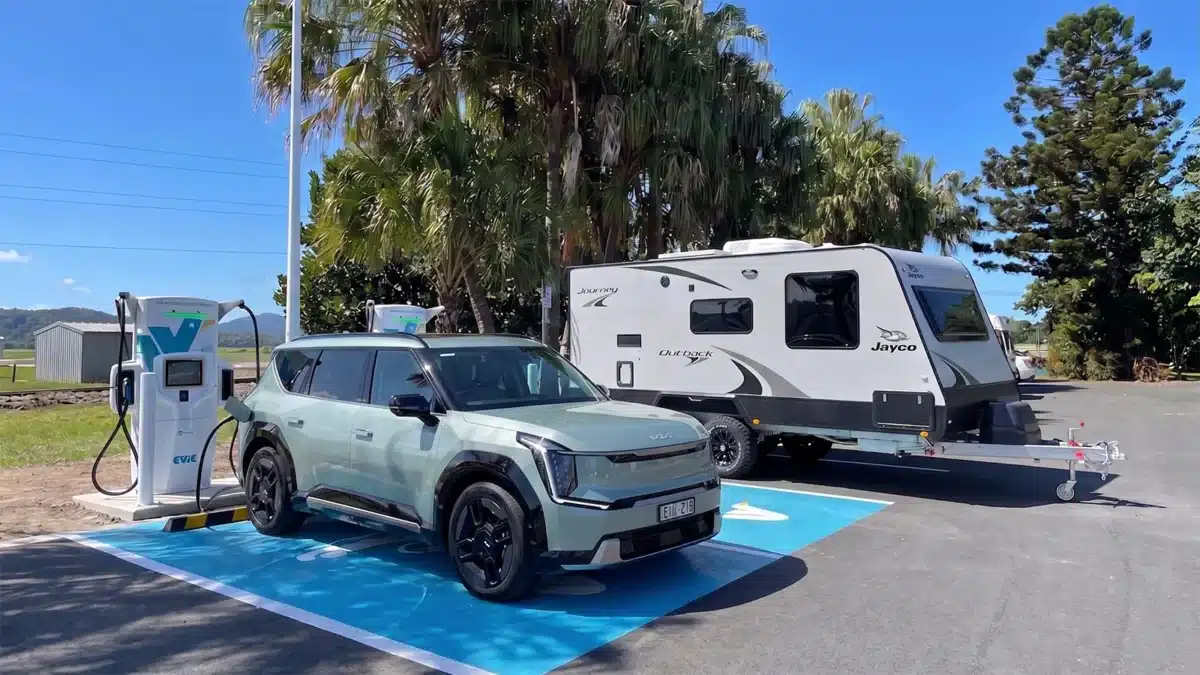
Many public EV chargers are not designed for vehicles with hitched caravans, potentially requiring unhitching for every charge, which adds significant time and inconvenience to longer trips.
Before you commit to an EV tow vehicle, you need to seriously consider the practicalities of charging on the road. This is one of the biggest differences compared to refuelling a diesel vehicle. Many public fast chargers are located in standard parking bays, not drive-through bays. This often means you’ll have to unhitch your caravan before you can charge.
Doing this once in a while might be acceptable. However, performing this manoeuvre every day on a long touring trip can quickly become tiresome. You also need to verify if caravan parks on your route allow EV charging, and if their power infrastructure can support it. Consider the charging port location on the vehicle and whether the cable will reach while hitched. Think about the gaps between towns and whether your EV’s towing range can comfortably cover them. This planning is essential for a smooth journey. Our guide on towball leverage explained also highlights how vehicle setup impacts stability, which is especially important for EVs.
Common Mistakes To Avoid When Considering An EV Tow Vehicle
Many caravanners get excited by the headline towing capacity of an EV, but overlook crucial details. Here are some common pitfalls:
- Ignoring Tow Ball Download: This is often the real limiting factor for Aussie vans. A high braked capacity means little if your van’s tow ball weight exceeds the vehicle’s limit.
- Underestimating Range Loss: Towing a caravan can halve an EV’s unladen range. Don’t rely on brochure figures; research real-world towing tests.
- Assuming Charger Accessibility: Not all charging stations are caravan-friendly. Planning your route around suitable charging infrastructure is critical.
- Overlooking Payload: EVs, especially premium ones, can have surprisingly low payloads once passengers and accessories are added. Towing a heavy van further reduces this.
- Not Confirming Towbar Type: Ensure the towbar is factory-approved or a genuinely rated aftermarket option. Some dealer-fitted options may have lower ratings.
- Forgetting Electric Brake Controllers: Not all EVs come pre-wired for a brake controller. Check if one can be fitted and if it integrates correctly with the vehicle’s systems.
- Ignoring Regional Support: While EV infrastructure is growing, regional areas still have fewer charging options and specialised EV mechanics. Consider your typical touring grounds.
Final Word
EV tow vehicles are steadily moving from novelty to genuine options for some Australian caravan owners. They offer a smooth, quiet, and often powerful towing experience, particularly for those with lighter vans, travelling shorter distances, or meticulously planning their trips around charging opportunities.
However, EV towing is not as simple as just matching a badge to a tow rating. The best approach for any buyer is to start with your caravan’s real loaded weight, its tow ball download, and your typical touring style. Then, choose the vehicle that genuinely fits those requirements. If the numbers line up, an EV can be a surprisingly capable and enjoyable tow vehicle. If the numbers are tight, it’s wise not to force it.
For now, EV towing is best suited for light to mid-weight touring. Heavy-duty caravan towing is on the horizon, but for most Australians, the smartest move is still to match the vehicle to the trip, not just the latest trend.