

Australia’s federal guide to building trailers up to 4.5 tonnes ATM, last updated on 19 August 2026, carries a line that catches out many first-time buyers: the brake rules are set by gross trailer mass, not the aggregate trailer mass on the brochure (Vehicle Standards Bulletin 1, Revision 6).
GTM is the most the van’s own tyres are rated to carry when it is fully loaded; ATM is the maximum total, including the weight on your tow ball. Both are on the van’s plate (our payload guide explains the rest), and the gap between them can put a van on either side of a line.
Where the trailer brake rules change, kilogram by kilogram
Two lines on one scale decide what brakes a van needs, and whether a controller is part of the deal.
The brake scale, by gross trailer mass (GTM)
GTM is the maximum load rated to sit on the van’s own tyres when fully loaded, printed on the plate beside ATM. The scale ends at 3,500kg; no brake rule changes there.
Up to 750kg
Brakes are not required.
Controller: not needed unless electric brakes are fitted.
Over 750kg, up to 2,000kg
An efficient service brake system, which may be fitted to just one axle. Over-run brakes are permitted.
Controller: needed if the brakes are electric, because they must be activated by a signal from the tow vehicle.
Over 2,000kg
Brakes on all wheels, plus breakaway brakes that apply immediately if the van comes unhitched and stay on for at least 15 minutes. Over-run brakes are allowed only up to 2,000kg.
Controller: part of the deal for electric brakes, which need that tow vehicle signal.
Source: Vehicle Standards Bulletin 1, Revision 6 (last updated August 2026), and ADR 38/05. The bulletin’s braking chapter is marked as under review.
WUDU calculation: the legal minimum at 2,000kg
At 2,000kg GTM the rules let a twin-axle van brake on only two of its four tyres. One kilogram over, all four must brake.
Share of the van’s own grip-limited braking that its brakes can deliver. At the legal minimum, the tow vehicle has to cover the rest.
Assumptions: GTM shared equally across four tyres (500kg each at 2,000kg), the same grip on every tyre, brakes strong enough to reach the grip limit, and no load transfer under braking. Braked tyres divided by total tyres; the result does not depend on the grip figure chosen. This compares legal minimums, not how every van is built. Thresholds from VSB1 Revision 6 and ADR 38/05, checked 16 November 2026.
If your van has electric brakes and a GTM over 750kg, it needs a controller in the tow vehicle. The bulletin says that, apart from over-run brakes, a trailer’s brakes “must be activated by a control signal generated by the tow vehicle”, and ADR 38/05 requires the braking force to be “progressively increased and decreased” by that signal. Over 2,000kg GTM, over-run brakes are no longer permitted, so every van’s brakes must be driven by a signal from the tow vehicle, which for electric brakes means a controller.
Proportional or timed: which controller type?
This comparison draws on Hayman Reese’s description of both types and REDARC’s Tow-Pro Elite manual (checked 16 November 2026).
| Proportional | Timed | |
|---|---|---|
| How it decides | Senses how hard the tow vehicle is braking and applies matching braking to the van | Applies a preset amount of braking after a delay from when you touch the pedal |
| Gentle stop vs hard stop | Brake harder and the van brakes harder | Works to the same preset amount |
| What you adjust | Gain (power output), plus boost on some units | Braking intensity and timing |
| The maker’s pitch | Smooth, synchronised stops regardless of speed or terrain | Lets the driver tune intensity and timing to preference and conditions |
Some proportional units also offer a user-controlled mode, which the REDARC manual says is often preferred for off road or precision use. Most controllers also have a manual override, which applies the van’s brakes on their own. REDARC says it suits moments such as correcting sway, though it is no substitute for the vehicle’s brakes.
What installation involves
A controller needs its own feed from the tow vehicle’s battery, protected by a fuse or circuit breaker installed “as close as possible to the battery”, according to REDARC. REDARC also rules out the cigarette lighter socket: most are rated around 10A and may not be powered all the time.
The brake signal reaches the van through pin 5 of the trailer plug, which the bulletin assigns to service brakes in both the 7-pin and 12-pin layouts. Vans up to 3,500kg ATM must use one of those two plugs. The 12-pin adds circuits including a battery supply, and the bulletin calls it preferable when auxiliary circuits are needed. Our Anderson plug guide covers the heavier charging side.
Most units are either a single box under the dash or a hidden module with only a small control head showing. Proportional units must be fixed firmly, since REDARC warns a loose mount gives “inaccurate braking force measurements”. REDARC wants a qualified auto electrician to fit it, and we would not compromise on that.
Setting the gain: a slow roll, then 35km/h stops
Gain sets the most braking the controller will send. Hayman Reese’s Compact IQ instructions call it power output and set out this test. Warm the brakes by driving about 0.4km at about 70km/h while pressing the override with the power set low. With boost off and power at its lowest, roll forward slowly and stop. Turn the power up slightly and repeat until you feel firm braking. If the van’s brakes lock up or jerk, back it off. Larger vans may need a higher boost setting and a repeat of that slow roll. Finish with several stops at about 35km/h, fine-tuning until they are smooth and firm.
The instructions say power should never be set high enough to lock the trailer’s brakes, and that settings may need changing for different loads and road conditions. Hayman Reese says to test settings before each use; REDARC says to check the brakes at low speed each time a trailer is attached. We would also rerun the full setup whenever the load or your weight distribution hitch changes.
Bottom line: if the van you are buying has electric brakes and a GTM over 750kg, budget for a controller and a professional install as part of the tow vehicle, not an accessory for later. Pick the type that suits how you tow, and redo the slow roll and 35km/h stops whenever the load changes.
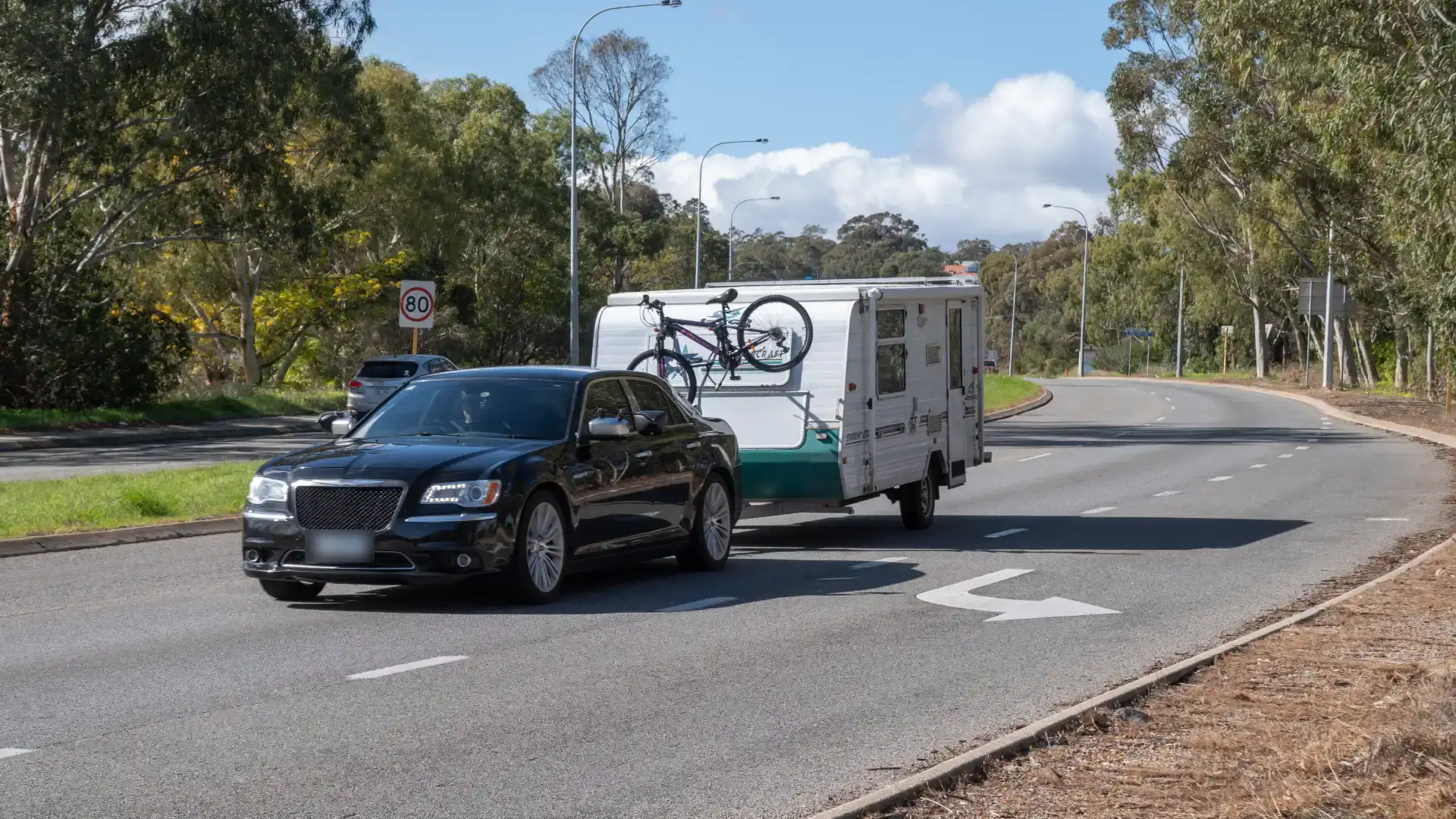
Image: Gnangarra via Wikimedia Commons (CC BY 2.5 AU), number plate blurred.