

Dometic Australia lists its 55-litre CFX5 55 at 0.87Ah an hour on 12V, measured at 32 degrees ambient with the inside at 4 degrees. The 25-litre CFX5 25, tested the same way, is listed at 0.77Ah. More than twice the space costs about 13 per cent more power.
That one comparison changes how to size a portable fridge. Litres are mostly a question of space, weight and what you eat. The power bill is set by two other things: how hot the day is, and whether part of the box is a freezer.
Buyers get the litres wrong in both directions. Too small, and you are at the shops every second day or the esky comes back out. Too big, and it rides around half empty in the space the recovery gear needed, adding kilos to a payload that was already tight. Every spec in this guide was checked on 16 November 2026.
How to use this workbook
Three passes, about five minutes.
- Find your cell. Pick the row for the number of people eating from the fridge and the column for the longest stretch you expect between shops. The cell gives a litre band.
- Tune it in the calculator. Tell it whether drinks live in the fridge and whether you need a freezer. It returns a band and an estimated daily battery draw at 25 and 32 degrees.
- Read only what applies. Each heading below answers one question buyers ask us. Then take the spec list at the end shopping.
Count days between resupply, not trip length. A three-week lap with a supermarket every four days is a four-day fridge.
The 12V Fridge Sizing Heatmap
Find your row and column, then tune it below. On Dometic Australia’s published figures, going from a 25-litre to a 55-litre fridge adds about 2.4Ah a day at 32 degrees. Running the freezer zone of its 47-litre dual-zone adds about 28Ah.
Recommended litre band, drinks kept cold
WUDU’s working: litres = people × (3L of food per day × days between resupply + 4.1L of drinks). 3L covers one person’s perishables for a day plus about 20% for baskets and gaps. 4.1L is six 375ml cans of rotating cold stock at 0.69L of fridge per can (Dometic Australia lists the 46L CFX5 45 as holding 67 cans). Bread, tins, UHT milk and root veg stay out. 4+ row: add 3L a day plus 4.1L for each extra person. Under 15L, buy the smallest fridge that fits your drinks.
Tune it: your trip
45–55L
About 50 litres by our method.
Estimated amp-hours a day as a fridge only. Set the freezer to Yes to see what it costs.
Assumptions: estimated daily draw on 12V for a compressor fridge of the litres above, interpolated from Dometic Australia’s published consumption for models in its current range, at 32°C ambient and 4°C inside (CFF18, 19L: 0.66Ah/h; CFX5 25: 0.77; CFX5 35, 36L: 0.77; CFX5 45, 46L: 0.76; CFX5 55: 0.87), × 24 hours. Above 55L, the largest single-zone CFX5, we extend the 46 to 55L trend, so big-fridge figures are rougher. Freezer: × 2.35, from Dometic’s 47L Recon CF Dual-Zone (0.86Ah/h at 4°C inside, 2.02Ah/h with the small zone at minus 15°C, 32°C ambient); on 47 to 94L sizes this lands within about 15 per cent of Dometic Australia’s published dual-zone figures (1.75 to 2.9Ah/h). 25°C: × 0.75, WUDU’s estimate from the 21 versus 28 degree gap between outside and a 4°C inside. Specs checked 16 November 2026. Real draw moves with lid opening, warm loads and ventilation. Examples of published specs, not product recommendations.
How we worked out the litres
This is WUDU's working, not an industry standard, and we have kept it simple enough to check on the back of a receipt.
Food. We allow 3 litres of fridge space per person per day. That covers a day of meat, dairy, salad, fruit and leftovers, plus a share of the condiments, with about 20 per cent added for baskets and the gaps that odd shapes leave. Bread, tins, UHT milk, potatoes and onions stay out of the fridge in our method.
Drinks. If they live in the fridge, we allow six 375ml cans per person as rotating cold stock, topped up from a dry box each day. Dometic Australia lists the 46-litre CFX5 45 as holding 67 cans, which works out to 0.69 litres of fridge per can, so six cans is about 4.1 litres a head.
Put together, the rule is people × (3 × days + 4.1). A couple restocking weekly lands at about 50 litres. A family of four on the same week needs about 100. Two people on a weekend need less than 25.
Change the inputs, not the rule, when a trip is unusual. On a tropical run where everyone drinks more cold water, count the extra drinks as one more person. Teenagers who eat like adults count as adults. A fishing trip that brings dinner home needs room for the catch, so add a day or two.
Two things the rule deliberately ignores. It does not chill a slab you could store warm, and it does not add litres for a freezer. The freezer changes the power, which is the next decision.
Single zone or dual zone?
A single-zone fridge is one compartment at one temperature. A dual-zone fridge has a divider and two controls, so one side can freeze while the other chills. The divider is not what costs you. The freezer is.
Dometic publishes both figures for the same box. Its 47-litre Recon CF Dual-Zone, sold in Australia, draws 0.86Ah an hour with the inside at 4 degrees, and 2.02Ah with the small zone at minus 15, both at 32 degrees ambient. That is more than double.
A second brand shows the same pattern. Evakool lists its 40-litre drawer fridge at 1.2Ah an hour set to 2 degrees and 2.4Ah set to minus 16, averaged over 24 hours at 32 degrees. That is the whole box set as a freezer, but the pattern is the same.
So a dual zone earns its place when frozen food stretches the gap between shops: meat for day six, ice for a long hot run, the catch from a fishing trip. On a long weekend it is often power spent for nothing. Some let you switch one side off (Evakool lists a power-saving option to turn off one side on its Down Under range), which buys the flexibility without paying for the freezer on every trip.
Compressor, 3-way absorption or thermoelectric?
There are three common ways to make cold, and Dometic, which makes all three, has published a worked comparison on 12V. Its absorption example draws about 7Ah an hour, or 168Ah a day. Its thermoelectric example draws 3.92Ah an hour, about 94Ah a day. The compressor example draws under 1Ah an hour, under 24Ah a day.
That gap is why we would only look at a compressor fridge for multi-day touring on battery power. Dometic Australia's own current portable range lists only compressor models, so the absorption and thermoelectric examples below come from its global listings. The other two types still have jobs.
| Type | Published example | Where it fits |
|---|---|---|
| Compressor | Dometic CFX5 45: 0.76Ah an hour at 32°C ambient, 4°C inside; operates from +20°C to –22°C | Multi-day trips on battery and solar, including a freezer |
| 3-way absorption | Dometic CombiCool ACX3 40G: 7.08A rated current on 12V; 302.4g of gas per 24 hours; cools up to 30°C below ambient | Silent cooling on gas at camp; 12V best kept to driving time |
| Thermoelectric | Dometic TropiCool TCX 35: 3.8A on 12V; cools up to 27°C below ambient | Day trips and the drive home, not a summer food fridge |
The thermoelectric number hides a second catch. Its cooling is relative to the air around it, so 27 degrees below a 32-degree day is 5 degrees inside, and that is the best case. Food Standards Australia New Zealand says to keep perishable food refrigerated at 5°C or colder, so on a hotter day a thermoelectric box cannot hold the line.
Absorption units are quiet (Dometic calls them "absolutely silent") and pleasant on gas under an awning. On 12V they are the thirstiest of the three, which is why we treat 12V as a driving-only mode for them.
What a 32-degree day does to your battery
Most brands quote consumption at a stated ambient temperature, and they do not all pick the same one. Dometic, myCOOLMAN and Evakool quote 32-degree figures for the models we checked. Bushman quotes its DC50-X at 0.98Ah an hour at 25 degrees. Set a 25-degree number beside a 32-degree number and the 25-degree fridge looks better than it may be.
To show both on the calculator, we scaled each 32-degree figure down using the temperature gap the fridge has to hold. With 4 degrees inside, a 32-degree day is a 28-degree gap and a 25-degree day is a 21-degree gap. Heat leaks through insulation roughly in proportion to that gap, so our 25-degree estimate is 75 per cent of the 32-degree figure. It is an estimate: lid opening, a warm load and a stuffy mounting spot all move it.
For a couple restocking weekly, that works out by our estimate to roughly 19Ah a day at 32 degrees and 15Ah at 25. Add a freezer zone and the 32-degree figure climbs to about 46Ah. Our curve uses Dometic Australia's current CFX5 and CFF figures; above 55 litres, the largest single-zone CFX5, it extends the trend, so treat big-fridge numbers as rougher.
Then read it against the battery. Dometic's guidance is that lead-acid batteries give about 50 per cent of their stated capacity, lithium iron phosphate nearly all of it. So 46Ah a day uses nearly all of the roughly 50Ah you can draw from a 100Ah lead-acid battery, while a 100Ah lithium would still have a little over half left with nothing coming back in. Our daily power budget puts the fridge alongside lights, pumps and charging, our solar guide covers how much panel puts it back, and our balanced power system guide shows how battery, solar and charger should be matched.
A cold fridge does not stay cold for long without power. In Dometic's own lab test, 24 cans in a switched-off CFX3 55 warmed at roughly 1.8 degrees an hour, starting from 3.3 degrees inside on a 21-degree day. At that rate the contents pass the 5-degree food-safety line in about an hour, and that was a mild day. Size the battery so the fridge never has to stop.
Worth knowing: Dometic's CFX5 operating manual warns that the minimum temperature in its cooling spec "may not be attained if the ambient temperature is above 32 °C", and lists an ambient range of 16°C to 43°C. A closed canopy in full summer sun is not the room the spec sheet was measured in.
Where should the fridge sit?
Ventilation first. Dometic's CFX5 manual asks for a minimum of 50mm of ventilation on all sides, and says not to use the fridge in closed compartments with little or no airflow. Bushman's owner's manual asks for sufficient air around the rear, sides and top of the compressor compartment. A fridge jammed against a seat back or boxed in by bags breathes its own hot air, and the compressor runs longer.
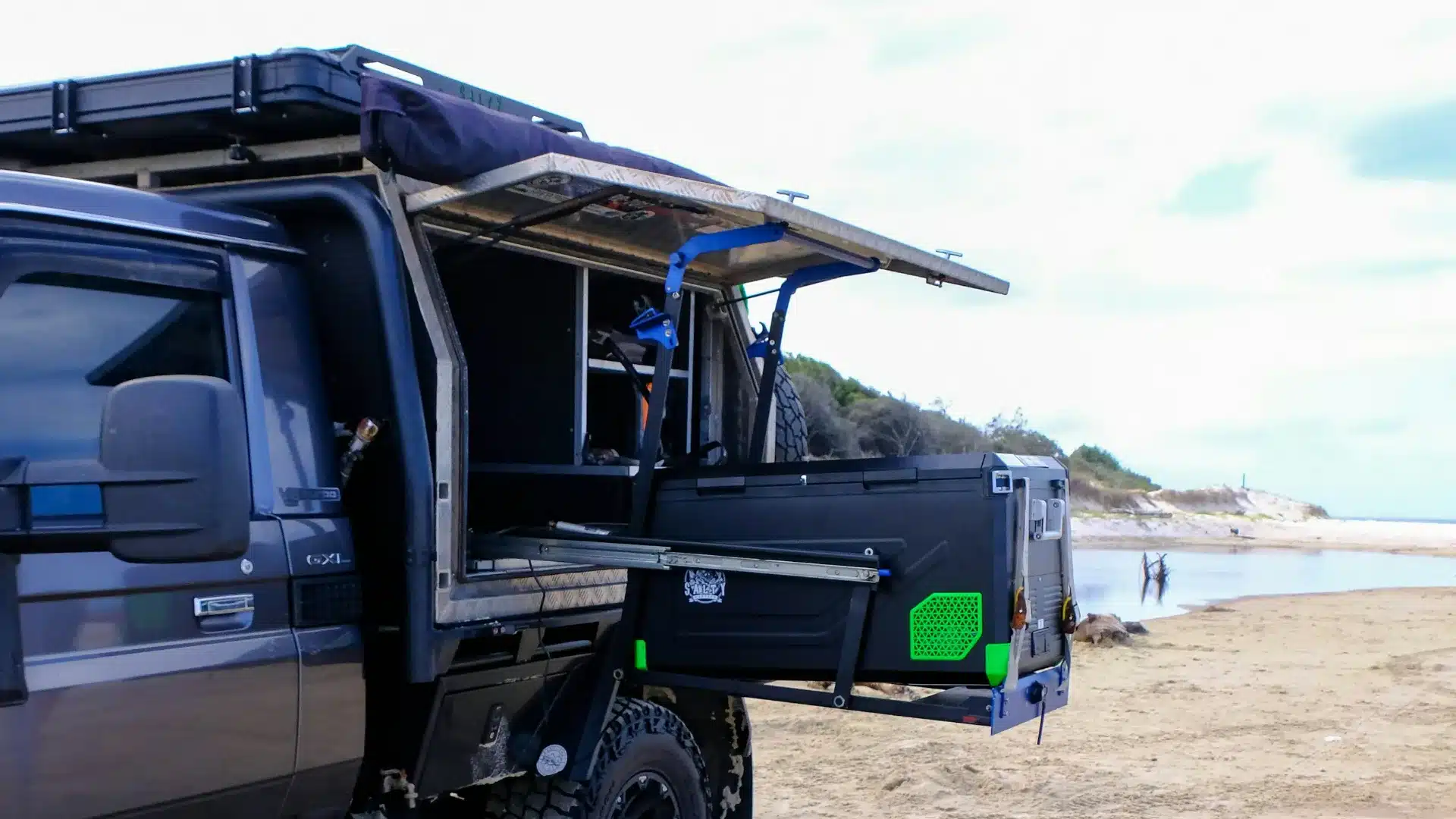
Slide. A slide brings the lid out to where you can reach it without unloading. Check its rated load against the full fridge, not the empty one, and count the slide itself as weight. Evakool rates its large heavy-duty slide at 80kg and lists the slide at 23kg. If the vehicle is tall, our look at drop-down fridge slides covers lowering the fridge as well.
Tie-down. A loaded fridge is a heavy object in the load space. Look for real anchor points on the fridge: Dometic lists M6 threaded inserts in the CFX5 base for mounting, and Bushman says its Original has four heavy-duty tie-down brackets. Then strap or bolt to points your vehicle maker or slide maker rates for the job.
Wiring. Dometic's CFX3 FAQ says not to use splitters, pigtails or extensions, because each adds voltage drop, and the fridge's battery protection works from the voltage that reaches its plug, not the voltage at the battery terminals. It recommends 12 AWG wire for DIY installs. If a fridge cuts out while the battery reads healthy, check the cable run before blaming the fridge.
In a caravan, the same rules apply to a portable fridge in a front boot. Leave air around it, and make sure that air can reach the outside.
What does a full fridge weigh?
Spec sheets quote an empty fridge. Dometic Australia lists the CFX5 45 at 18.9kg. Fill it with its 67 cans at about 0.39kg each (our estimate for a 375ml can, drink and aluminium included) and the contents weigh about 26kg. Put it on that 23kg slide and the fridge corner of the vehicle carries about 68kg.
Scale it up and it gets serious. Dometic Australia lists the 94-litre CFX5 95DZ at 29.5kg empty and says it holds 133 cans. Full of cans, that is about 52kg of contents and roughly 81kg before the slide.
A mixed food load usually packs lighter than a fridge full of cans, so treat these as the top of the range. All of it counts against your vehicle's payload, or the caravan's if the fridge rides in the van. Our weight audit shows where to weigh it, and our payload guide explains tare, ATM and the legal limits the fridge sits under.
If we were buying one tomorrow
We would not start with a brand. We would start with this list and let it rule models in and out.
- Litres from the workbook. If you land on the edge of two bands, take the bigger one, not the one after that.
- Compressor cooling with a published consumption figure at a stated ambient temperature, ideally 32 degrees. No stated temperature, no fair comparison.
- Dual zone only if the plan needs frozen food, and only with a zone you can switch off.
- A daily draw your battery can carry on a 32-degree day using no more than about a third of its usable capacity, so two cloudy days do not end the trip.
- An ambient rating to at least 43 degrees and battery protection you can set to suit a starter or an auxiliary battery.
- Ventilation you can actually keep clear in your mounting spot, 50mm on every side.
- Proper anchor points and a slide rated above the full weight.
- A full weight (fridge, contents and slide) that your payload absorbs with room left over.
A fridge bought to that list may be bigger or smaller than the one your neighbour at camp swears by. That is the point: it is sized to how you eat, how often you shop and how much battery and payload you have, not to a number on someone else's lid.
Images: Iszac Bale and snap wander on Unsplash.


