
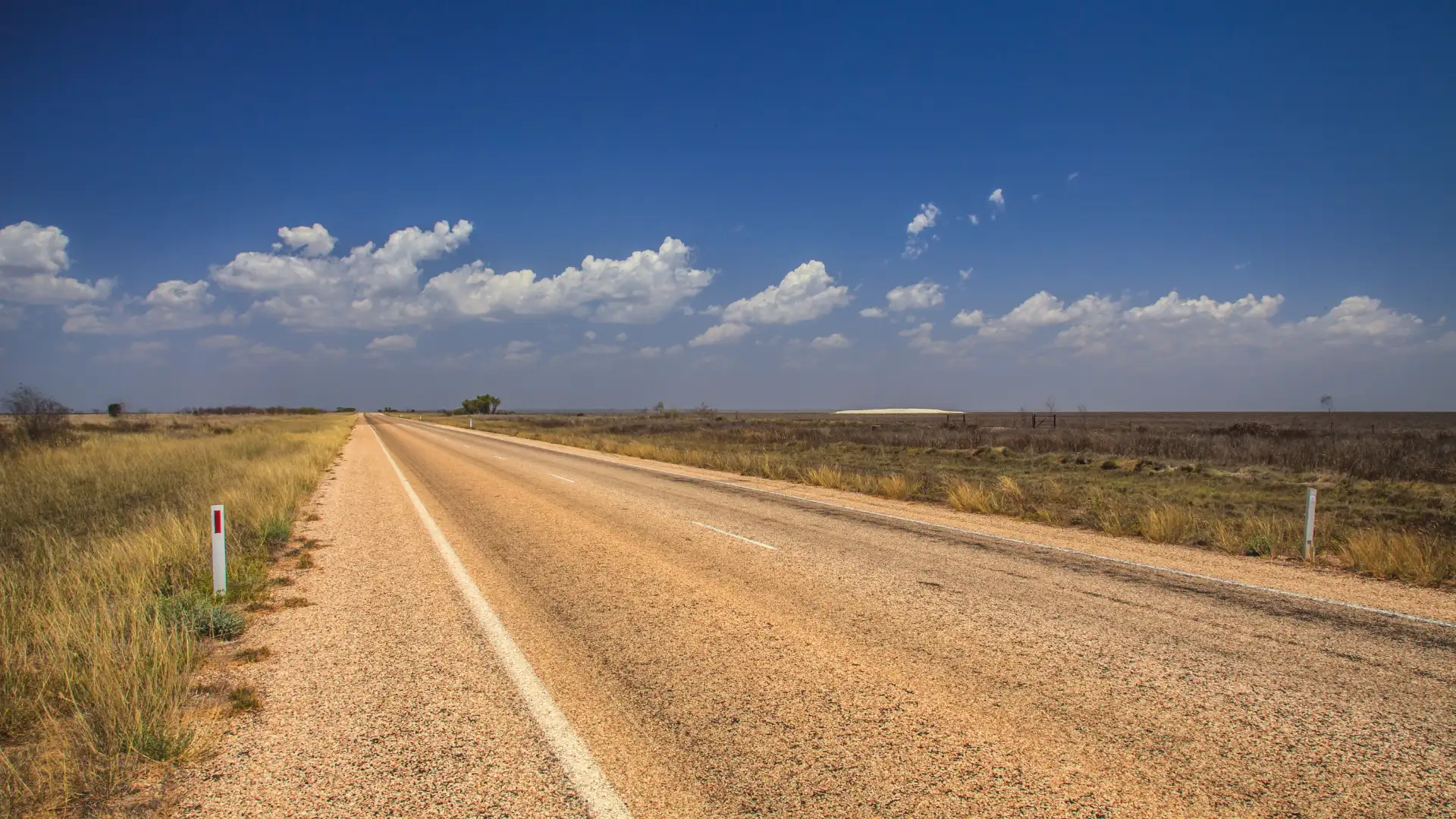

Perth to Broome is about 2,344km by the coast, on Brand Highway and the North West Coastal Highway, or about 2,227km inland on the Great Northern Highway. At a steady 400km a towing day, either way is six driving days before you stop to see anything. The figure that shapes the trip is smaller: 286km, the longest run without diesel, from Sandfire Roadhouse to Roebuck Plains.
We measured every leg on Main Roads WA road network data and checked every diesel stop against FuelWatch, which every fuel retailer in the state has had to report to since 1 May 2026. Then we set the gaps against the tanks of five common tow vehicles. On the thirstiest published towing figure, the two smallest tanks reach the end of the longest gap with their reserve already dipped into, or right on its edge.
| Leg | km | Longest gap between diesel |
|---|---|---|
| Perth to Geraldton | 416 | 79km, Eneabba to Dongara |
| Geraldton to Carnarvon | 475 | 180km, Northampton to Billabong |
| Carnarvon to Karratha | 619 | 259km, Nanutarra to Karratha |
| Karratha to Port Hedland | 201 | 187km, Roebourne to South Hedland |
| Port Hedland to Broome | 633 | 286km, Sandfire to Roebuck Plains |
| Coastal total | 2,344 | |
| Inland total | 2,227 | 286km, the same Sandfire stretch |
Distances run from the Perth CBD to Chinatown in Broome. The highway sections are Main Roads WA’s own measured distances; the short city sections at each end are approximate, from a route planner. Gaps are road distances between diesel sites listed on FuelWatch on 27 October 2026.
Perth to Geraldton
The easy day. From the CBD it is about 50km through the northern suburbs to the start of Brand Highway near Muchea, then 366km of highway to Geraldton: 416km in all.
Fuel is never far away on this leg. FuelWatch lists diesel at roadhouses all the way up, from Gingin and Regans Ford to Cataby, Badgingarra, Eneabba and Dongara, and the longest run between any two of them is 79km, from Eneabba Roadhouse to Dongara. Eneabba’s listed hours are 7am to 7pm, which is only worth knowing if you leave Perth late.
The catch is somewhere to stop. Main Roads WA’s rest area data shows no 24-hour stopping places on Brand Highway, so plan the first night in a town. Dongara, about 350km from the CBD, and Geraldton, where FuelWatch lists several diesel sites as open 24 hours, are the obvious choices. Either way, fill up before you leave Geraldton or at Northampton the next morning. The first real gap is next.
Geraldton to Carnarvon
The North West Coastal Highway starts in Geraldton and covers 475km to Carnarvon on this leg. Northampton is about 50km up the road, with one FuelWatch site listed as open 24 hours and another open 6am to 7pm.
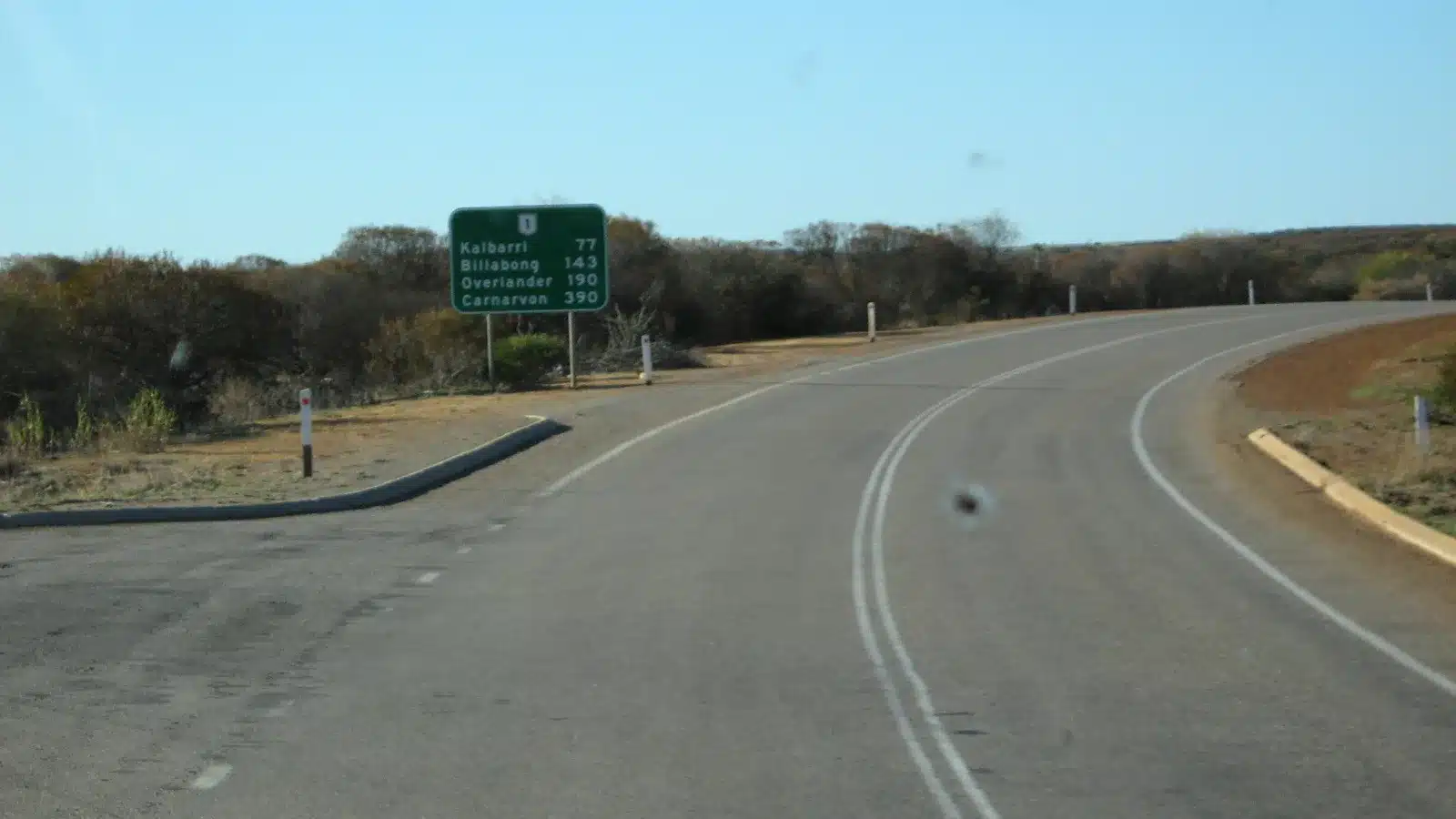
Then the country opens up. From Northampton it is 180km to the next diesel at Billabong Roadhouse, whose listed hours are 6am to 8.30pm. Overlander Roadhouse comes 47km later, with no hours listed on FuelWatch, then Wooramel Roadhouse 76km after that (6.30am to 6pm) and Carnarvon 117km on. None of those gaps is a problem for a full tank. The point of this leg is to arrive at each one with enough to reach the next without counting.
For a night on the road, Main Roads lists 24-hour rest areas with toilets and a dump point at two places on this leg. Galena, about 113km north of Geraldton, has two, listed as Galena North and Galena South. Nerren Nerren is about 187km north of Geraldton and 45km short of Billabong, which makes it a good place to stop if the afternoon is getting away from you.
Carnarvon to Karratha
The longest leg on the coast road before Broome, at 619km, and the one with two of the three biggest gaps. Fill in Carnarvon, where FuelWatch lists several sites as open 24 hours.
Minilya Bridge Roadhouse is 133km north, and the Exmouth turn-off another 7.4km past it. If you are detouring to Ningaloo, Exmouth is 212km up the Minilya Exmouth Road, so treat it as a trip of its own rather than a side step.
Back on the highway, it is 227km from Minilya to Nanutarra Roadhouse, then 259km from Nanutarra to the Karratha roadhouse at Stove Hill. FuelWatch lists Minilya and Nanutarra as open 24 hours; the Karratha roadhouse’s listed hours are 4am to 10pm.
One trap: Main Roads still lists a private roadhouse stopping place at Fortescue, about 163km north of Nanutarra. No diesel retailer there appears on FuelWatch. Since every retailer in WA now has to report, treat Nanutarra to Karratha as the full 259km.
Overnight options are good here. Main Roads lists 24-hour rest areas with toilets and a dump point at Lyndon River, about 182km north of Carnarvon; Yannarie River, about 289km north and 71km short of Nanutarra; and Robe River, 119km past Nanutarra. Nanutarra Roadhouse is itself listed as a 24-hour stopping place. Splitting the leg there gives a 360km day and a 259km day, with a full tank for the long one.
Karratha to Port Hedland
The short one: 201km from the Karratha roadhouse to where the North West Coastal Highway meets the Great Northern Highway outside Port Hedland. It is the leg to pair with a rest day, because the next one is the biggest of the trip.
Roebourne’s BP is 40km along, with listed hours of 5am to 7pm. After that, FuelWatch lists no diesel until the cluster of service stations around South Hedland and Wedgefield, 187km from Roebourne to the first of them. Several there, and the Refuel site on the Great Northern Highway at Port Hedland, are listed as open 24 hours.
Main Roads lists no 24-hour rest area on this stretch. Peawah West, about 151km past Karratha, has toilets and a dump point but is not a 24-hour stop, so plan to sleep in Karratha, Roebourne or Port Hedland.
Port Hedland to Broome: the 600km Eighty Mile stretch
From the highway junction it is 599km on the Great Northern Highway to the Broome turn-off at Roebuck, and about 34km more into town: 633km, the longest leg of the trip. The coastal and inland routes share every kilometre of it.
Fuel up in Port Hedland. Pardoo, 174km from the junction, is listed as open 24 hours. Sandfire Roadhouse, 313km from the junction and listed on FuelWatch under Eighty Mile Beach, opens 7am to 7pm. Then comes the 286km run to Roebuck Plains Roadhouse, about 34km short of Broome, with no diesel on the highway in between. FuelWatch does list two off-highway sites: Bidyadanga Store, about 10km from the highway in a straight line (8am to 4.30pm Monday to Thursday, shorter hours Friday and Saturday, closed Sunday), and Port Smith Caravan Park, about 19km off in a straight line (8am to 5pm). Both are side-road detours with limited hours, so check before you count on either.
Sandfire’s hours are the catch. Arrive after 7pm and you either wait for morning or start the longest gap of the trip on whatever is left from Pardoo, 139km back. Roebuck Plains has no hours listed on FuelWatch, so do not plan to arrive there on fumes late at night either.
Main Roads lists Pardoo and Sandfire roadhouses as 24-hour stopping places, and two 24-hour rest areas with toilets and a dump point between Sandfire and Roebuck: Stanley, about 107km past Sandfire, and Goldwire, about 166km past it and 120km short of the Broome turn-off. If Broome is the start of a Kimberley run rather than the end, our Kimberley and Top End holiday parks guide picks up from here.
Will your tank cover the gaps?
Towing fuel use is the number nobody can give you exactly, so we went to published tow tests with heavy vans behind. With 2,800kg to 3,000kg caravans, results ranged from 16.3L/100km for a 2025 Prado towing a 3,000kg off-road van (caravancampingsales.com.au, 4 July 2025) and 19.1L/100km for a LandCruiser 300 GX towing 2,800kg (caravancampingsales.com.au, 9 December 2021), up to 18.1 to 22.4L/100km across six dual-cab utes towing 2,800kg in a 4X4 Australia comparison published on 23 March 2017.
As a stress test, we applied the thirstiest of those, 22.4L/100km (the HiLux SR5 in the 2017 test), to every vehicle, and kept a fifth of the tank in reserve for headwinds, a detour or a bowser that is shut when you arrive. Tank sizes are from each manufacturer’s current Australian spec sheet.
| Tow vehicle | Tank | Safe range at 22.4L/100km |
|---|---|---|
| Isuzu D-MAX | 76L | 271.4km |
| Ford Ranger (diesel) | 80L | 285.7km |
| Toyota Prado 250 | 110L | 392.9km |
| Toyota LandCruiser 300 (diesel) | 110L | 392.9km |
| Toyota LandCruiser 70 | 130L | 464.3km |
On that stress test, the Sandfire to Roebuck Plains run takes about 64 litres. That is 84 per cent of a D-MAX’s tank, which leaves it short of the gap with a full reserve, and 80 per cent of a Ranger’s, which puts it right on the line: a 285.7km safe range against a gap of about 286km, a difference of a few hundred metres. The Prado and LandCruiser 300 use 58 per cent of theirs, and the 70 Series 49 per cent.
Use each ute’s own tested figure and the picture improves, but the margin is still thin. In the same 2017 test the D-MAX averaged 19.0L/100km and the Ranger 20.6L/100km, both earlier generations than today’s. On those numbers the safe ranges are 320.0km and 310.7km, so both clear the gap with the reserve intact, but with only about 34km and 25km to spare. Nanutarra to Karratha, at 259km, also sits within 15 per cent of both vehicles’ stress-test range.
None of this rules out a D-MAX or a Ranger. The point is the reserve: on two days of this trip, a small tank’s spare fifth is the only margin you have, and thin margins need a plan: fill at every listed stop on those legs, carry diesel in an approved container or fit a long-range tank, and know your own consumption rather than the brochure’s. Our guide to saving fuel while towing covers the habits that move it.
Watch out: a tow test is one van, one route and one day. A heavier van, a headwind, a hot afternoon with the air conditioning running or a roof-top load can all push your use above the published range. Do a full-tank run on the highway before you leave Perth, then put your own number in the calculator below.
286km of highway without diesel
Every fuel-to-fuel gap on the coast road from Perth to Broome, measured against what a tank of diesel really does with a caravan on the back.
Coastal route, diesel stop to diesel stop
Perth
Longest hop on Brand Highway shownGeraldton
Several sites open 24 hoursNorthampton
One site open 24 hoursBillabong Roadhouse
6am to 8.30pmOverlander Roadhouse
No hours listedWooramel Roadhouse
6.30am to 6pmCarnarvon
Several sites open 24 hoursMinilya Bridge Roadhouse
Open 24 hours; Exmouth turn-off 7.4km onNanutarra Roadhouse
Open 24 hoursKarratha Roadhouse
4am to 10pmRoebourne
5am to 7pmSouth Hedland and Port Hedland
Several sites open 24 hoursPardoo
Open 24 hoursSandfire Roadhouse
7am to 7pmRoebuck Plains Roadhouse
No hours listed, 34km from BroomeBroome
Check your rig
285.7km safe range
Sandfire Roadhouse to Roebuck Plains Roadhouse (286km) sits right on that line, so the reserve is your only margin. 1 tight gap (within 15% of your range): Nanutarra Roadhouse to Karratha Roadhouse (259km).
Assumptions: safe range = tank litres x 0.8 / towing use x 100, so a fifth of the tank stays in reserve for headwinds, detours and a closed bowser. The default 22.4L/100km is a stress test: the thirstiest result in the published tow tests we found with 2,800kg to 3,000kg caravans (a 2017 HiLux; range 16.3 to 22.4). In the same 2017 test the D-MAX used 19.0 and the Ranger 20.6. A gap within 1km of your range counts as on the line. Gaps are road distances between diesel sites listed on FuelWatch on 27 October 2026, measured on Main Roads WA road network data; the Perth to Geraldton bar shows the longest single hop on Brand Highway. Off-highway diesel at Bidyadanga and Port Smith, about 10km and 19km off the Sandfire to Roebuck Plains stretch in a straight line with limited hours, is not counted. Tank sizes are from Ford, Isuzu and Toyota Australia spec sheets. Opening hours are FuelWatch listings and can change: check before each leg.
The inland alternative: Great Northern Highway
The inland route leaves Perth’s north-east on the Great Northern Highway and runs through Mount Magnet, Meekatharra and Newman before meeting the coast road near Port Hedland. It is 2,227km to Broome, 117km shorter than the coast.
The gaps come earlier and there are more of them. FuelWatch-listed diesel runs out for 256km between Meekatharra and Kumarina, 190km between Newman and Auski Roadhouse, and 246km from Auski to South Hedland. Further south, Wubin to Paynes Find is 154km and Paynes Find to Mount Magnet 145km. Kumarina is listed as open 24 hours; Auski’s listed hours are 5am to 9pm. Then the Sandfire stretch is the same as on the coast.
What you get for it is Karijini. Australia’s North West, the regional tourism body, lists Auski as the stop north-east of Karijini National Park. What you give up is the coast: Shark Bay, Ningaloo and the Pilbara coast around Karratha. If you are driving back to Perth as well, taking one route each way means you only drive each road once.
Inland is also more remote between towns, which raises the stakes on a blown tyre. Our lessons from six tyre failures on one outback lap are worth ten minutes before you choose.
When to go
Go in the dry. Bureau of Meteorology averages for Broome Airport show 200mm of rain in January, 180mm in February and 99mm in March, against less than 20mm in each month from June to October. The Bureau’s official tropical cyclone season runs from 1 November to 30 April.
Heat is the other reason. Port Hedland‘s mean maximum is 36.8°C in December and in March, against 27.4°C in July. Broome’s July mean maximum is 29.0°C.
That points to a window of roughly May to September. If your dates are fixed, book Broome before you book anything else on the way up.
Road trains and WA’s 100km/h towing limit
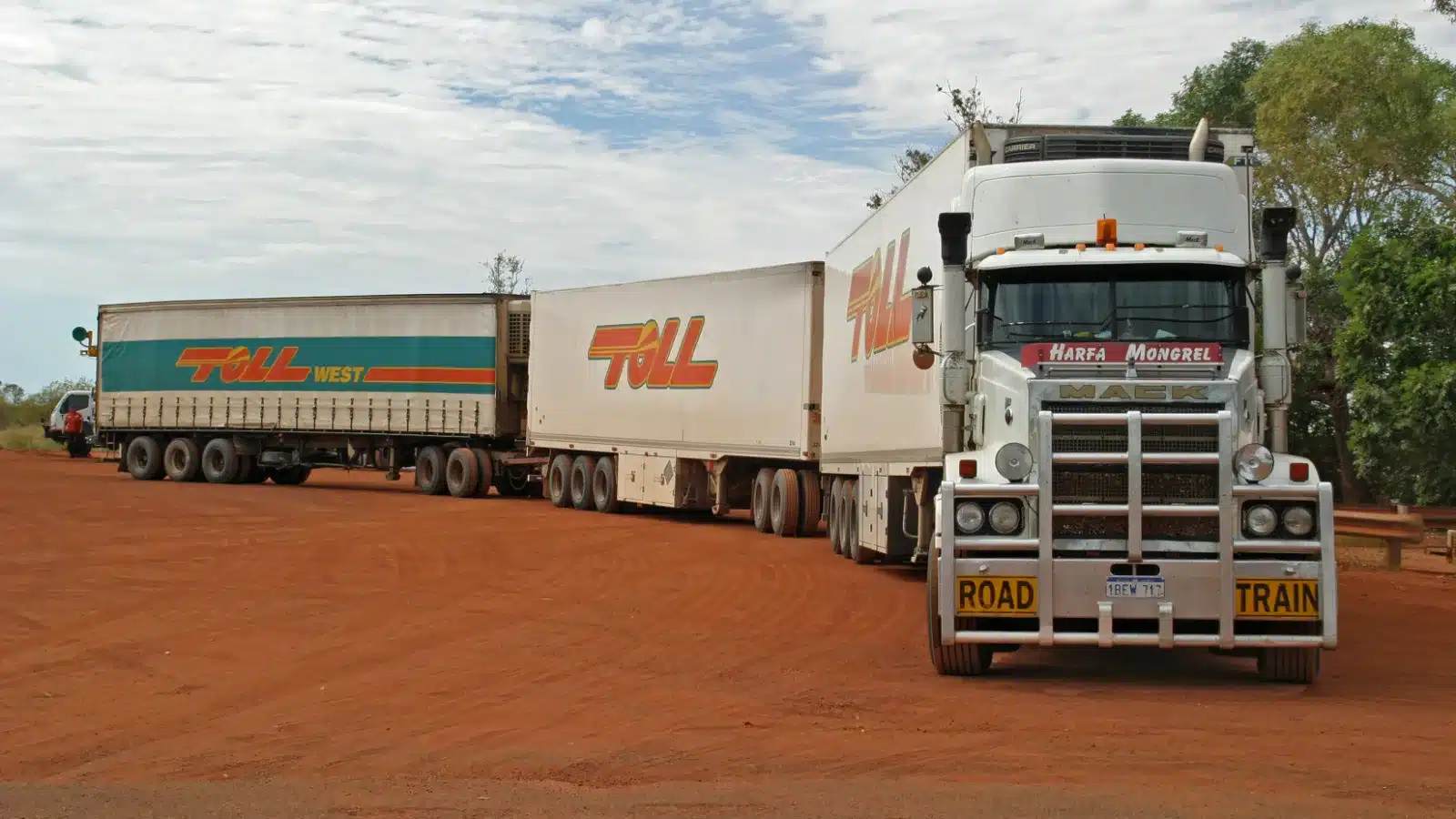
In Western Australia the maximum legal speed for any vehicle towing a trailer or caravan is 100km/h, even where the sign says 110km/h. It is a maximum, so a lower posted limit still applies. The Road Safety Commission states it plainly on its towing page, and it applies on every leg of this trip. That matters here: Main Roads data shows 96 per cent of Brand Highway and the North West Coastal Highway signed at 110km/h, so for most of the drive the sign is not your limit. Other states do it differently; our towing speed limits explainer has the details.
At a constant 100km/h the coastal route is 23.4 hours of driving, and the inland route 22.3. Real averages are lower once you add towns, roadworks and stops, which is why 400km is a sensible towing day rather than a lazy one.
The same page covers sharing the road. Vehicles towing a caravan must stay at least 60m behind heavy vehicles or other towing vehicles unless overtaking, and “drivers of road trains or B-doubles must maintain a following distance of at least 200m, unless overtaking”. If you are holding up traffic, the Commission’s advice is to pull over and stop when it is safe. It also describes a UHF radio as a valuable safety tool, particularly in regional areas where you may need to pass road trains.
In practice, talk to the driver before you overtake or when you are ready to let them by, wait for a long, clear straight, and only pull off the bitumen where the shoulder is firm enough to take the van.
Before you leave Perth
- Get FuelWatch on your phone. Every WA retailer reports to it, along with supply outages, so it is the best single list of open bowsers on the day.
- Know your real towing figure. Run a full tank on the highway with the van loaded, then use that number, not the brochure’s, in the calculator.
- Mark the three long gaps. Sandfire to Roebuck Plains (286km), Nanutarra to Karratha (259km) and Minilya to Nanutarra (227km). Fill at the start of each, every time.
- Plan the Sandfire day. Reach it before 7pm, or stop there for the night and fill in the morning.
- Carry a margin if your range is under 300km. Diesel in an approved container, or a long-range tank, turns a tight day into a normal one.
- Check your weights before the long haul. Our payload guide and our list of tow vehicles that can legally tow 3.5t fully loaded cover the numbers that matter.
- Set tyre pressures for hot, long highway days. Our touring tyre pressures guide explains how.
- Fit a UHF radio and set the cruise control no higher than 100km/h.
- Leave a plan with someone. Tell them each night’s stop. Our remote touring guide has the rest of the safety kit.
The coast road to Broome is not difficult. It is long, and on two days it asks a lot of a small tank. Know your number before Geraldton, and Sandfire is just another fuel stop.
Images via Wikimedia Commons: Murray Foubister (CC BY-SA 2.0), Steven Nairn (CC BY-SA 3.0), W. Bulach (CC BY-SA 4.0) and Josh Janssen (CC BY 3.0).


