

Ask ten caravanners what the towing speed limit is in Australia and you will get ten answers. They are all partly right, which is exactly the problem.
There is no national towing speed limit. What there is instead is a posted limit, a state towing rule that exists in only one state, and a figure buried in your owner’s manual that most people have never read. On one stretch of road all three can apply at once, and the lowest of them is the one that counts.
There is no national towing speed limit
In New South Wales, Victoria, Queensland, South Australia, Tasmania, the Northern Territory and the ACT, a car towing a caravan travels at the posted limit, the same as any other vehicle. There is no separate towing figure to remember. The NRMA sets this out state by state, and the common thread is that the sign is the rule.
Here is how it sits in every state and territory in 2026.
| State | Towing limit | Highest sign, and what to know |
|---|---|---|
| NSW | Posted limit | 110km/h. Vehicles over 4.5t GVM capped at 100km/h |
| VIC | Posted limit | 110km/h |
| QLD | Posted limit | 110km/h |
| SA | Posted limit | 110km/h |
| WA | 100km/h | 110km/h, but the towing cap applies at any weight |
| TAS | Posted limit | 110km/h, for combinations under 12t. Unsealed roads generally 80km/h |
| NT | Posted limit | 130km/h on much of the Stuart, Barkly, Arnhem and Victoria highways |
| ACT | Posted limit | 100km/h |
Two qualifications matter. A vehicle with a gross vehicle mass over 4.5 tonnes is capped at 100km/h in New South Wales regardless of what the sign says, which catches some larger motorhomes and heavily upgraded utes. And in Tasmania the posted-limit rule applies to combinations under 12 tonnes, with unsealed roads generally signed at 80.
Western Australia is the exception
Western Australia is the only state with a blanket towing cap. The Road Safety Commission puts it in one line: “The maximum legal speed limit for any vehicle towing a trailer or caravan is 100km/h.” No weight threshold, no road type exemption.
That means on a WA highway posted at 110 you are legally required to sit at 100, and the car overtaking you without a van is doing nothing wrong. On the Perth to Broome run of roughly 2,240km, obeying it costs you about two hours against a driver doing 110 the whole way.
The Northern Territory posts 130
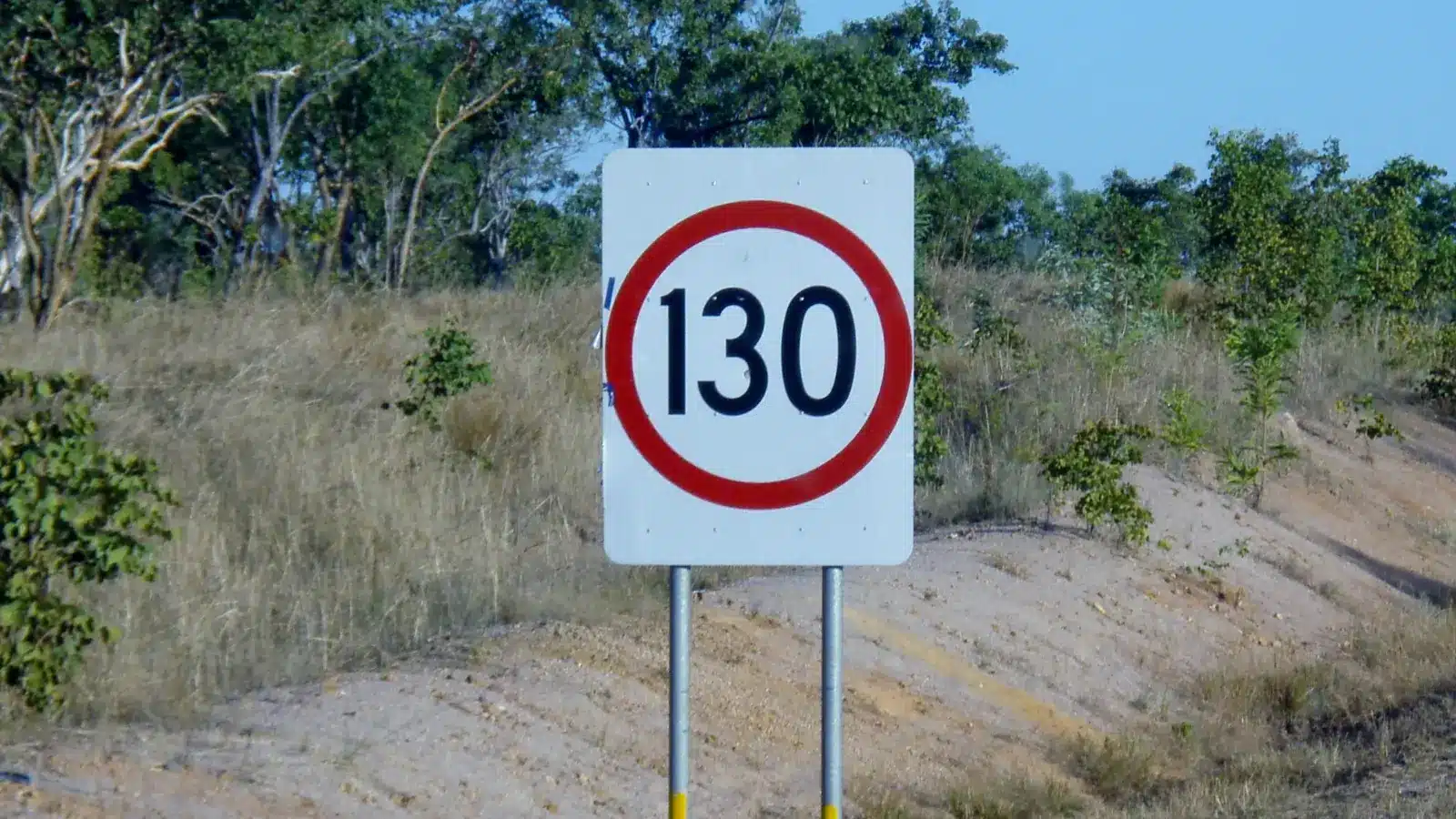
At the other end, much of the Stuart, Barkly, Arnhem and Victoria highways is zoned at 130km/h, restored in November 2016 after the open-limit trial ended. The Territory has no towing cap, so the posted limit applies to you with a van on the back exactly as it does to a sedan.
Legally, then, you may tow at 130 in the Northern Territory. Whether you should is a different question, and it is the point at which the third number enters.
Three speed limits apply to your caravan. Only one is on the sign.
The posted limit, the state towing cap and the figure in your owner’s manual are three different numbers, and the lowest one is the one that counts.
The numbers that actually bind you
The only state with a blanket towing speed limit, at any weight, on any road.
Lower than postedNorthern Territory, on much of the Stuart, Barkly, Arnhem and Victoria highways.
No towing capAustralia’s most popular tow vehicle sets its own maximum, below the posted limit in six states.
Check your manualBetween an NT 130 zone and a Subaru owner’s manual limit of 80. Both apply at once.
Same stretch of roadWhat ten kilometres an hour is worth
Against driving the same distance at 100km/h.
About 64L of extra diesel, or $128 across the trip.
Assumptions: 20L/100km while towing, and a 10 per cent rise in consumption at 110km/h versus 100km/h, since aerodynamic drag scales with the square of speed. Your own figures will differ with van height, headwind and terrain. Time figures are pure arithmetic.
Which limit wins, and who enforces it
The number in your owner’s manual
Vehicle manufacturers set their own towing speed limits, and they are frequently lower than any road rule. According to the RAC, the Ford Ranger, Everest and F-150 carry a maximum recommended towing speed of 100km/h. Subaru has specified 80km/h for the Outback and Forester, with the manual warning that exceeding it “could cause loss of vehicle stability”. The 150-Series Prado nominates the lower of the posted limit or 100. Most current Toyotas, including the 200-Series LandCruiser and the 250-Series Prado, specify none at all.
The Ranger figure is the one that affects the most people, because it is the country’s most popular tow vehicle. In six states and territories it sets a limit below the posted sign.
Worth knowing: a manufacturer limit is not a road rule. Police will not book you for exceeding it, because it is a condition of the vehicle rather than a traffic law. Whether going past it affects a warranty claim or an insurance claim depends on your specific policy wording and the circumstances of the incident, so read both documents rather than relying on forum advice. This is general information and not legal advice.
What ten kilometres an hour is actually worth
The argument for pushing on is always time. It is worth putting a number on it, because the number is smaller than most people assume.
Over a 3,200km leg, driving at 110 rather than 100 saves two hours and fifty-five minutes. That is real. But aerodynamic drag rises with the square of speed, so the same leg burns roughly 64 litres more diesel, about $128 at $2.00 a litre. You are buying back an hour of your holiday for about $44.
Scale that to a normal touring day and the case thins out further. On a 300km day, the difference between 100 and 110 is sixteen minutes. On a 400km day it is twenty-two. That is roughly one coffee stop, bought with extra fuel, extra tyre heat and a longer stopping distance behind a loaded van.
What we do
Find your manufacturer figure first. It is in the towing section of the owner’s manual, not the glovebox quick-reference card, and it takes about two minutes. That number, or the posted limit, whichever is lower, is your working maximum for the whole trip.
Treat Western Australia as 100 and stop thinking about it. Do not chase the Territory’s 130 with a van on the back: tyre speed ratings, sway behaviour and stopping distance all move against you well before you get there, and our guide to tyre pressures for touring covers why. If you are new to loading a van, start with our payload guide and the piece on how towball weight affects stability.
The WUDU takeaway
The speed limit question feels like a legal one, and it mostly is not. In seven of eight states and territories the law simply points at the sign. The number that should actually govern your trip is the one your vehicle manufacturer set, and almost nobody has looked it up.
Go and read it tonight. Then drive to whichever figure is lowest, and accept that it costs you about sixteen minutes a day. That is a cheap price for being both legal and inside the envelope your vehicle was engineered for.
Images: Bahnfrend (hero, Nullarbor signs, Eucla), CC BY-SA 4.0 and 3.0; Cuddy Wifter (NT 130 sign), CC BY-SA 3.0; Kerry Raymond (Barkly Highway border signs), CC BY 4.0. All via Wikimedia Commons, cropped and resized.