
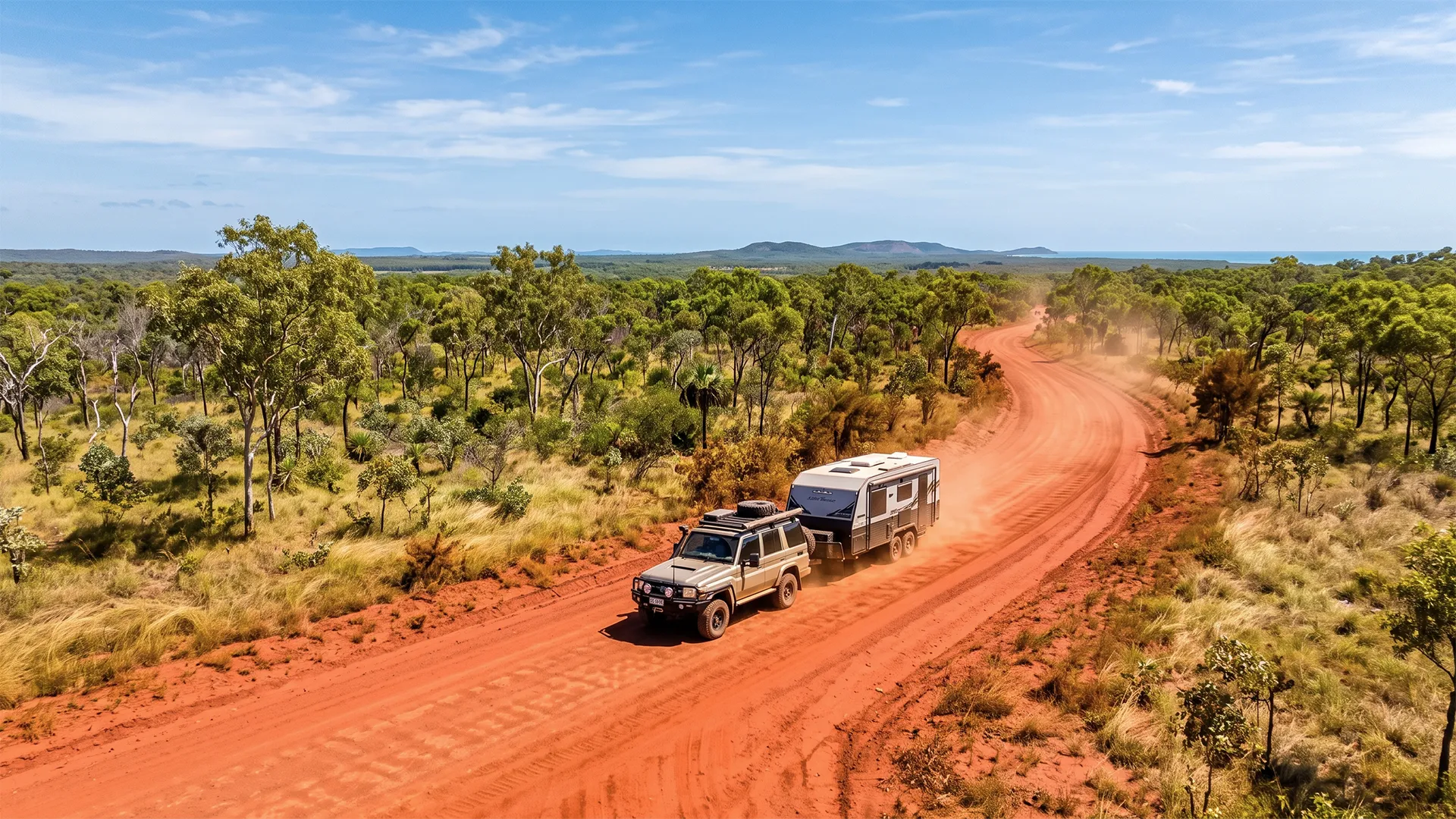

If Cape York has been sitting on your list for a few years, the next ten weeks are the best shot you will get in 2026. After that, the heat builds, the bulldust deepens, and the window starts closing again.
But there is a version of this trip that ends with a cracked A-frame and a very expensive tow, and a version that ends with a photo at the Tip. The difference is almost always planning, not gear, and the fundamentals in our remote caravan touring guide apply to every kilometre of it. Here is what is actually open right now, what it costs in 2026, and the honest answer on whether you can take your van.
Why August to October is the sweet spot
Cape York runs on two seasons, and the local shorthand is blunt: the mud and the dust. The Peninsula is generally accessible by road from around May through to October, with the wet season from November to April closing much of it entirely.
Early season has its own risks. May and even early June can still be greasy underfoot, with the Peninsula Developmental Road prone to closures while the country dries out. Water levels in the crossings are also less predictable.
By contrast, the middle and back half of the dry season is far more settled. Daytime temperatures generally sit in the high twenties to mid thirties, nights are comfortable rather than cold, and the major crossings have found their level. Traffic has also thinned from the July school holiday peak.
The trade-off arrives late. From around late September the heat climbs and the corrugations turn to powdery bulldust that punishes air filters, wheel bearings and patience. Some locals will tell you the road smooths out in October once the traffic drops, which is true, and also true that you will be doing it in the heat.
What is actually open in 2026, and what is not
This is the part most planning guides skip, because it changes every year. As of this month, here is the picture across the far north.
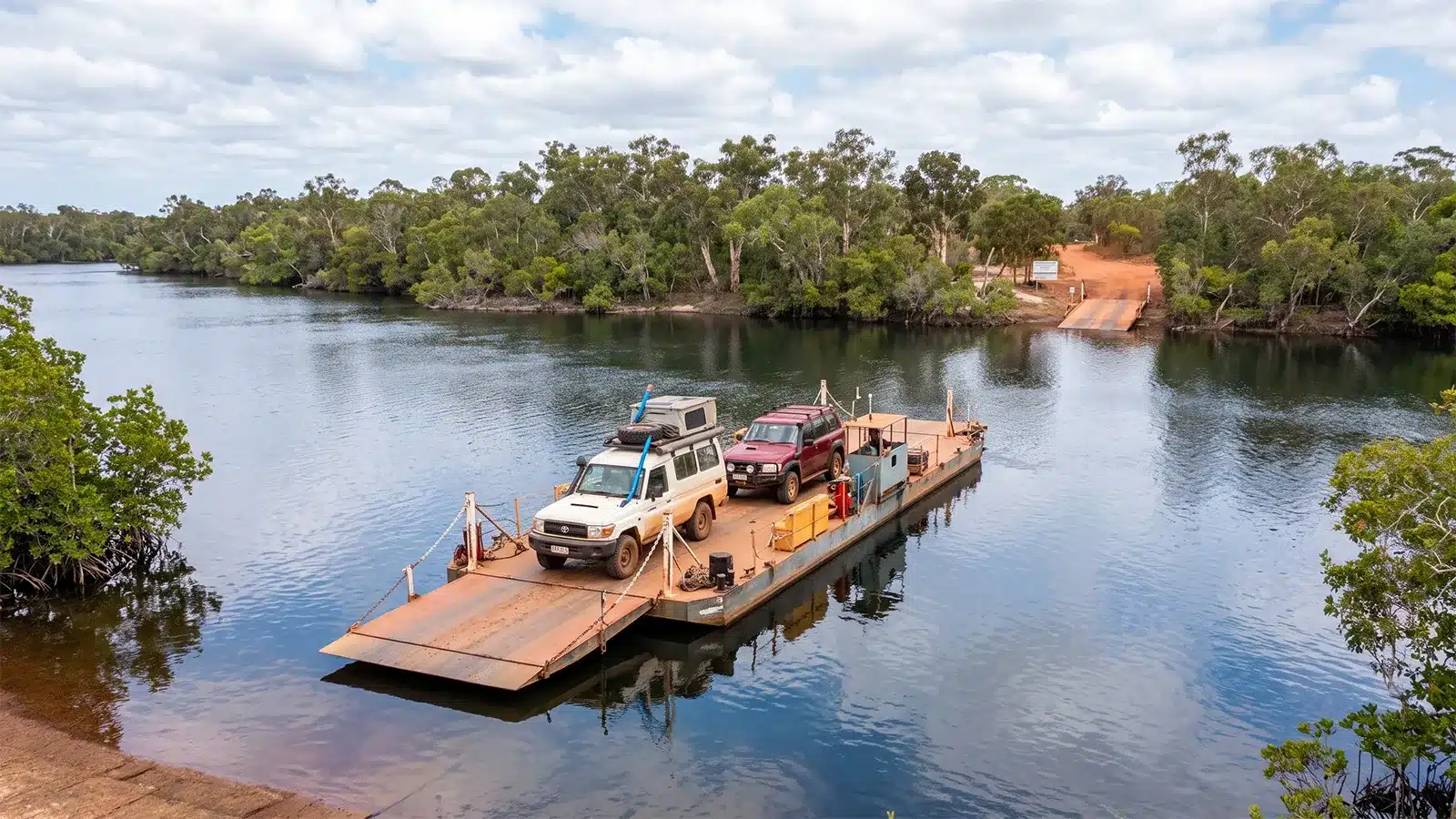
The Jardine River Ferry is running its tourism season hours of 7am to 6pm daily from 1 May to 31 October 2026. Northern Peninsula Area Regional Council asks all vehicles to arrive by 4pm to be sure of a crossing, and the crew may take a break between noon and 1pm. Delays through the peak months are normal, so build slack into the day rather than racing the clock.
One important change catches people out. Fuel is not currently available at the ferry service station. The next fuel north is roughly 50km away at Injinoo, Seisia or Bamaga, which means the practical run from Bramwell Junction to Bamaga is around 210km with nothing in between.
In the national park, the old Jardine River National Park is now managed as Apudthama National Park (CYPAL). Several alerts are live for this season. Captain Billy Landing camping area is closed from 18 to 28 September 2026, site 4 at Ussher Point remains closed through to June 2027, and the track into Ussher Point is flagged as severely eroded.
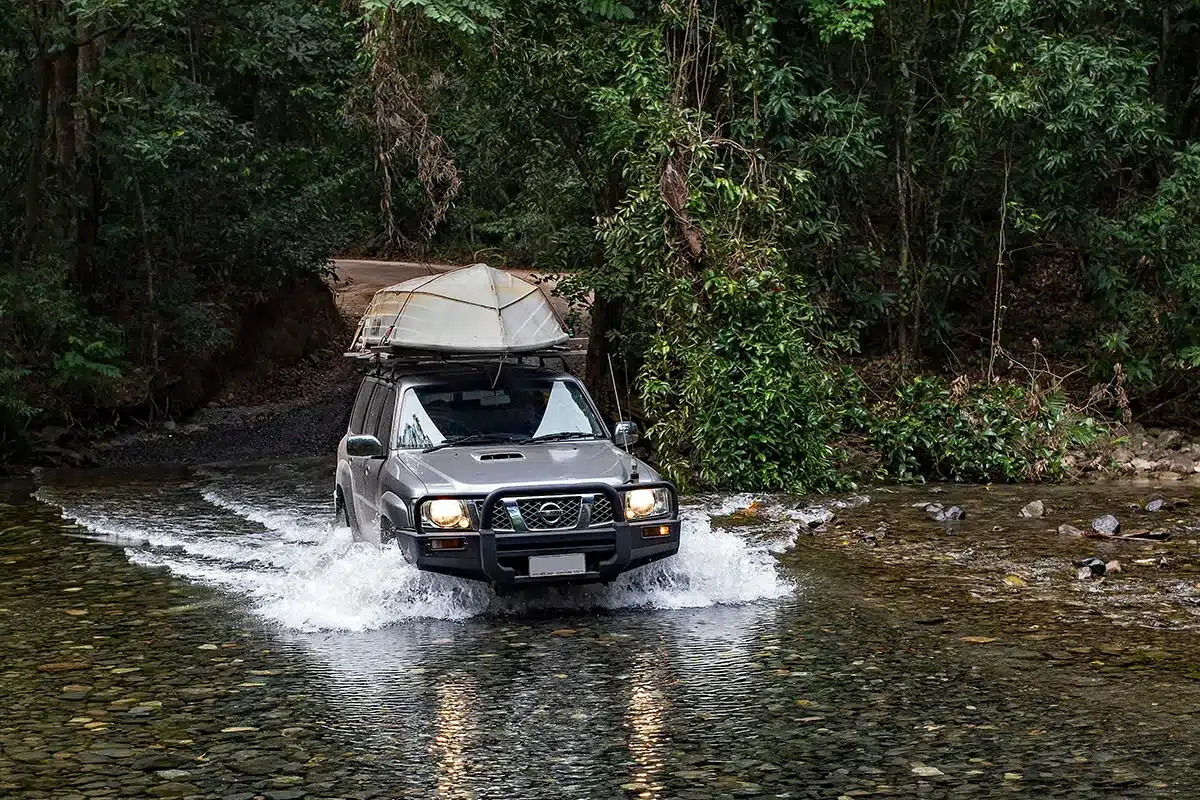
The Scrubby Creek crossing into Eliot Falls also carries a standing safety advisory that runs to December 2026. Queensland Parks describes the creek as more than a metre deep in sections, with severe erosion at the entry and exit points. It is a high clearance four-wheel drive proposition only, and not a place to learn.
Further west, the Top End has its own significant closure. Kakadu’s Jim Jim and Twin Falls area is closed for all of 2026 while road and infrastructure upgrades are delivered, including sealing a 19.25km section of Jim Jim Falls Road to gravel standard. Works began in June and are expected to finish by December, with the area reopening for the 2027 dry season.
The honest question: can you tow it up there?
For most WUDU readers this is the real decision, so let us be direct about it. A conventional caravan can reach Bamaga and the Tip, but not by the route people picture when they imagine Cape York.
The Old Telegraph Track is not a caravan road. It has seen no real maintenance since the mid 1980s and now exists as a deliberately unmaintained technical route, with steep rutted banks, deep water crossings and tree roots. Queensland Parks is equally clear about the Eliot Falls camping area: access suits high clearance four-wheel drives and off-road camper trailers, and is not suitable for buses, campervans, caravans or low clearance vehicles.
We have covered what this actually looks like in practice in how we tackled the Old Tele Track with a caravan, which is worth reading before you commit either way.
The bypass roads exist for exactly this reason. The Southern and Northern Bypass Roads let you reach the ferry and the Tip without touching the hardest sections, and plenty of well-built off-road vans make that trip every season. It is still corrugated, dusty, remote work, just not technical.
The smartest play for a lot of couples is a split trip. Base the van at Bramwell Station, Loyalty Beach, Seisia or Punsand Bay, then run the Telegraph Track and the falls unhitched over two or three days. You get the experience without gambling your home on it.
Whatever you tow, assume you will need genuine off-road construction rather than a gravel-road package. Independent suspension, a protected water tank, sealed dust ingress points and a proper stone guard are the difference between a van that arrives and a van that gets patched at Weipa. Carry two spares for the van as well as the tug, and get your touring tyre pressures sorted before you hit the dirt rather than guessing at Archer River.
What it costs in 2026
Cape York is not an expensive trip in the sense of accommodation, but there are a few fixed costs that surprise people. The ferry is the big one, and it is charged per vehicle configuration rather than per person.
Northern Peninsula Area Regional Council’s current published fees, set from January 2025 and still listed as current, are $160 for a single car, $250 for a vehicle with a trailer or van, and $275 for an oversized vehicle with a trailer or van. Motorbikes are $80, bicycles $40, and pedestrians cross free. Camping at the Jardine Ferry campgrounds is $15 a night for ages 13 and over, and $10 for under 13s.
That ferry fee is doing more work than it looks. It covers your return crossing and your access and camping permits for council camping areas in the Northern Peninsula Area, which is why free camping is available at a number of spots north of the river. Tickets are best bought online in advance, and the ferry takes EFTPOS only.
Queensland national park camping is separate and much cheaper. From 1 July 2026 the rate is $7.75 per person per night or $31 per family per night, with a family defined as one or two adults plus children under 18 up to eight people total. Children under five camp free, and you must hold the permit before you arrive.
Fuel is the variable that blows out budgets. Prices climb steadily the further north you go from Cairns, with Weipa offering some relief and remote stops like Archer River charging a premium. Build a genuine contingency into your budget, because a remote recovery on the Telegraph Track can cost more than the rest of the trip’s fuel combined. Our outback tyre survival guide covers the failures most likely to strand you.
Your Cape York pre-departure checklist
Work through this before you leave the bitumen, not at Bramwell Junction.
- Book Queensland Parks camping e-permits online before you lose reception
- Pre-purchase your Jardine River Ferry ticket and carry a printed or emailed copy
- Check the Kakadu Access Report or Queensland Parks alerts for the sites you plan to visit
- Fuel up at Bramwell Junction, because there is no fuel until Bamaga
- Carry two spare tyres for the tug and two for the van or trailer
- Pack recovery gear you know how to use, including a rated recovery point front and rear
- Fit or check your snorkel and check your diff and gearbox breathers if you are attempting crossings
- Confirm your insurance actually covers unsealed and unmaintained tracks
- Carry a PLB or satellite messenger, and understand that reception is limited to Coen, Weipa and Bamaga (see our outback communication guide)
- Know the Northern Peninsula Area alcohol carriage limits before you cross the Jardine
- Allow 14 to 21 days for a return trip from Cairns rather than rushing it
- Carry a spade and a plan for waste, because campsite hygiene is the number one local complaint
Cape York 2026: What’s Open and What It Costs
The dry season window runs to late October. Here are the live access conditions, the fixed costs and the rules that catch travellers out.
Where to swim, and where absolutely not
The reward for all that corrugation is a handful of the best freshwater swimming holes in the country. The catch is that the difference between a safe waterhole and a fatal one is not visible from the bank, so this is one area where local advice is not optional.
Fruit Bat Falls is the classic. It sits on Eliot Creek, a short sandy run off the bypass road, with a 400m return boardwalk taking about ten minutes to the plunge pool and the top of the falls. There are toilets and picnic tables, it is day use only, and camping is not permitted.
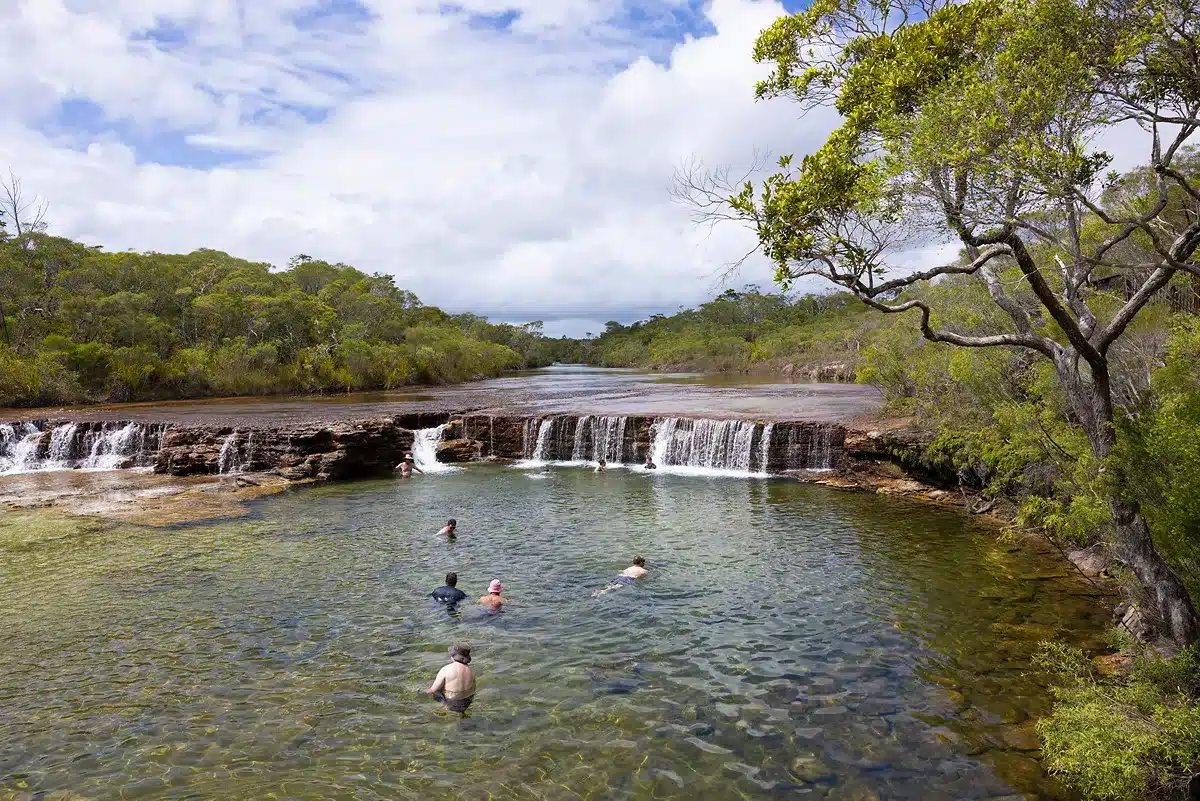
Eliot Falls and Twin Falls sit further along, alongside the Eliot Falls camping area, with picnic tables, fireplaces, drinking water and toilets. Getting there means the Scrubby Creek crossing described above. Fishing and crabbing are prohibited in Eliot Creek and in the lower Jardine River.
Everywhere else, assume crocodiles. The Jardine River holds a significant estuarine crocodile population, and the temptation to walk a crossing to check its depth is exactly the mistake that gets people hurt. Swim only where signage and rangers say you can, and treat every other waterway as occupied.
The rules that catch travellers out
Two sets of local laws generate most of the trouble, and neither is discretionary.
The first is alcohol. The Northern Peninsula Area, covering Bamaga, Injinoo, New Mapoon, Seisia and Umagico, is a restricted area under an Alcohol Management Plan. The maximum you can have is 2 litres of unfortified wine plus one 30-can carton of 375ml beer, or 2 litres of unfortified wine plus one 24-can carton of premixed spirits up to 5.5 per cent.
Read that limit carefully, because it applies per vehicle regardless of how many people are aboard, not per adult. Drinking in public is prohibited except at designated places, which include the Seisia camping ground but not its car park. Penalties run into tens of thousands of dollars and vehicles carrying more than the limit can be confiscated.
The second is permits and camping. Camping in Apudthama National Park is allowed only at Eliot Falls, North and South Jardine River, Ussher Point and Captain Billy Landing, with a permit tag displayed at your site. Fruit Bat Falls is day use only, fires are permitted in existing fireplaces only, and you cannot collect firewood in the park.
You are also travelling on and beside country that belongs to Traditional Owners, including the Injinoo, Apudthama and neighbouring communities whose permission makes much of the northern camping possible. Camp where you are welcome, leave it cleaner than you found it, and ask rather than assume.
If the Cape is more than you want this year
Not every rig or every traveller is suited to Cape York, and there is no shame in choosing the other great dry season run instead. The Top End is open, sealed for most of its best bits, and far kinder to a conventional caravan.
Kakadu remains the anchor, with the significant caveat that Jim Jim and Twin Falls are out for all of 2026. That reshapes a Kakadu itinerary rather than ruining it, and it makes the southern end of the park, Maguk, Yellow Water and the rock art at Ubirr and Burrungkuy more central to your plan. Check the Kakadu Access Report, which is updated daily.
Litchfield National Park is the easier win, close to Darwin with sealed access to Wangi, Florence and Buley, and it suits families and first-timers well. Nitmiluk near Katherine adds the gorge, where the sunset dinner cruise is a genuine highlight, plus the hot springs at Mataranka and Bitter Springs nearby. The Savannah Way then gives you a legitimate long-haul route east toward Queensland without needing a technical vehicle. If you are building the trip around parks rather than bush camps, our rundown of holiday parks across the Kimberley and Top End is the place to start.
The bottom line
The window is open now and it will not stay open. If Cape York is the goal, book the ferry, lock in your park permits, and be honest with yourself about what your van can take and where it should stay behind.
And if this is the year for the Top End instead, that is a genuinely excellent trip in its own right, not a consolation prize. Either way, the country is at its best right now. Go while it is.