


You see it in new builds. You hear it from dealers. You see travellers swapping gas for electric setups and talking about lithium batteries, inverters and solar like they are suddenly part of the dinner recipe.
But for most caravan owners, the real question is not simply, “Is induction better?” It is: “will an induction cooktop actually work for the way I travel?”
Because there is a big difference between using a caravan induction cooktop on a powered site and trying to cook dinner off-grid after three cloudy days in the bush.
That is where this guide comes in.
We are looking at what induction cooking really means for Australian touring, what power setup you need, who it suits, and when it might be smarter to wait until your caravan electrical system is ready.
Why Are Induction Cooktops Becoming So Popular in Caravans?
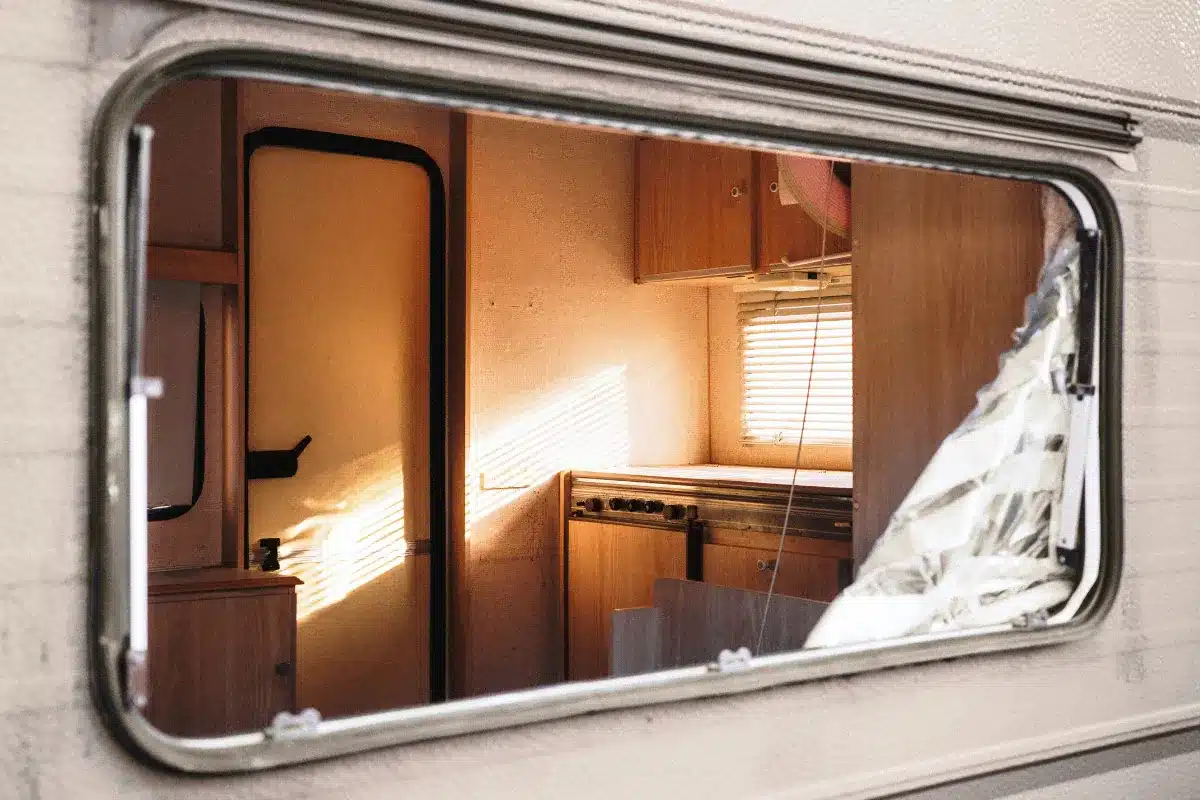
Caravan kitchens are changing.
For decades, gas was the default choice for cooking on the road. It was familiar, reliable and easy to understand. But as more modern caravans move towards lithium battery systems, larger inverters and improved solar capacity, electric cooking has become far more practical than it used to be.
At the same time, many travellers are looking for cleaner, simpler and lower-maintenance cooking options inside the van.
That is why induction cooktops are becoming more common in caravans, campers and RVs.
They are fast, easy to clean, efficient to cook on and do not create the same open-flame concerns as gas. For travellers who spend most of their time on powered sites, induction can feel like a very easy upgrade.
For those heading off-grid, induction can still work beautifully, but only if the system behind it is up to the job.
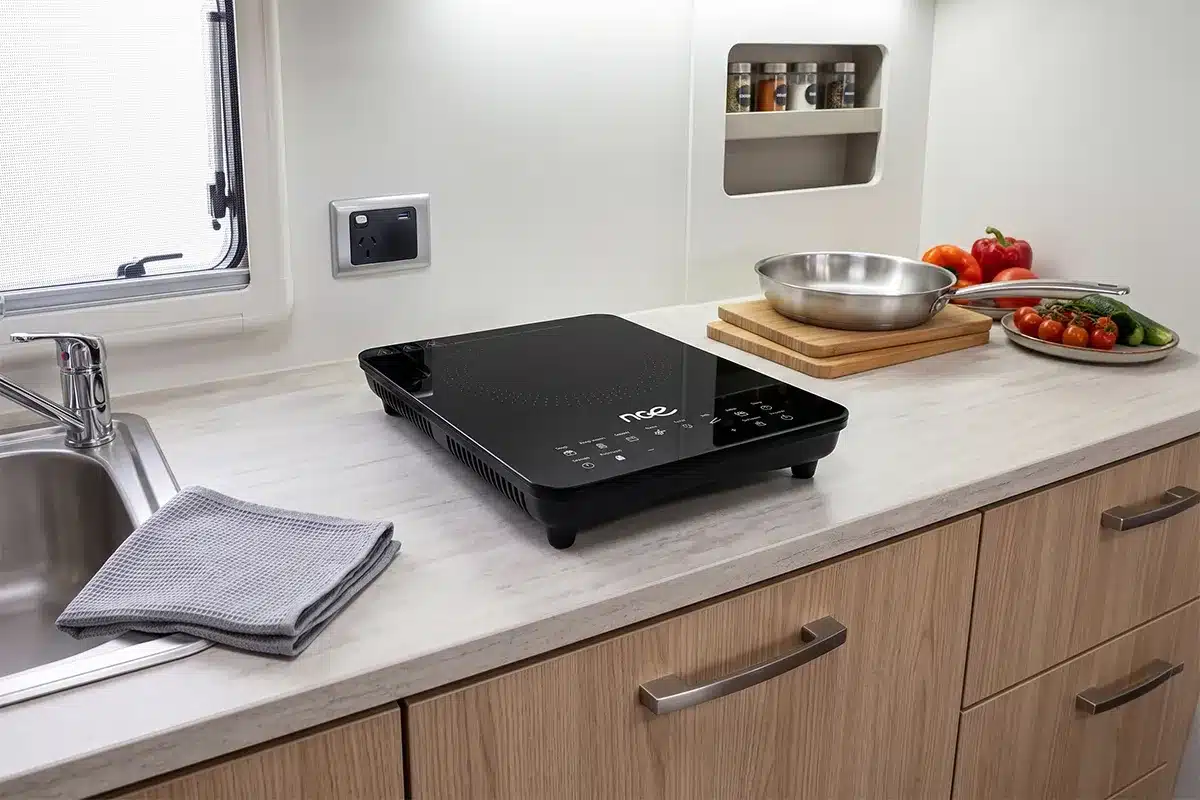
How Does an Induction Cooktop Work in a Caravan?
Induction cooking works differently from gas or a traditional electric element.
Instead of heating a flame or metal coil, an induction cooktop uses a magnetic field to heat the cookware directly. That means the pan heats quickly, temperature control is responsive, and less heat is wasted into the caravan.
In a caravan, however, the important part is not just how the cooktop heats the pan. It is how the cooktop gets its power.
Most induction cooktops run on 240V power. When you are plugged into mains power at a caravan park, that is straightforward. When you are off-grid, your battery system needs to supply that power through an inverter.
How an Induction Cooktop
Gets Its Power
This is the basic power pathway inside a caravan setup when running an induction cooktop from battery power.
An induction cooktop does not run directly from the battery alone. It needs a properly sized inverter to turn stored battery power into 240V power the cooktop can actually use.
That is why you will often hear people talk about “12V induction cooking” or a “12V induction cooktop” when what they usually mean is a caravan electrical system that stores power in a 12V battery bank and converts it to 240V through an inverter.
The cooktop itself is not usually running directly from 12V. Your inverter is doing the heavy lifting.
Can You Run an Induction Cooktop Off-Grid?
Yes, you can run an induction cooktop off-grid, but only with the right electrical setup.
This is where many caravan owners get caught out. Induction cooking is efficient, but it is not low draw. A portable induction cooktop can pull a serious amount of power, especially on higher settings.
That does not mean induction is unsuitable for caravanning. It simply means your battery, inverter and solar setup need to match the way you actually cook and travel.
If you are using induction occasionally, mainly on powered sites, or for short off-grid stays with a modern lithium setup, it can be a very practical upgrade.
If you are planning to rely on it as your main cooking method while free camping for long periods, your electrical system needs to be properly designed for that load.
What Power Setup Do You Need for a Caravan Induction Cooktop?
The right setup depends on how you travel.
Some caravanners spend most of their time plugged into powered sites. Others mix caravan parks with free camping. Some travel remotely for long stretches and rely heavily on battery, solar and inverter capacity.
Induction can suit all three styles, but the system requirements are very different.
– If You Mostly Stay on Powered Sites
If you mainly stay in caravan parks and plug into 240V mains power, induction cooking is very straightforward.
You are not relying heavily on your battery bank or inverter, so a portable induction cooktop can be an easy way to upgrade your cooking setup without major electrical changes.
For park-based travellers, induction is clean, fast and simple.
It is also ideal if you want an extra cooking option outside or under the awning when conditions suit.
– If You Mix Caravan Parks and Off-Grid Camping
This is where induction starts to make a lot of sense, provided your setup is modern enough.
If you have a lithium battery system, decent solar and an inverter that can comfortably support the cooktop’s draw, a portable induction cooktop can work well for weekends away, short free-camp stays and hybrid touring.
This type of traveller might cook on induction at a powered site, then use it carefully for one or two meals off-grid before moving on or recharging.
For this style of travel, induction can be a very practical middle ground. You get the benefits of electric cooking without needing a full premium off-grid power system.
– If You Spend Long Periods Fully Off-Grid
Induction can still work for extended off-grid touring, but the power system needs to be properly designed.
If you are relying on a basic AGM battery, a small solar panel and an undersized inverter, induction will not be enjoyable. You may technically be able to run it briefly, but it will place a heavy load on the system and quickly expose weak points.
For serious off-grid travel, you would generally want a more capable lithium setup, a quality inverter and enough solar to replenish your batteries across normal daily use.
The cooktop is not usually the problem. The system behind it is.
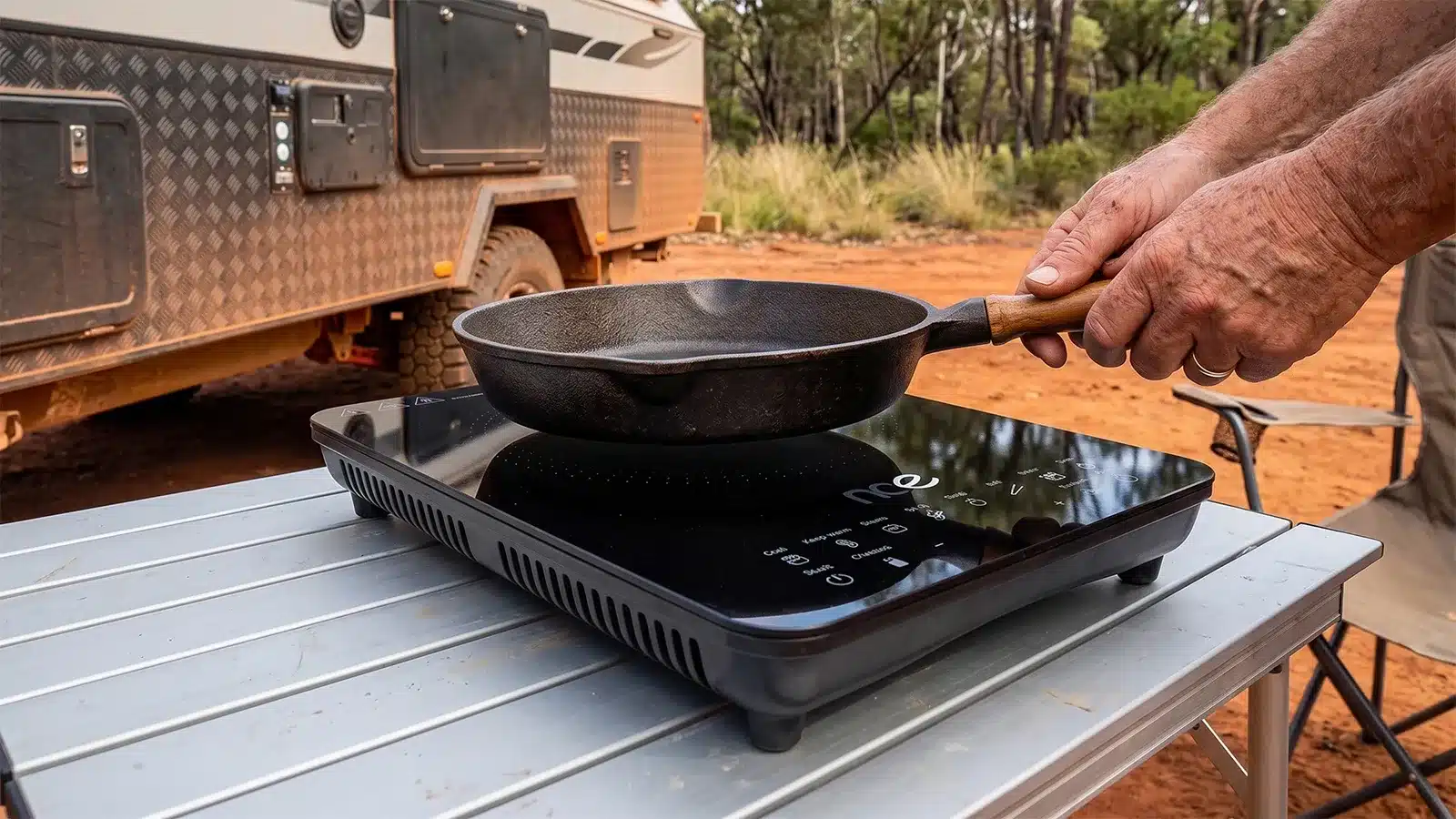
Is a Portable Induction Cooktop Better Than a Built-In Caravan Cooktop?
Both options have their place.
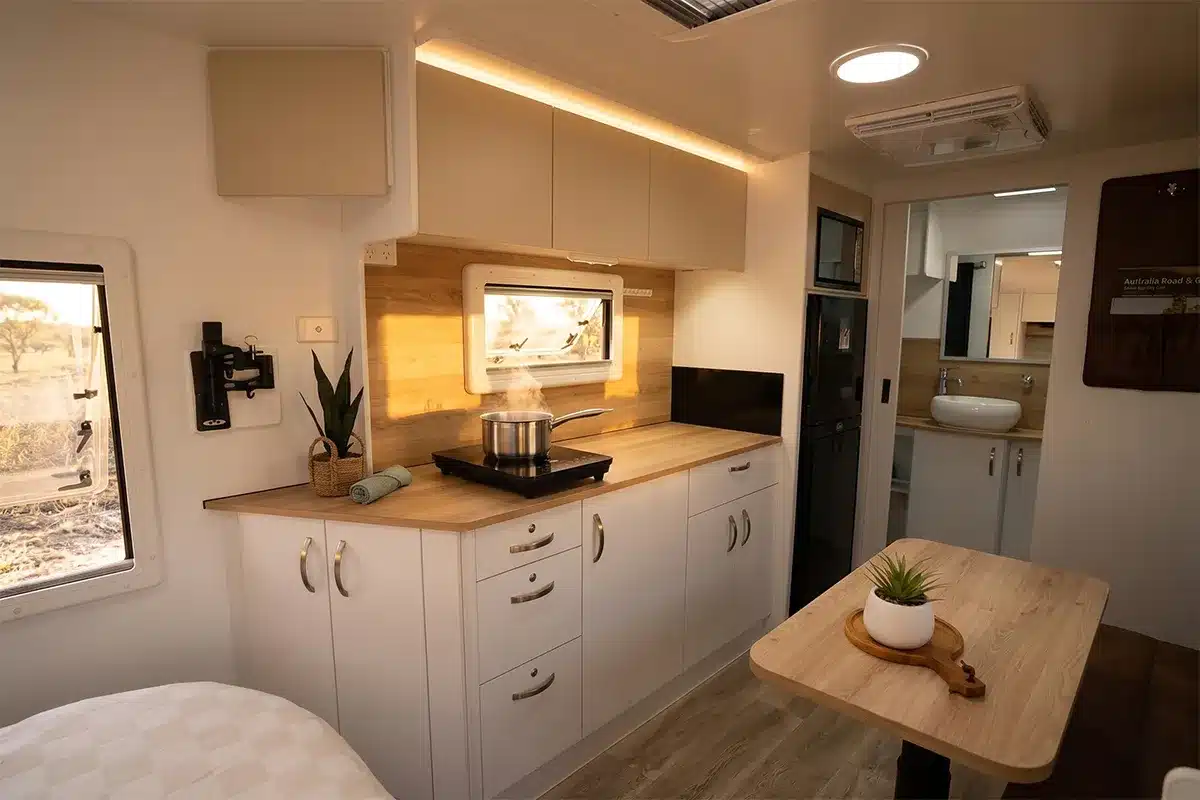
A built-in induction cooktop is ideal if you are building a new caravan, renovating the kitchen, or already upgrading the electrical system. It gives you a clean, integrated finish and a permanent cooking solution inside the van.
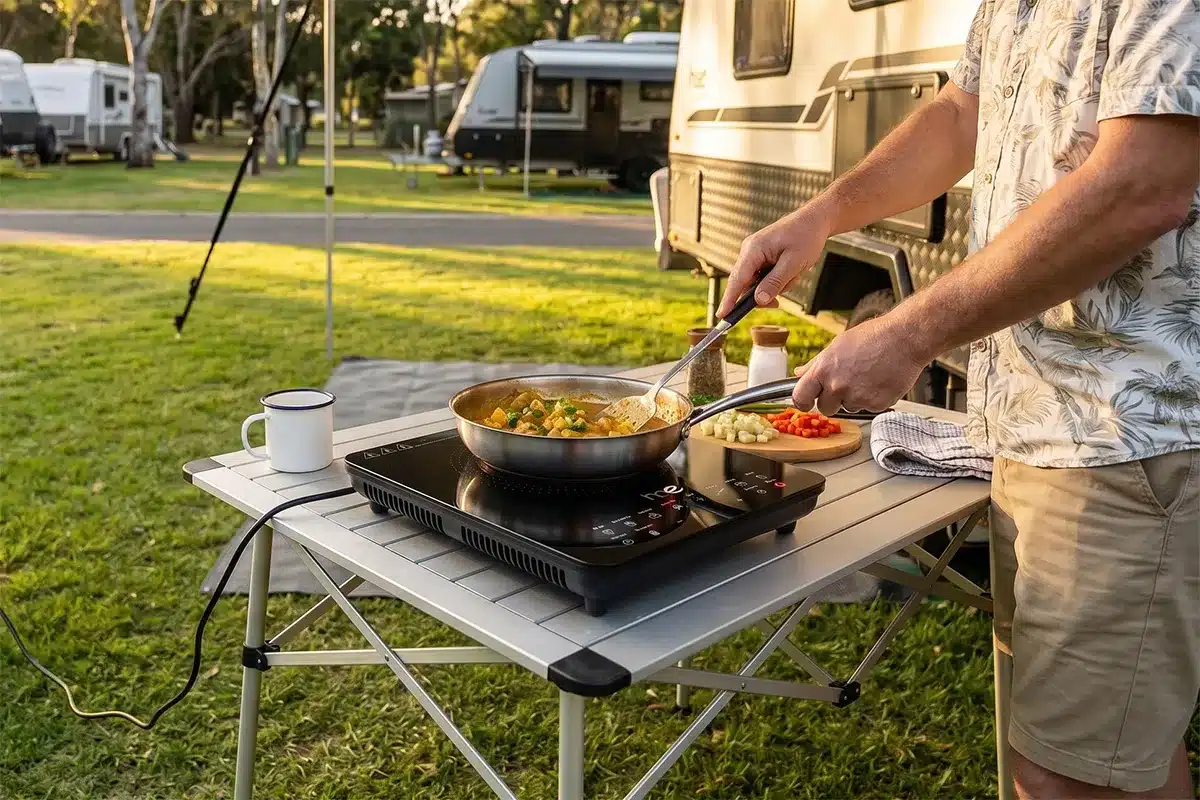
A portable induction cooktop is more flexible. It can be stored away when not in use, moved between indoor and outdoor cooking areas, and used as an extra cooking zone when you need it. For many travellers, it is also the easiest way to trial induction before committing to a permanent built-in setup.
That makes portable induction especially useful for:
- Smaller caravans and campers
- Travellers with limited bench space
- Weekend and hybrid travellers
- Owners who want to test induction before upgrading the full kitchen
- Anyone wanting an extra cooking option on powered sites
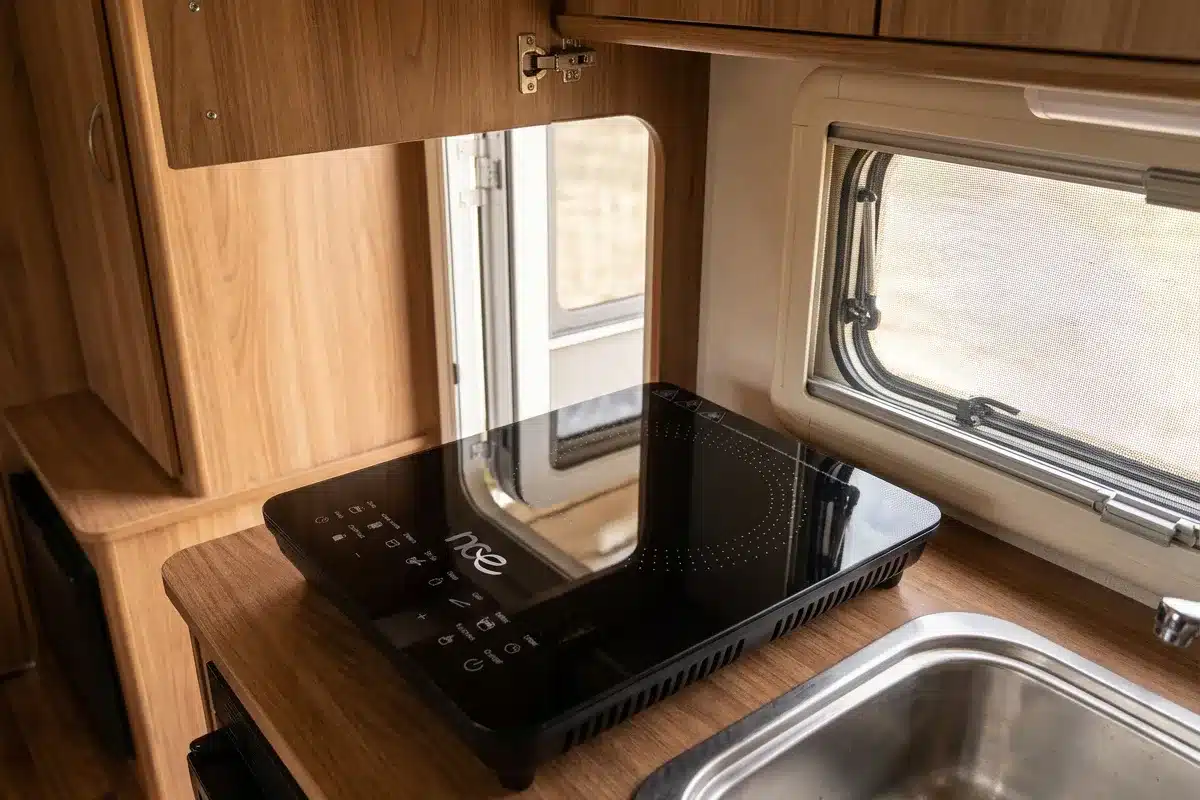
For travellers wanting to add induction cooking without rebuilding the entire kitchen, the NCE Portable Induction Cooktop is a strong fit.
It is compact, lightweight and designed for caravan, RV and outdoor setups. With a 2000W output, responsive touch controls, child lock controls, a crystal-glass surface, LED display, seven cooking modes and a timer function, it gives travellers a practical way to cook with induction without committing to a permanent built-in appliance.
This is the kind of product that makes sense for people who want flexibility.
You can use it on a powered caravan site, in a well-specced off-grid setup, or as an additional cooking option when the van kitchen is already busy. It is also a good entry point for anyone who wants to understand how induction fits into their travel routine before taking the next step.
View the NCE Portable Induction Cooktop at Home & RV
What Do Caravan Owners Get Wrong About Induction Cooking?
Induction is one of those upgrades that sounds simple until you look at the electrical side.
The biggest mistake is assuming that because induction is efficient, it must be easy on power.
It is efficient in the way it cooks. It transfers heat quickly and directly into the pan. But it can still draw a lot of power while it is running.
A 2000W induction cooktop needs a system that can support that load. If the inverter is too small, the batteries are tired, or the solar is not keeping up, the experience will not be great.
The second mistake is expecting solar to solve everything.
Solar helps recharge your batteries. It does not magically remove the load of cooking dinner, especially if you are cooking at night or after a cloudy afternoon. In real use, your batteries and inverter are doing the work at the moment you cook.
The third mistake is buying the appliance before checking the system.
Before buying any caravan induction cooktop, check:
- Your inverter rating
- Your battery capacity
- Your battery type
- Your solar input
- How often you cook off-grid
- Whether you have other high-draw appliances running
Induction works best when it is part of a properly planned electrical setup.
Is Induction Better Than Gas in a Caravan?
This depends on how you travel.
For powered sites, short trips and modern lithium setups, induction can be excellent. It is fast, clean, easy to wipe down and does not require carrying or changing gas bottles for cooking.
For remote travel, gas still has advantages. It is independent of your electrical system and remains useful when battery power is limited.
For many caravanners, the answer is not one or the other. The best setup may be a combination: induction for powered sites and capable electrical setups, with another cooking option available for remote or backup use.
That is why a portable induction cooktop can be such a practical first step. It lets travellers add electric cooking without removing every other option.
Who Should Consider a Caravan Induction Cooktop?
A caravan induction cooktop is worth considering if:
- You mostly stay at powered caravan parks
- You have a modern lithium battery system
- Your inverter is large enough for the cooktop
- You do short off-grid stays between powered stops
- You want cleaner and faster cooking inside the van
- You are upgrading or simplifying your caravan kitchen
- You want a portable cooking option that can be packed away
For these travellers, induction is not just a trend. It can genuinely make day-to-day cooking easier.
When Is Induction Not the Right Move Yet?
Induction may not be the right upgrade yet if your caravan is still running a basic power setup.
Be cautious if:
- You rely on AGM batteries
- Your inverter is undersized
- You have limited solar capacity
- You regularly run several high-draw appliances
- You are not sure what your system can safely support
That does not mean induction is off the table forever.
It simply means the smarter path may be to upgrade the electrical system first, then add the cooktop.
Is Your Caravan Setup
Ready for Induction?
A quick guide to where induction cooking makes sense, where it needs planning, and when your power setup may need an upgrade first.
Induction is not just about the cooktop. The real question is whether your battery, inverter, solar and charging setup can support how you actually travel.
So, Are Caravan Induction Cooktops Worth It?
Yes, for the right traveller and the right setup.
If you spend most of your time on powered sites, a portable induction cooktop is one of the easiest caravan kitchen upgrades you can make. It is clean, fast and simple to use.
If you travel off-grid, induction can still work very well, but only when your battery, inverter and solar setup are designed to support it.
The key is not asking whether induction is good. The key is asking whether your caravan is ready for it.
For many modern caravanners, especially those already running lithium power systems, induction is absolutely worth considering. For others, it may be a future upgrade once the electrical foundation is in place.
Final Word
Induction cooking is not just for high-end caravans anymore. With the right setup, it is becoming a practical option for more everyday travellers. But the smartest approach is to match the cooktop to the way you actually travel.
If you are mostly plugged into power, the switch is easy. If you are heading off-grid, make sure your inverter, battery and solar system are ready before relying on induction as your main cooking method.
For travellers wanting a flexible starting point, the NCE Portable Induction Cooktop offers a simple way to bring induction cooking into the caravan without committing to a full kitchen rebuild.
FAQs
Can you use an induction cooktop in a caravan?
Yes. You can use an induction cooktop in a caravan if you have access to 240V power or a suitable inverter and battery setup. On powered sites, it is straightforward. Off-grid, your electrical system needs to be capable of supporting the cooktop’s power draw.
Can you run an induction cooktop off a 12V battery?
Not directly in most caravan setups. Induction cooktops generally run on 240V power, which means a 12V battery system needs an inverter to convert battery power into usable 240V power.
What size inverter do I need for an induction cooktop?
It depends on the cooktop’s wattage. A 2000W portable induction cooktop needs an inverter that can comfortably support that load, with enough headroom for safe and reliable operation. Always check the appliance specifications and your system’s limits before use.
Is a portable induction cooktop good for caravanning?
Yes, a portable induction cooktop can be a very practical option for caravanning. It is especially useful for powered sites, hybrid travellers and those who want a flexible cooking option without installing a built-in cooktop.
Is induction better than gas for caravans?
Induction is cleaner, faster and easier to wipe down than gas, but it relies on your electrical system. Gas can still be useful for remote travel where power is limited. The better option depends on how and where you travel.
Do induction cooktops use a lot of power?
They can draw a high amount of power while operating, especially on higher settings. However, they cook efficiently and heat the pan directly, which means they can be very effective when matched with the right caravan power setup.
What cookware do you need for induction cooking?
You need induction-compatible cookware with a magnetic base. A simple way to check is to place a magnet on the bottom of the pot or pan. If it sticks firmly, it will usually work on induction.
Take a look at the NCE 29L Convection Microwave Review: Installation, Power and Caravan Suitability